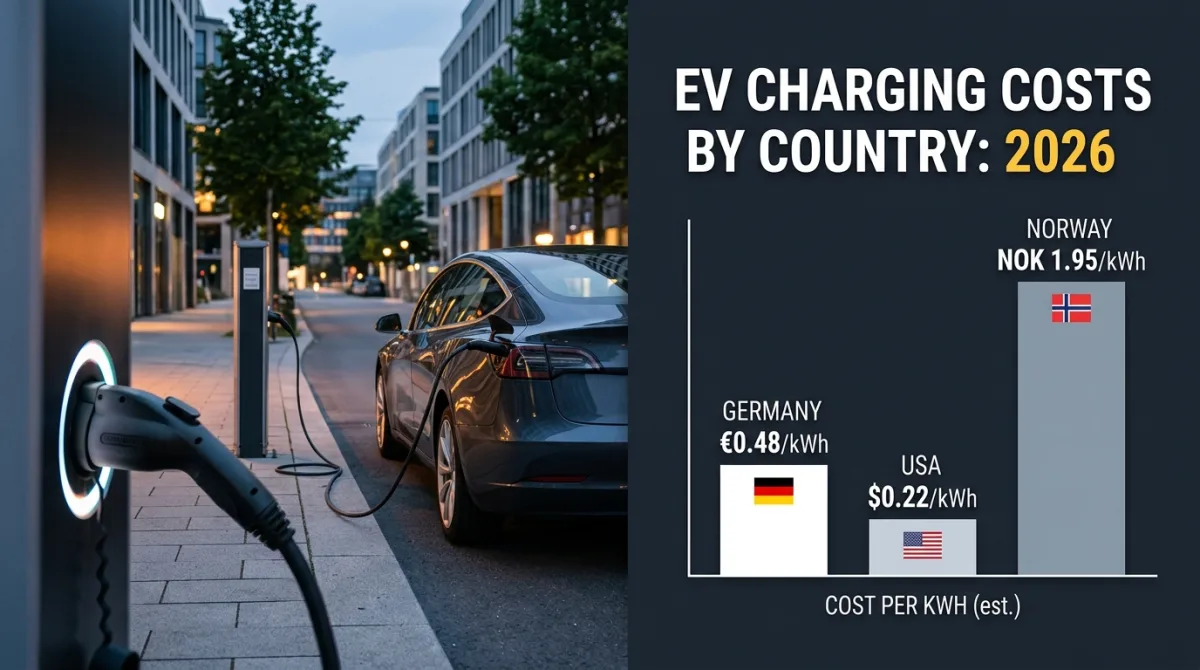
The same EV, charged in two different countries, can cost up to 5x more to run. Electricity prices, taxes and charging-network pricing vary enormously — and so does the financial case for going electric.
Here's the 2026 EV charging cost comparison across 15 countries, both at home and at public fast chargers.
Home charging costs by country (2026)
Cost per 100 km at home, assuming 3.5 mi/kWh efficiency:
| Country | Avg home electricity $/kWh | Cost per 100 km |
|---|---|---|
| Norway | $0.11 | ~$2.40 |
| France | $0.23 | ~$5.10 |
| USA | $0.17 | ~$3.70 |
| UK | $0.33 | ~$7.30 |
| Germany | $0.42 | ~$9.20 |
| Netherlands | $0.35 | ~$7.70 |
| Spain | $0.25 | ~$5.50 |
| Italy | $0.28 | ~$6.20 |
| Canada | $0.16 | ~$3.50 |
| China | $0.09 | ~$2.00 |
| Australia | $0.22 | ~$4.80 |
| Japan | $0.25 | ~$5.50 |
Public fast-charging costs by country
The picture changes dramatically at public fast chargers — this is where pricing varies most:
| Country | Avg DC fast $/kWh | Cost per 100 km | vs home charging |
|---|---|---|---|
| China | $0.12 | ~$2.60 | ~1.3x |
| Norway | $0.22 | ~$4.80 | ~2x |
| USA | $0.42 | ~$9.20 | ~2.5x |
| France | $0.40 | ~$8.80 | ~1.7x |
| Germany | $0.55 | ~$12.10 | ~1.3x |
| UK | $0.62 | ~$13.60 | ~1.9x |
| Netherlands | $0.60 | ~$13.20 | ~1.7x |
Prices are indicative averages; exact rates vary by network, time of day and membership tier.
The big takeaways
- Norway and China are EV paradise — cheap electricity makes running an EV trivially affordable, which is exactly why both have the world's highest EV adoption rates.
- Germany is the home-charging exception — very high electricity prices mean even home charging costs more than most countries' public rates.
- UK and Netherlands fast charging is punishing — public fast charging can approach the cost of gas. Home charging is essential there.
- The US is mid-pack — decent home rates and rapidly improving fast-charging prices make the EV case solid.
Why the differences?
- Taxes and levies on electricity (Germany, UK) push home rates up
- Network competition (China, Norway, US) keeps public prices down
- Grid mix affects cost and carbon — see electricity mix and CO2
- Regulation — some countries cap or subsidize charging prices
How to pay the least per kWh (in any country)
- Charge at home overnight on a night tariff — always the cheapest (see home charging costs)
- Join charging-network subscriptions for frequent public users
- Use roaming apps to compare live prices across networks
- Charge off-peak where dynamic pricing exists
- Take advantage of incentives — see EV incentives by country
> Find the cheapest charger near you with the charging map and estimate costs with the charging cost calculator.
FAQ
Which country has the cheapest EV charging? China and Norway lead — both under ~$0.11/kWh at home. At public fast chargers, China is the cheapest by a wide margin.
Is EV charging more expensive than gas anywhere? In countries with very high electricity prices and no cheap-rate home tariffs, public fast charging can approach gas costs. But home charging is cheaper than gas almost everywhere.
Why is German electricity so expensive for EVs? High grid levies and taxes on household electricity. However, generous incentives and cheap night tariffs still keep EVs competitive.
The bottom line
EV charging costs range from ~$2.00 to ~$9.00 per 100 km depending on country and charging location — a 4x spread. Home charging wins everywhere, and the financial case for EVs is strongest where electricity is cheap (Norway, China, France) or where EV ownership is supported by incentives. Match your charging strategy to your country, and you'll be on the right side of that spread.