Efficiency is the quiet superpower of electric cars. It decides your real-world range, how fast you charge, your electricity bill and your carbon footprint — yet almost nobody compares it when shopping.
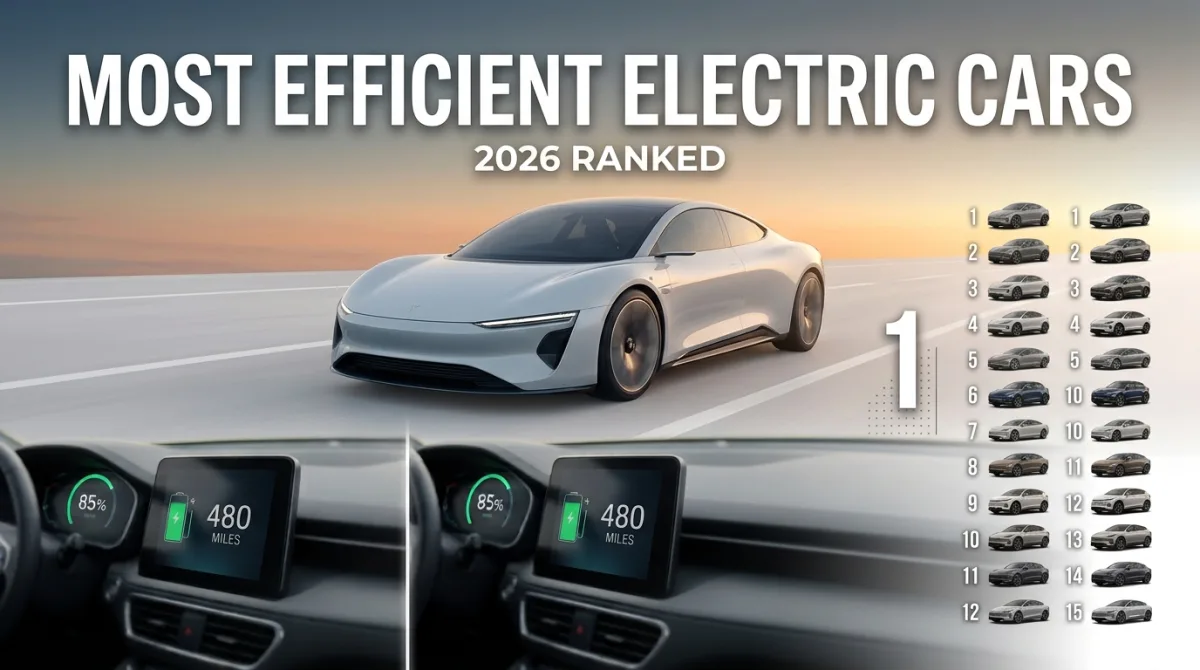
Here are the 15 most efficient electric cars in 2026, ranked by real-world miles per kWh.
How efficiency is measured
mi/kWh (miles per kilowatt-hour) — how far you travel per unit of energy. Or kWh/100km (Europe). The higher the mi/kWh (lower the kWh/100km), the more efficient the car.
| Rating | mi/kWh | kWh/100km | Verdict |
|---|---|---|---|
| Excellent | 4.5+ | <14.0 | Efficiency champion |
| Great | 4.0–4.5 | 14–15.5 | Well above average |
| Good | 3.5–4.0 | 15.5–18 | Respectable |
| Average | 3.0–3.5 | 18–21 | Typical SUV/everyday |
| Poor | <3.0 | >21 | Heavy or powerful |
The 15 most efficient EVs of 2026
| # | Model | Real-world mi/kWh | kWh/100km | Why it's efficient |
|---|---|---|---|---|
| 1 | Hyundai Ioniq 6 | ~4.6 | ~13.5 | Slippery body, small frontal area |
| 2 | Tesla Model 3 LR | ~4.5 | ~13.8 | Legendary aero + powertrain |
| 3 | Lucid Air | ~4.3 | ~14.4 | Ultra-aero, efficient motors |
| 4 | Tesla Model Y | ~4.0 | ~15.5 | Big crossover, tiny drag |
| 5 | Kia EV6 | ~3.9 | ~16.0 | Good aero, efficient 800V tech |
| 6 | Polestar 2 | ~3.8 | ~16.4 | Slick sedan |
| 7 | BMW i4 | ~3.8 | ~16.4 | Aero sedan, efficient |
| 8 | Nissan Leaf | ~3.8 | ~16.4 | Light, simple, efficient |
| 9 | Mercedes EQS | ~3.7 | ~16.8 | The most aero production car ever |
| 10 | Hyundai Kona Electric | ~3.7 | ~16.8 | Small + efficient |
| 11 | VW ID.7 | ~3.6 | ~17.3 | Purpose-built aero saloon |
| 12 | Tesla Model S | ~3.6 | ~17.3 | Fast AND efficient |
| 13 | BYD Seal | ~3.5 | ~17.8 | Good aero, LFP density |
| 14 | Skoda Enyaq | ~3.4 | ~18.3 | Efficient for its size |
| 15 | Volvo EX30 | ~3.6 | ~17.3 | Small, light crossover |
> Figures are real-world estimates at moderate temperatures. Actual numbers vary with speed, weather and driving style — use the real range calculator for your conditions.
Why efficiency is the metric that matters
1. More real range
An efficient car turns the same battery into more miles. The Ioniq 6's 77 kWh battery matches cars with 100 kWh packs.
2. Faster effective charging
Efficient cars consume less per mile, so a given charger speed covers more distance. An efficient car on a 150 kW charger effectively "charges faster" than a guzzler on the same unit.
3. Cheaper to run
Electricity savings add up: at 4.5 mi/kWh vs 3.0 mi/kWh, you use 50% less electricity for the same miles. See charging costs.
4. Better in winter
Efficient cars lose a smaller share of their range in the cold — see winter range loss.
The efficiency trade-offs
- The most efficient cars are aerodynamic sedans — if you need an SUV or 7 seats, expect 3.0–3.5 mi/kWh
- Performance costs efficiency — the fastest EVs trade mi/kWh for 0–60 times
- Larger batteries add weight — a 500-mile monster uses more energy per mile than a 300-mile efficient car
Our energy converter and efficiency calculator help you compare any two cars precisely.
FAQ
What's the most efficient EV in 2026? The Hyundai Ioniq 6 leads at around 4.6 mi/kWh real-world, with the Tesla Model 3 Long Range a close second.
Does higher efficiency mean longer range? All else equal, yes — efficiency is range per unit of battery. That's why efficient cars often beat bigger-battery cars on real range.
Is a more efficient EV worth more money? If you drive a lot, yes — the savings on electricity over 5 years can be substantial. See the true cost of EV ownership.
The bottom line
Efficiency is the EV spec nobody talks about and everybody should. The Ioniq 6, Model 3 and Lucid Air lead the 2026 pack, delivering the most real-world miles per kWh — more range, faster effective charging and lower bills. Whatever you buy, comparing mi/kWh is the smartest thing you can do after the price.