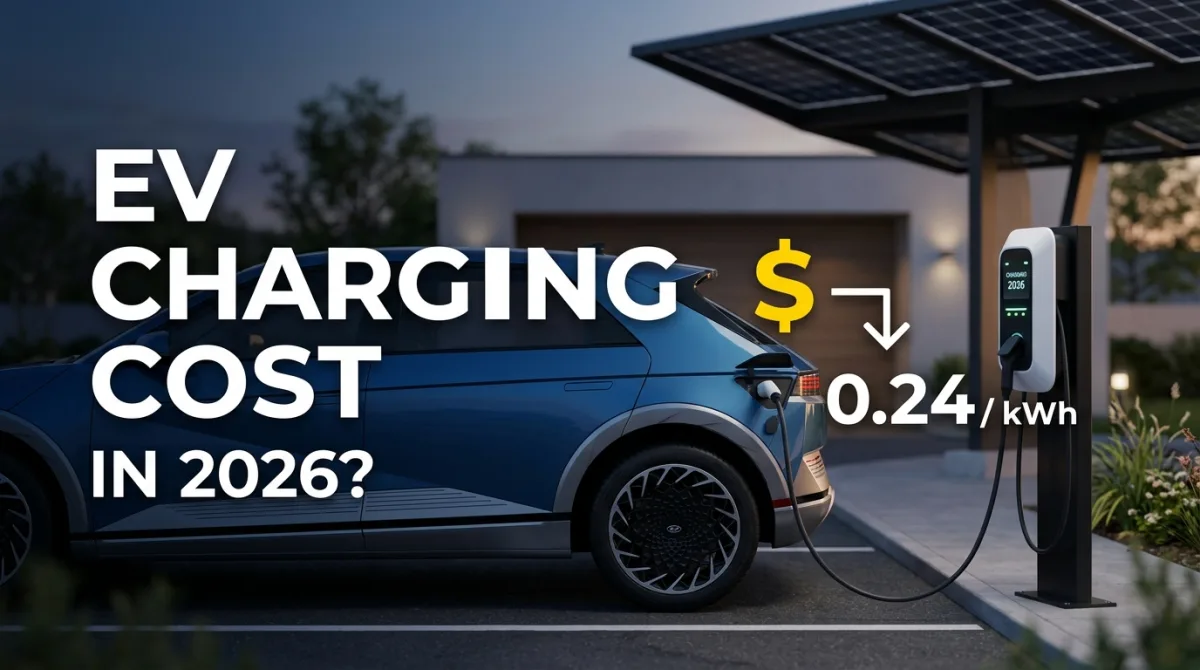
The cost of charging an EV in 2026 ranges from "practically nothing" at home overnight to "almost as much as gas" at a peak-time public fast charger. The difference is enormous, and understanding it is the difference between loving and hating EV ownership.
Here is the real cost to charge, broken down by where you plug in.
Charging cost by location (2026 typical prices)
| Where you charge | Typical price per kWh | Cost per 100 km | Cost per year (15,000 km) |
|---|---|---|---|
| Home, night tariff | $0.08–0.12 | ~$3.00 | ~$450 |
| Home, standard rate | $0.15–0.25 | ~$5.50 | ~$825 |
| Workplace | $0.15–0.30 | ~$6.00 | ~$900 |
| Public AC (destination) | $0.30–0.45 | ~$9.50 | ~$1,425 |
| Public DC fast | $0.35–0.60 | ~$12.50 | ~$1,875 |
| Ultra-fast (350 kW) | $0.45–0.75 | ~$15.00 | ~$2,250 |
Numbers assume ~3.5 mi/kWh average efficiency (22 kWh per 100 km). Use the charging cost calculator for your exact car and prices.
The charging cost hierarchy
- Home overnight (night tariff) — always cheapest, often 3–5x cheaper than public
- Home standard rate — still much cheaper than gas
- Workplace — cheap and convenient if available
- Public AC — fine for destination charging while you shop or eat
- Public DC fast — for road trips only; the convenience premium is real
- Ultra-fast (350 kW) — the most expensive; only worth it when you need speed
How to cut your charging bill in half
- Switch to an EV-friendly night tariff. Most providers offer 4–8 hours of cheap overnight electricity. If you charge then, your effective cost can drop by 50% or more.
- Charge at work when possible. Free or cheap workplace charging can cover a large share of your driving.
- Precondition before fast charging. A warm battery charges faster and you pay for fewer minutes at premium rates.
- Avoid charging to 100% at fast chargers. The last 20% is slow and you're paying per minute in many networks.
> See how much EV charging costs at home and compare charging costs by country.
EV vs gas on a per-100km basis
At home rates, an EV costs roughly $3.00 per 100 km versus $11.00 for a gas car — an EV is about 4x cheaper per km. At public fast rates, the gap narrows to roughly 1.5x. This is exactly why home charging is the key to EV savings.
FAQ
How much does it cost to fully charge an electric car? A typical 60 kWh battery: about $6–$12 at home, $20–30 at a public fast charger. Check your battery size and local rates with the charging calculator.
Is it cheaper to charge at home or at a charging station? Home charging is almost always significantly cheaper — often 3–4x less per kWh than public fast charging.
Why is public charging so expensive? You're paying for the hardware, the network, grid connection costs and, often, peak-time demand pricing. It's the convenience premium.
The bottom line
Charging an EV in 2026 costs between $450 and $2,250 per year depending entirely on where you plug in. The single best money decision you can make as an EV owner is to set up cheap home charging and use it 80% of the time. Do that, and your fuel bill will be a rounding error.