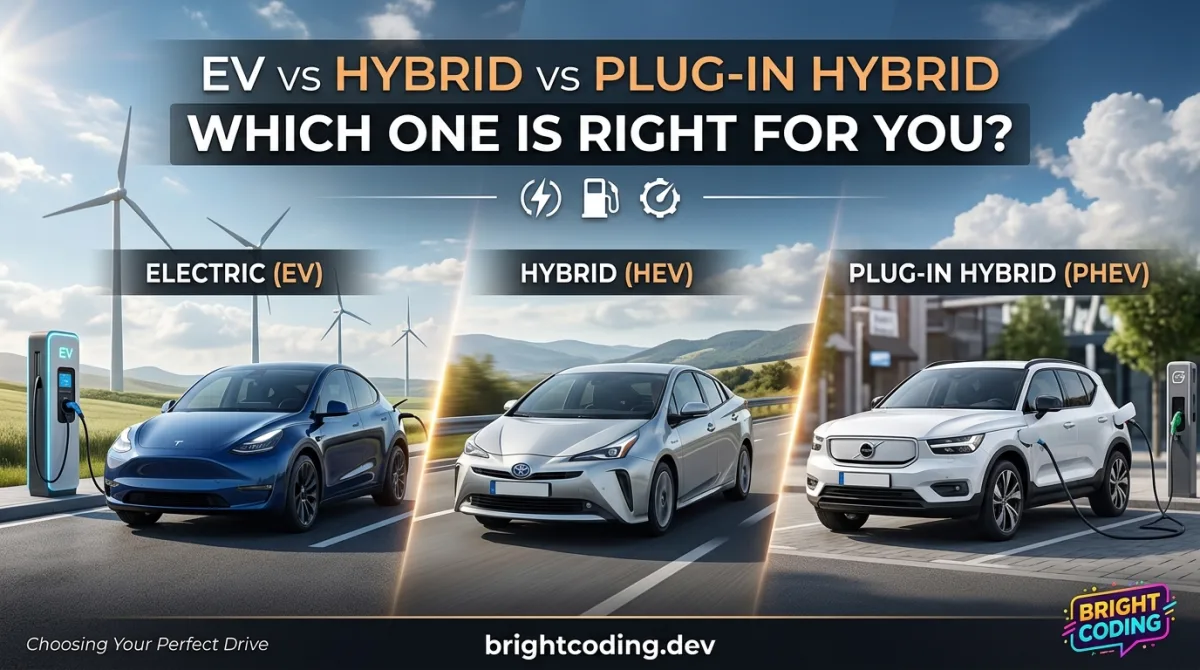
You want lower running costs, or you want to stop burning petrol, or both. Standing in the dealership (or scrolling listings at midnight), you hit the same wall: a full EV, a regular hybrid, and a plug-in hybrid all promise roughly the same thing, and the sales pitch for each sounds convincing. They are not the same car with different badges. They are three different answers to the question of where the energy comes from, and picking wrong means living with a compromise you did not need to accept.
The criteria that actually decide this are narrower than the brochures suggest: how far you drive on a typical day, whether you can charge at home, what your longer trips look like, your budget including incentives, and how long you plan to keep the car. Everything else is noise. Let us work through all three honestly, then match them to real people.
Full EV: the simplest drivetrain, the most planning
A full EV runs on a traction battery only. No petrol engine, no fuel tank, no exhaust. Typical modern models carry packs in the broad 40-100 kWh range depending on size and price, with claimed ranges anywhere from roughly 150 to over 350 miles. Treat every range number as optimistic: cold weather, highway speeds and heating can knock 20-40% off it, so verify the real-world figure for the specific model you are eyeing rather than trusting the badge.
Pros. Running costs are the lowest of the three if you charge at home, often a fraction of petrol per mile, and maintenance is minimal: no oil changes, no spark plugs, fewer moving parts, and regenerative braking that stretches brake life. Instant torque makes them genuinely pleasant to drive. If you can plug in overnight, you wake up "full" every day.
Cons. Charging speed and network matter more than the car itself. A DC fast charger can add meaningful range in 20-40 minutes, but only if you find a working one, and only if your car accepts a decent rate. Home charging usually needs a dedicated wallbox and, ideally, off-street parking. Purchase price is still higher than equivalent petrol cars in most markets, even after incentives. Long trips require planning around chargers, not fuel stations.
If you are weighing specific models, the EV model directory lets you line up real specs instead of guessing, and our head-to-head comparisons are useful when two EVs look identical on paper.
Hybrid (HEV): petrol first, battery as a helper
A conventional hybrid has a small battery (typically 1-2 kWh) that never plugs in. It captures energy from braking and uses a motor to assist the engine, cutting fuel use most in stop-start city driving. You fill it with petrol like any other car.
Pros. No charging, no range anxiety, no behaviour change. They are often the cheapest electrified option up front, they are proven and reliable, and they shine in city traffic where the engine can shut off frequently. Resale is usually strong because the buyer pool is huge.
Cons. You are still burning petrol, so your running cost tracks fuel prices, and on the highway the battery does little, so economy is closer to a normal efficient car. There is no meaningful electric-only range: you cannot do a zero-emission commute. The driving experience is smoother than a plain petrol car but nothing like an EV.
Plug-in hybrid (PHEV): two cars in one, with caveats
A PHEV has a larger battery (commonly 10-20 kWh) plus a petrol engine. It drives electric-only for a limited distance, often claimed in the 20-50 mile range, then switches to hybrid operation. Crucially, it only delivers its promised economy if you actually plug it in.
Pros. For the right driver, this is the best of both: a short daily commute on cheap electricity, plus unlimited petrol range for holidays with no charging stops. It removes range anxiety entirely while still letting you drive electric most weekdays. In some regions it qualifies for incentives a conventional hybrid does not.
Cons. This is where buyers get burned. A PHEV that is never charged is a heavy petrol car dragging a dead battery, and real-world fuel use can be poor. You need home charging to get the benefit. You also carry two drivetrains, which means more complexity, more weight, and more to maintain over time. Electric-only range is short, so a long commute may exhaust the battery before you arrive.
The comparison table
| Criterion | Full EV | Hybrid (HEV) | Plug-in Hybrid (PHEV) |
|---|---|---|---|
| Energy source | Electricity only | Petrol + small battery | Electricity + petrol |
| Battery size (typical) | ~40-100 kWh | ~1-2 kWh | ~10-20 kWh |
| Electric-only range | Full range, often 150-350+ miles | None | ~20-50 miles (verify per model) |
| Charging needed | Yes, home or public | No | Yes, to get real benefit |
| Running cost | Lowest if home charging | Moderate | Low if charged, high if not |
| Long trips | Needs charging stops | Easy | Easy |
| Maintenance | Lowest | Low | Highest (two systems) |
| Upfront price | Highest | Lowest | Middle to high |
| Best for | Home charging + predictable routes | No charging access | Short commutes + long trips |
Figures vary widely by model and market. Check the actual specs before you commit.
Which one should you choose?
City commuter with home charging. Full EV, almost every time. Short, predictable routes play to its strengths and you avoid petrol entirely. Run your own numbers with the free EV calculators and tools to see what your commute actually costs per mile.
Long-distance driver who cannot charge at home. Conventional hybrid. No plugs, no planning, no anxiety, and decent economy in traffic.
Family with one car. A PHEV is often the pragmatic pick if you have a driveway: electric school runs and shopping trips, petrol for the motorway holiday. A full EV works too if you accept charging stops and pick a model with a long range.
First EV, nervous about range. A PHEV is a gentler on-ramp, but be honest: if you will not plug it in, buy the hybrid instead. A full EV with a solid fast-charging curve is the bolder but cleaner long-term choice.
Tight budget. Conventional hybrid wins on purchase price, and it avoids the cost of a home charger. A used EV can undercut a new hybrid, but check battery health first. If a warning light appears on any of these, our EV troubleshooting guides help you work out what is safe to investigate yourself.
Verdict
For the most common case, a driver with off-street parking who covers a predictable daily distance and wants the lowest running costs, the full EV wins. It is the simplest to own, the cheapest to run, and the cleanest to live with once charging becomes routine.
Two things tip the decision the other way. If you cannot charge at home or you regularly drive routes with thin charging coverage, a conventional hybrid is the honest, low-stress answer. If you can charge at home but refuse to plan long trips around chargers, a plug-in hybrid gives you electric weekdays and petrol weekends, provided you actually plug it in. The moment you stop charging a PHEV, you have bought the worst of both worlds.
FAQ
Is a plug-in hybrid just a hybrid with a bigger battery? Not quite. A PHEV can drive meaningful distances on electricity alone and recharges from the grid; a conventional hybrid cannot do either. That difference is the whole point, and it only pays off if you plug in.
Can I own an EV without a home charger? Yes, but it is harder. You rely on public and workplace charging, which costs more and takes time. It works for some city dwellers; it is a daily annoyance for many others.
Do EVs really cost less to run? Usually, if you charge at home on a cheap tariff. Public fast charging narrows the gap, and in some regions electricity prices make it closer than you would expect. Do the maths for your own tariff.
Will a hybrid or PHEV need less maintenance than an EV? No. An EV has the fewest moving parts. A PHEV carries both a petrol engine and an electric system, so it has the most to maintain.
What should I check before buying any of them? Real-world range or economy for your climate, charging access, battery health on used cars, and total cost including insurance and any home charging setup. Our diagnostic and fuse guides are handy once you own one and something misbehaves.
Final takeaway
The choice is not about which technology is "best". It is about whether you can plug in, how far you actually drive, and whether you will tolerate planning. Full EV for home chargers with predictable routes; conventional hybrid when charging is off the table; PHEV only if you will genuinely keep it charged. Get those three answers right and the decision makes itself.