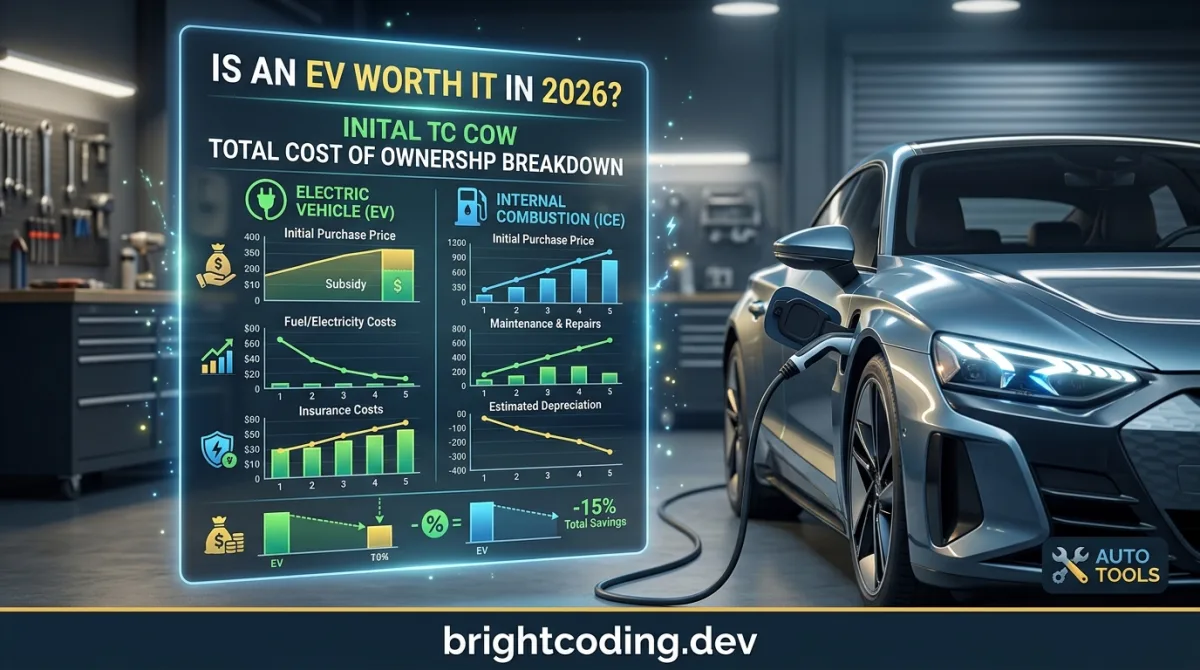
Is an EV Worth It in 2026? Total Cost of Ownership Breakdown
You are standing at a dealership—or scrolling through listings at midnight—and the same question keeps circling back: Is an electric vehicle actually going to save me money, or am I paying a premium for a promise?
You are not alone. In 2026, the EV market has matured, incentives have shifted, and the math looks different than it did three years ago. Sticker shock still exists, but so do hidden savings that most buyers never calculate until after they sign. This article breaks down the real total cost of ownership (TCO) for electric vehicles in 2026, shows you how to run the numbers for your exact situation, and gives you a clear decision framework—no hype, no assumptions.
The Problem: The Sticker Price Is Only Half the Story
Walk onto any lot in 2026 and the pattern is obvious. A comparable electric vehicle often costs $5,000 to $15,000 more upfront than its gas-powered equivalent. For a midsize sedan, that gap might sit around $8,000. For a three-row SUV, it can stretch past $12,000.
That gap triggers a natural reflex: "This is too expensive." And for many shoppers, the conversation ends right there.
But here is what most buyers miss. The purchase price is a single data point in a five-to-ten-year financial timeline. Fuel, maintenance, insurance, depreciation, tax incentives, and resale value all shift the final number dramatically. When you only look at the window sticker, you are solving the wrong equation.
The people most affected by this mistake are:
- First-time EV shoppers who have never owned an electric vehicle
- Budget-conscious families running their cars for 8+ years
- Buyers in regions with volatile gas prices or expensive electricity
- Anyone assuming that "EV equals expensive" without running the math
The common mistake? Comparing monthly payments on the loan instead of lifetime ownership costs.
Why It Happens: Three Forces Distort the Real Cost
1. We Are Trained to Think in Monthly Payments
Car marketing is built around the monthly number. A $45,000 EV with a low APR might have the same monthly payment as a $38,000 gas car. That creates a false equivalence. It ignores the $1,200+ annual fuel savings, the near-zero maintenance for the first four years, and the tax incentives that often arrive after purchase.
2. Incentives Are Fragmented and Confusing
In 2026, federal EV tax credits, state rebates, utility discounts, and local perks still exist—but they vary by income, vehicle price, battery sourcing, and assembly location. A buyer in California might stack $7,500 federal credit with a $2,000 state rebate and a $500 utility discount. A buyer in a neighboring state might see none of those. That inconsistency makes apples-to-apples comparisons feel impossible.
3. Charging Costs Are Invisible Until You Live With Them
Gas prices are posted on giant signs. Electricity rates hide inside utility bills, time-of-use plans, and public charging networks that range from $0.15 per kWh at home to $0.55 per kWh at a fast charger. Most buyers have no framework for translating kWh into miles or dollars into years.
The Solutions: Four Ways to Approach EV Ownership in 2026
Solution 1: Buy New and Maximize Incentives
What it is: Purchasing a new EV that qualifies for the full federal tax credit and any available state or utility incentives.
How it works: You pay the higher upfront price, file for credits, and recoup the gap within the first 12 to 24 months. From there, lower operating costs compound in your favor.
Advantages:
- Full warranty coverage
- Latest battery technology (LFP and advanced NMC packs in 2026)
- Eligibility for the full incentive stack
- Best resale value for the first five years
Disadvantages:
- Highest upfront capital requirement
- Depreciation is steepest in years one and two
- Some models still carry delivery premiums depending on demand
When it makes sense: You plan to keep the vehicle for at least five years, you have the tax liability to absorb a federal credit, and your state offers additional rebates.
Potential costs: Expect $35,000 to $65,000 for mainstream models before incentives. Factor in a Level 2 home charger ($500–$2,000 installed) if you do not already have one.
Solution 2: Buy Used and Let the First Owner Absorb Depreciation
What it is: Purchasing a two- to four-year-old EV from the used market.
How it works: The original owner took the depreciation hit and likely claimed the tax credit. You enter at a lower price point and still benefit from reduced fuel and maintenance costs.
Advantages:
- Lower purchase price, often 30–45% below original MSRP
- Incentive-free buying process—no tax filing complexity
- Proven battery health data available from service records
Disadvantages:
- Battery degradation is a real factor; a 2022 model may have 85–92% of original capacity
- Used EV warranties are shorter or expired
- Older models may lack the charging speed and software updates of 2026 releases
When it makes sense: You are budget-limited, you drive moderate daily miles, and you can verify battery health before purchase.
Potential costs: $18,000 to $35,000 for mainstream used EVs. Always budget for a battery inspection or extended warranty if available.
Solution 3: Lease and Transfer the Risk
What it is: Leasing an EV for 24 to 36 months.
How it works: You pay for depreciation and interest, not the full vehicle. At the end of the term, you walk away or buy out the residual.
Advantages:
- Lowest monthly outlay
- No long-term battery degradation risk
- Easy upgrade path to newer technology
- Lease incentives are often applied at the point of sale, reducing paperwork
Disadvantages:
- Mileage limits and wear penalties
- No equity at the end of the term
- Buyout prices may not reflect actual market value
When it makes sense: You want to test EV life without commitment, you drive predictable miles, or you expect rapid technology improvements that would make a 2026 model feel dated by 2029.
Potential costs: $300 to $600 per month for mainstream models, plus a down payment. Watch for acquisition and disposition fees.
Solution 4: Keep Your Current Car and Run the Numbers Honestly
What it is: Delaying the purchase and calculating your true break-even point.
How it works: Use an interactive TCO tool to compare your current vehicle's ongoing costs against an EV's projected costs over your intended ownership period.
Advantages:
- Zero financial risk
- Reveals whether your current car is actually costing more than you think
- Lets you time the market for better incentives or lower prices
Disadvantages:
- You miss out on current fuel savings
- Incentive structures can change
- Your current vehicle may face rising maintenance costs
When it makes sense: Your current car is reliable, paid off, and has low mileage. Or you are uncertain about your driving patterns and want data before deciding.
Potential costs: Free to calculate. Tools like the EV total cost of ownership calculator let you input your local gas price, electricity rate, annual miles, and vehicle choice to see your personalized break-even point.
The Best Choice: It Depends on Your Math, Not the Headlines
There is no universal winner. The right path depends on four variables:
| Factor | New Purchase Wins | Used Purchase Wins | Lease Wins | Keep Current Wins |
|---|---|---|---|---|
| Ownership timeline | 5+ years | 3–7 years | 2–3 years | Indefinite |
| Daily driving distance | High (15k+ miles/year) | Moderate | Low to moderate | Very low |
| Home charging access | Yes | Yes | Yes | N/A |
| Tax situation | High liability | Any | Any | Any |
| Budget flexibility | Moderate to high | Tight | Tight | Zero |
The honest truth: If you drive fewer than 8,000 miles per year, have no home charging, and live in a region with cheap gas and expensive electricity, an EV may not save you money in 2026. But if you drive 12,000+ miles annually, can charge at home on a time-of-use plan, and qualify for even partial incentives, the TCO advantage usually appears within 18 to 36 months.
For buyers stuck between two specific models, the head-to-head EV comparator lines up vehicles across eight real-world categories—range, charging speed, interior space, tech, safety, value, performance, and running costs—so you are not guessing.
Step-by-Step Action Plan: Run Your Own Numbers This Week
Step 1: Gather your current costs Pull your last 12 months of fuel receipts, maintenance records, and insurance bills. Calculate your true cost per mile.
Step 2: Check your local incentive stack Visit your state energy office and utility website. In 2026, federal credits still apply to qualifying vehicles, but state and local layers change frequently.
Step 3: Find your electricity rate Check your utility bill for your per-kWh rate. If you are on a flat rate, ask about EV time-of-use plans. Charging overnight can cut your per-mile energy cost by 40–60%.
Step 4: Model your TCO Use an interactive tool like the EV charging cost vs gas calculator to plug in your annual mileage, local gas price, electricity rate, and vehicle candidates. Look at the five-year projection, not just year one.
Step 5: Test-drive with intent Drive your top two choices on your actual commute. Test the charging experience. See how the range holds up with your driving style.
Step 6: Negotiate on total cost, not monthly payment If buying, negotiate the out-the-door price first. Then apply incentives. If leasing, confirm the money factor, residual, and any cap cost reductions.
Step 7: Plan your charging setup before delivery If you are buying, schedule a Level 2 charger installation before the car arrives. Relying solely on public charging erases much of the financial advantage.
Common Mistakes to Avoid
-
Ignoring the total cost of ownership. A cheaper gas car can cost more over five years than a pricier EV. Always run the full timeline.
-
Assuming all public charging is expensive. Home charging is where the savings live. If you cannot charge at home, your math changes significantly.
-
Forgetting insurance differences. Some EVs carry higher insurance premiums due to repair costs. Get a quote before you buy, not after.
-
Overestimating range needs. Most drivers average 30–40 miles per day. Buying a 350-mile range vehicle when you need 200 miles means paying for battery you rarely use.
-
Missing the resale angle. In 2026, EV resale values have stabilized. Some brands hold value better than others. Factor depreciation into your TCO model.
-
Skipping the test charge. If you plan to road trip, test the fast-charging network on your common routes before committing.
-
Waiting for "perfect" technology. Solid-state batteries and 800V architectures are improving, but the vehicles available today already deliver strong TCO for most buyers. Delaying indefinitely costs you fuel savings in the meantime.
Expert Takeaway
The question is no longer whether EV technology works. It does. The question is whether the financial model works for you in 2026. That answer lives in your annual mileage, your local energy prices, your tax situation, and your ownership timeline. Run the numbers honestly. The tools exist to make it precise. The only wrong decision is the one made on assumptions.
FAQ
How much does it really cost to own an EV for five years?
It varies by model and location, but for a mainstream EV driven 12,000 miles annually with home charging, total five-year ownership costs in 2026 typically range from $28,000 to $42,000 after incentives—often $4,000 to $8,000 less than an equivalent gas vehicle. Use a 5-year TCO tool for your exact scenario.
Do EV tax credits still exist in 2026?
Yes. The federal EV tax credit remains active for qualifying vehicles and buyers, though income caps, price caps, and battery sourcing requirements still apply. Many states and utilities offer additional rebates. Check current eligibility before you buy.
Is charging an EV cheaper than buying gas in 2026?
For most home-charging owners, yes. Home electricity rates typically translate to $0.03–$0.05 per mile, while gas at $3.50 per gallon in a 30 MPG vehicle costs roughly $0.12 per mile. Public fast charging narrows or eliminates that gap, so home access matters.
Should I buy or lease an EV in 2026?
Buy if you plan to keep the vehicle long enough for operating savings to offset the upfront premium and you can claim available tax credits. Lease if you want lower monthly costs, prefer upgrading every few years, or do not have the tax liability to benefit from a credit.
What is the biggest hidden cost of EV ownership?
Tires and insurance. EVs are heavier and often use specialized tires that wear faster and cost more to replace. Insurance can also run higher due to repair complexity. Build both into your TCO calculation.