The screen said 41 percent. I was 12 kilometres from home, it was minus six outside, and the heater was doing its best impression of a hairdryer. I made it, but the last three kilometres I drove with the climate off and my breath fogging the windscreen like a teenager in a cold car park. That night I started reading, and then I started changing things.
I am not an engineer. I have owned one electric car for four years and put roughly 70,000 km on it. Most of what follows I learned by getting it slightly wrong first.
Why I started paying attention
When I bought the car, the salesman told me the battery would "outlast the car". Maybe. But when I started tracking my range, I noticed it had dropped from an indicated 380 km in summer to around 310 km in the same conditions two winters later. Some of that is normal degradation. Some of it, I suspect, was me.
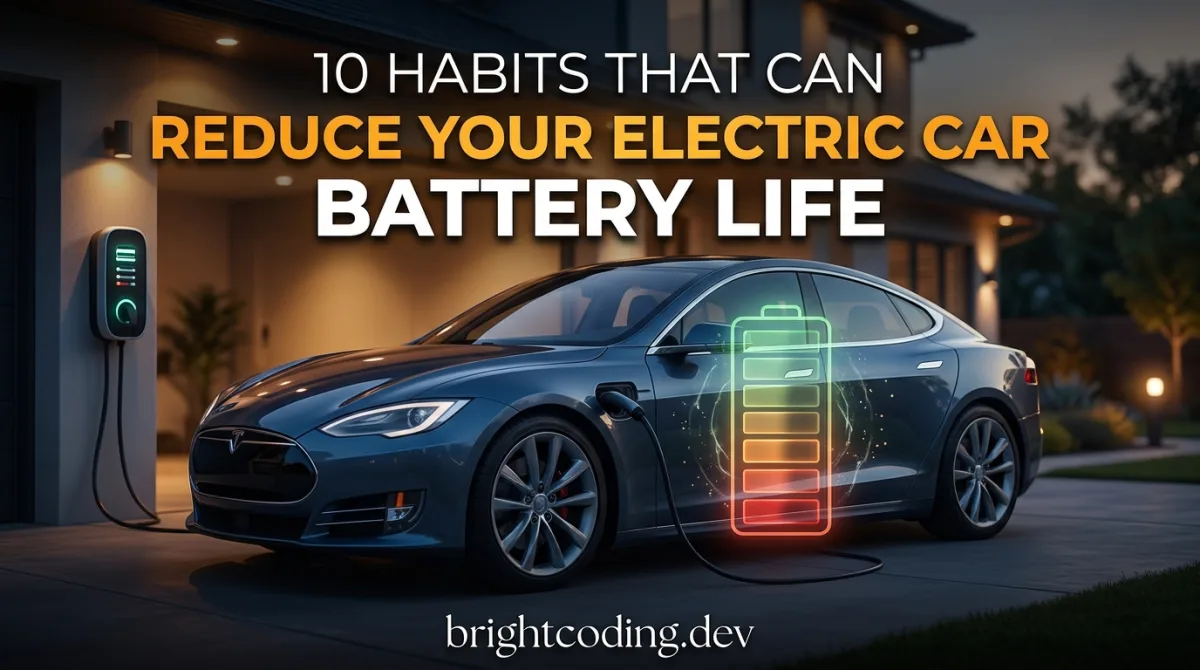
A replacement traction battery, if you ever need one outside warranty, can run into thousands. That number alone made me a more careful owner. So here are the ten habits I either had, or still fight, and what I learned about each.
Habit 1: Charging to 100 percent every night out of habit
For the first year I plugged in every evening and let it fill to 100 percent, because that is what I did with my phone. That is the wrong mental model. Lithium-ion packs are happiest sitting in the middle. Most manufacturers suggest a daily ceiling around 80 percent, with 100 percent reserved for long trips.
I now charge to 80 percent for weekday driving and only push to full the night before a road trip. My range anxiety did not get worse. My habits got cheaper.
Habit 2: Leaving it parked at very low charge for days
The opposite mistake is just as bad. Twice I came home on a near-empty pack and left the car sitting at 4 or 5 percent because I was tired. Sitting for long periods at very low state of charge is not kind to the cells.
If you are leaving the car for a week or more, most guidance points to parking somewhere around 50 percent. I now do that before holidays without thinking about it.
Habit 3: Treating DC fast charging as my default
There is a rapid charger near my office, and for a while it was just convenient. Ten minutes at a fast charger felt like a superpower. But doing that several times a week is a lot of heat and stress on the pack compared with a slow overnight top-up.
Fast charging is not forbidden. It is a tool for journeys. For daily life, home or workplace charging at lower power is gentler. If you want to understand the difference between AC and DC charging properly, the EV troubleshooting guides explain the hardware side well.
Habit 4: Living in extreme heat and cold without thinking
Batteries dislike extremes at both ends. A car baking in direct summer sun, or a winter parked outside at minus 15, will both lose usable range and, over years, degrade faster.
I do not have a garage. What helped was the boring stuff: parking in shade when I can, preconditioning while still plugged in so the cabin and pack are warmed by mains power rather than the battery, and using seat heating instead of blasting the cabin heater. My winter range penalty is real, but it stopped getting worse once I stopped fighting the weather.
Habit 5: Ignoring state of charge when I parked for weeks
I once left the car at the airport for 18 days. I came back to a noticeably lower percentage than I left, because the car had been awake, doing background work, and it was cold.
Modern EVs manage this far better than older ones, but the principle stands: for long parking, aim for around half charge, and check whether your car has a low-power storage mode. Mine does. I only found it in the menu last year.
Habit 6: Hammering the accelerator because it was fun
This one hurt to give up. Electric torque is addictive. But repeated hard launches pull big current, generate heat, and eat range. I am not saying drive like a vicar. I am saying that if you want maximum pack life, gentle is better than theatrical.
The honest trade-off: driving gently did cost me some of the joy that made me buy the car. I still use the power occasionally. I just stopped using it as my default.
Habit 7: Leaving the car plugged in at 100 percent for days
Charging to full and then leaving it sitting there, plugged in, for a week is worse than charging to full and driving off. High state of charge plus time equals more stress. Some cars let you set a charge limit and a departure time so it finishes just before you leave. That is the trick I wish I had known in year one.
Habit 8: Never checking the health data I already had
My car quietly logs battery health, energy consumption and charging history. I ignored all of it because the dashboard is not exactly friendly. When I finally looked, I could see my efficiency dropping in winter and my average consumption creeping up, both of which I could partly explain by my own driving.
If your car exposes state of health, read it once a year. It is a far better signal than guessing from the range display. The diagnostics and fuse guides are useful if a number looks genuinely wrong rather than just seasonal.
Habit 9: Assuming the range number on screen was the truth
Early on I trusted the guess-o-meter completely and got caught out twice. That number is an estimate based on recent driving, temperature and climate use, not a promise. Learning to read it as a forecast rather than a fact changed how I planned trips.
If you are comparing how different models handle this, the head-to-head EV comparisons are worth a look before you buy, because some cars are much more honest about their estimates than others.
Habit 10: Thinking one bad habit would kill the battery
This is the meta-mistake. No single late charge or cold week ruins a pack. Degradation is cumulative and slow. The habits above matter because they stack over years, not because one slip is fatal.
That realisation made me less paranoid and more consistent, which is probably the healthiest change of all.
Honest pros and cons of changing my habits
What got better: my winter range stopped surprising me, my charging costs dropped because I stopped filling to 100 percent nightly, and I stopped worrying every time the percentage moved.
What got worse: I think about charging more than I used to, long trips need a bit of planning, and I gave up some of the carefree acceleration that made the car fun. There is a real cost to being a careful owner, and it is mostly mental.
What it actually cost
| Change | Approximate cost impact |
|---|---|
| Charging to 80 percent instead of 100 | Saves a little on home electricity each month, roughly a few percent of your charging bill |
| Fewer DC fast charges | Fast charging often costs noticeably more per kWh than home charging, so this can save real money over a year |
| Parking in shade or preconditioning | No direct cost, some convenience |
| Reading battery health data | Free |
| Replacement traction battery (if ever needed out of warranty) | Expect around several thousand, varies hugely by model, verify with your dealer |
The money is not the main story. The main story is that careful habits may delay the day you need that last row.
What I would do differently
I would check the car's charge limit settings on day one rather than in year two. I would read the manual section on battery care once, properly, instead of skimming it.
I would stop treating the range display as a guarantee and start treating it as weather. I would set a departure time so the car finishes charging just before I leave, not hours earlier.
And I would accept that some degradation is normal and not a personal failure. Cars wear. Batteries age. The goal is to be gentle, not perfect.
Quick practical tips
- Set your daily charge limit around 80 percent unless you need the full range tomorrow.
- For storage of a week or more, park near 50 percent if your manual allows it.
- Use DC fast charging for journeys, not as your everyday top-up.
- Precondition while plugged in during winter so the grid, not the pack, does the warming.
- Read your car's battery health screen once a year and compare it with last year's number.
- If anything looks genuinely wrong, like a sudden range collapse, stop guessing and get it checked. The free EV calculators and tools can help you sanity-check consumption before you panic.
FAQ
Does charging to 100 percent always damage the battery? Not instantly, and not always. The issue is doing it constantly and then leaving the car sitting at full. Occasional full charges for long trips are fine.
Is fast charging bad for my battery? It is harder on the pack than slow charging, especially in extreme temperatures. Used sensibly for journeys, it is a normal part of EV ownership.
Can I recover lost range? Genuine chemical degradation cannot be reversed. Some cars recalibrate their range estimate after a full charge cycle, which can make the number look better, but the underlying capacity does not come back.
When should I see a professional? If you see a sudden, large drop in range, warning lights, or unusual charging behaviour, get it diagnosed. High-voltage battery work is not a DIY job and should always go to a qualified technician.
I still drive that car. It is a bit slower to fill on a cold morning and I still glance at the percentage more than I should, but I stopped treating it like a phone, and it stopped treating me like a problem.