Last Updated: August 21, 2026
Reading Time: 12 minutes
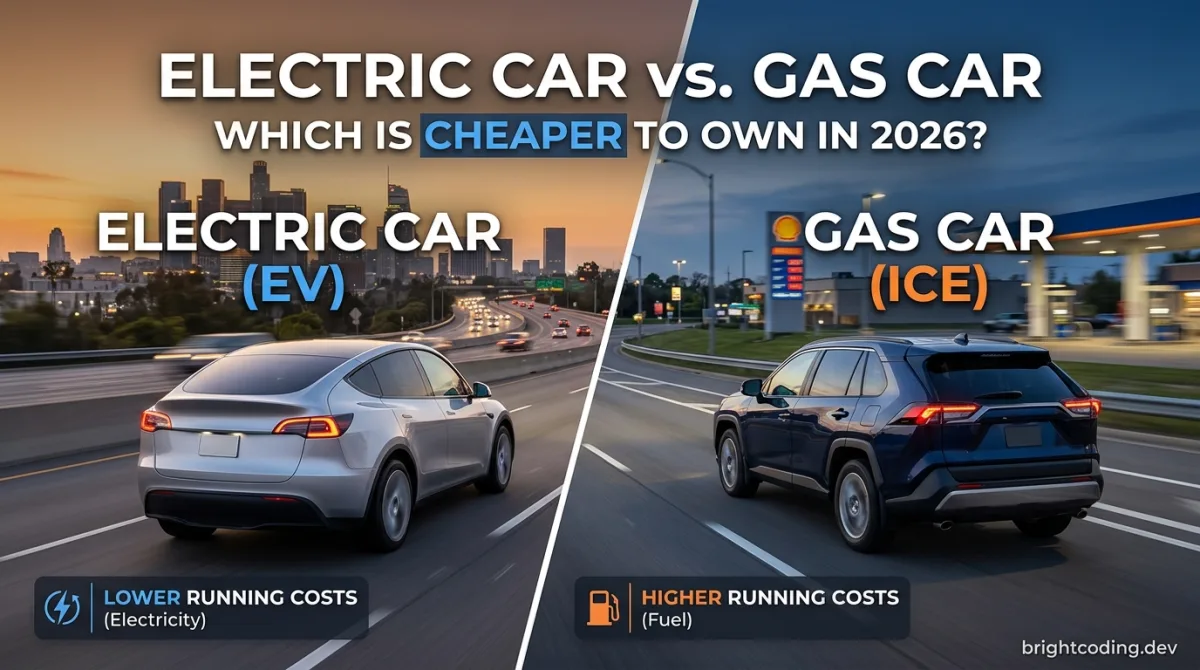
The debate at every dealership, dinner table, and Reddit thread right now is the same: Are electric cars actually cheaper than gas cars? Not just to buy — to own. In 2026, with gas prices hovering near $3.93 per gallon nationally and electricity rates averaging 18¢ per kWh, the math has shifted dramatically. But the answer isn't a simple yes or no. It depends on how you drive, where you live, and — critically — whether you can charge at home.
We crunched the latest data from the EIA, AAA, Consumer Reports, Atlas Public Policy, and iSeeCars to give you the definitive 2026 cost breakdown. No brand bias. No greenwashing. Just numbers.
Table of Contents
- The Sticker Price Shock: What You Pay Up Front
- Fuel Costs: The 60% Advantage Nobody Talks About
- Maintenance: The $7,000 Hidden Savings
- Insurance: The EV Tax Nobody Expected
- Depreciation: Where EVs Lose Badly
- 7-Year Total Cost of Ownership: The Final Verdict
- When a Gas Car Still Wins
- The Used EV Opportunity
- FAQ: Your Top Questions Answered
The Sticker Price Shock: What You Pay Up Front {#the-sticker-price-shock}
Let's get the bad news out of the way first. In 2026, a new EV still costs more at the dealership than a comparable gas vehicle.
| Vehicle Segment | Average Gas Car Price | Average EV Price | Premium |
|---|---|---|---|
| Compact Sedan | $32,000 | $42,000 | +$10,000 |
| Mid-Size SUV | $40,000 | $52,000 | +$12,000 |
| Full-Size Pickup | $48,000 | $62,000 | +$14,000 |
That gap is genuine, and for many buyers, it's where the conversation stops. But here's what most people miss: you don't pay the sticker price every month. You pay for fuel and maintenance every month. And that's where the arithmetic turns.
> Key Insight: The federal EV tax credit of up to $7,500 expired on September 30, 2025. Some manufacturers have slashed MSRPs to compensate (Hyundai cut Ioniq 5 prices by up to $10,000), but the days of automatic government rebates are over. Run your math on the price you'll actually pay, not the price a 2024 analysis assumed.
Fuel Costs: The 60% Advantage Nobody Talks About {#fuel-costs}
This is where EVs dominate. The per-mile fuel cost gap is staggering in 2026.
The Simple Math
| Metric | Gas Car (30 MPG) | Electric Car (3.5 mi/kWh) |
|---|---|---|
| Fuel cost per mile | $0.131 | $0.051 |
| Annual fuel (12,000 mi) | $1,572 | $612 |
| 5-year fuel cost | $7,860 | $3,060 |
| EV Advantage | — | 61% cheaper |
At the national average of $3.93 per gallon and 18¢ per kWh, an EV costs roughly 5.1 cents per mile to fuel, while a 30 MPG gas car costs 13.1 cents per mile.
For the average American driving 12,000 miles annually, that's $960 per year in fuel savings alone. Over five years: $4,800 back in your pocket.
Regional Variations Matter
The EV advantage is largest in states with cheap electricity and expensive gas (Washington, Oregon) and narrowest where electricity is pricey and gas is cheap (Hawaii, Connecticut). In Washington, an EV owner can save up to $14,480 over a vehicle's lifetime. In Hawaii, higher electricity costs could mean spending $2,494 more with an EV.
The Home Charging Rule
Critical caveat: Nearly all these savings assume home charging. Public DC fast charging costs substantially more — often 2-3x residential rates. If you can't charge at home, the fuel advantage shrinks dramatically.
> Pro Tip: Many utilities offer time-of-use rates that let you charge overnight for 30% less. A Level 2 home charger ($1,000–$2,500 installed) pays for itself quickly if you drive significant miles.
Maintenance: The $7,000 Hidden Savings {#maintenance}
Fuel is only half the story. Maintenance is where EVs quietly save you thousands.
An electric vehicle has dramatically fewer moving parts than a gasoline car:
- No oil changes
- No timing belts
- No transmission fluid
- No spark plugs
- No exhaust system
Regenerative braking means brake pads last significantly longer, because the motor does most of the slowing down.
Annual Maintenance Comparison
| Cost Category | Gas Car | Electric Car | Annual Savings |
|---|---|---|---|
| Routine Maintenance | $900–$1,500 | $300–$500 | ~$700 |
| Oil Changes | $120–$180 | $0 | $120–$180 |
| Brake Service | $200–$400 | $50–$100 | $150–$300 |
Atlas Public Policy puts maintenance savings at roughly 39% across compared vehicles. Broader estimates from AAA and Consumer Reports place EV maintenance at $300–$500 per year versus $900–$1,500 for gasoline.
Over a typical 7-year ownership period, that's roughly $4,900–$7,000 in maintenance costs you simply never schedule.
> The One EV Maintenance Catch: Tires. EVs are heavier due to batteries, and they wear tires faster. EV-specific tires cost more and may need replacement more frequently. Budget an extra $200–$400 every few years.
Insurance: The EV Tax Nobody Expected {#insurance}
Here's where EVs lose ground — and it's a bigger gap than most buyers expect.
In 2026, EVs cost an average of $3,159–$4,058 per year to insure with full coverage. Gas-powered cars average $2,732 per year. That's a 42–49% premium for electrics.
Why EV Insurance Costs More
| Factor | Impact |
|---|---|
| Higher purchase prices | Higher replacement values |
| Proprietary parts | No aftermarket alternatives |
| Specialized labor | Fewer qualified technicians |
| Battery replacement risk | $10,000+ potential claim |
| ADAS sensors | Expensive recalibration after minor bumps |
EVs require 3.04 hours of mechanical labor per repair versus 1.66 hours for gas cars. And because many EVs require original manufacturer parts, technicians can't pull from recycled parts inventory.
The Cheapest & Most Expensive EVs to Insure
| Vehicle | Annual Full-Coverage Premium |
|---|---|
| Chevrolet Silverado EV | $1,947 |
| Hyundai Ioniq 5 | $1,962 |
| Tesla Model 3 | $3,268 |
| Tesla Model X | $4,469 |
| Audi SQ8 e-tron | $10,402 |
Mainstream EVs from Hyundai, Kia, Toyota, and Volkswagen are competitive with gas cars. Luxury EVs from Tesla, Audi, and Lucid are brutally expensive to insure.
> Bottom Line: Budget an extra $400–$1,200 per year for insurance if you're switching from a gas car to an EV. Shop around — Travelers and Lemonade offer EV-specific discounts.
Depreciation: Where EVs Lose Badly {#depreciation}
If you plan to sell or trade in your car, this is the most painful number.
According to iSeeCars' 2026 study:
- Hybrids: Lose 35.4% after 5 years (best retention)
- Gas cars: Lose 41.8% after 5 years (market average)
- EVs: Lose 57.2% after 5 years (worst retention)
Specific Model Depreciation (5 Years)
| Vehicle | Value Lost |
|---|---|
| Nissan LEAF | 63.1% |
| Volkswagen ID.4 | 62.1% |
| Ford Mustang Mach-E | 60.8% |
| Tesla Model Y | 57.8% |
| Tesla Model 3 | 54.6% |
Why EVs Depreciate So Fast
- Incentive hangover: The now-defunct $7,500 federal tax credit artificially lowered new EV prices, forcing used prices down to match
- Technology anxiety: Buyers fear obsolete batteries and outdated tech
- Lease flood: Hundreds of thousands of off-lease EVs are flooding the market, outpacing demand
- Battery uncertainty: Used buyers worry about replacement costs
> Strategic Takeaway: If you buy an EV, plan to keep it for 7+ years to amortize the depreciation hit. Or lease — let the manufacturer absorb the loss.
7-Year Total Cost of Ownership: The Final Verdict {#tco}
This is the number that matters. Atlas Public Policy compared the five best-selling 2024 gas models against their closest electric counterparts over a 7-year ownership period.
| Comparison | Segment | 7-Year TCO Winner | Margin |
|---|---|---|---|
| Chevrolet Equinox EV vs. Gas Equinox | Compact SUV | EV | 20% cheaper |
| Tesla Model Y vs. Jeep Grand Cherokee | Mid-Size SUV | EV | 15% cheaper |
| Hyundai Ioniq 6 vs. Toyota Camry | Sedan | EV | 7% cheaper |
| Nissan Leaf vs. Toyota Corolla | Compact Sedan | EV | 5% cheaper |
| Ford F-150 Lightning vs. Gas F-150 | Pickup | Gas | 4% cheaper |
Four out of five EVs are cheaper to own over seven years. The advantage is largest in SUVs — where Americans actually buy — and narrowest in compact sedans. The one loss is the pickup truck segment.
What Happens Without the Federal Tax Credit?
Atlas modeled the repeal scenario (which is now reality). The impact is severe:
- Chevrolet Equinox EV savings drop from ~$9,000 to ~$200
- Two models still win without the credit: Equinox EV and Model Y
- Others get much closer to a wash
The operating savings are real and permanent — they come from physics, not policy. But the upfront price gap is now fully on the buyer.
When a Gas Car Still Wins {#when-gas-wins}
Honesty makes the rest of this more credible. Here are the cases where the math doesn't land for EVs:
| Scenario | Why Gas Wins |
|---|---|
| No home charging | Public DC fast charging is 2-3x more expensive; savings evaporate |
| Low annual mileage | At 4,000 miles/year, payback period stretches past relevance |
| Pickup trucks | F-150 Lightning still loses to gas F-150 on TCO |
| Cheap gas + expensive electricity | Hawaii, parts of the Northeast |
| You own a paid-off car | The cheapest vehicle is always the one in your driveway |
| 3-year ownership cycle | EV depreciation hits hardest in years 1-3 |
The Used EV Opportunity {#used-ev}
Here's the twist: EV depreciation is terrible for new buyers but fantastic for used buyers.
A 3-year-old EV with 40,000 miles may have lost 40-50% of its value while still retaining 90%+ battery health. Geotab's 2026 data shows average EV battery degradation of just 2.3% per year — meaning many batteries still hold significant capacity after 5 years.
Used EV Shopping Checklist:
- Get the high-voltage battery diagnosed independently
- Check remaining warranty (8-year/100,000-mile federal minimum)
- Verify real-world range vs. original EPA rating
- Confirm charging port functionality
- Review charging history (frequent fast charging accelerates degradation)
A used EV can deliver all the fuel and maintenance savings without the brutal depreciation hit.
FAQ: Your Top Questions Answered {#faq}
Are electric cars worth it in 2026?
For most drivers who can charge at home and drive 10,000+ miles annually, yes. Fuel runs roughly 60% cheaper per mile and maintenance saves $500–$1,000 per year. Four of five best-selling segments show lower 7-year TCO for EVs.
How much does it cost to charge an electric car at home?
At 18¢/kWh with 3.5 miles per kWh efficiency: about 5.1¢ per mile, or roughly $612/year at 12,000 miles. With rooftop solar, daylight charging approaches zero.
Do EVs save money without the federal tax credit?
Some do. The Chevrolet Equinox EV and Tesla Model Y still beat their gas counterparts without the $7,500 credit. For other models, the gap narrows considerably. Fuel and maintenance savings are unaffected.
Are electric cars cheaper to maintain?
Substantially. No oil changes, no spark plugs, no timing belts, no transmission fluid, and regenerative braking extends brake pad life. Expect $300–$500/year for EVs versus $900–$1,500 for gas cars.
Why is EV insurance so expensive?
Higher repair costs, proprietary parts, specialized labor, and expensive batteries. EVs average 42–63% more to insure than gas cars. Mainstream models (Hyundai, Kia, Toyota) are much closer to parity than luxury EVs.
Should I buy new or used?
Buy new if you want latest tech, full warranty, and maximum range. Buy used if you want to avoid the steepest depreciation. A 3-year-old used EV can be 40-50% off MSRP with plenty of battery life remaining.
The Bottom Line
In 2026, the electric car vs. gas car debate isn't about ideology anymore — it's about math. And the math says:
- EVs win on fuel: 60% cheaper per mile
- EVs win on maintenance: ~$700/year less
- EVs lose on insurance: ~$500–$1,200/year more
- EVs lose on depreciation: 15-20 percentage points worse over 5 years
- Net result: EVs are cheaper over 7 years in 4 of 5 popular segments
Your move: Plug your actual numbers into the calculator above. Because the only math that matters is your math.
Sources: U.S. Energy Information Administration (EIA), AAA Your Driving Costs 2024, Consumer Reports, Atlas Public Policy/NRDC 2025 TCO Analysis, iSeeCars 2026 Depreciation Study, Insurify 2026 Auto Insurance Report, The Zebra, MoneyGeek, CarBuzz, Geotab Battery Health Data 2026.