Used EVs can be the best value in the car market right now, or the worst purchase of your life, and the difference comes down to battery health, warranty coverage and how the car was charged before you got it. This article answers the five questions buyers ask most, then digs into depreciation, battery degradation, tax credits and the specific checks that separate a bargain from a money pit. If you want to compare specific models side by side while you read, the EV model directory is a good place to keep open in another tab.
Quick answers
- Do used EVs lose value faster than petrol cars? Historically yes, often steeply in the first three years, though that gap has narrowed for popular models. Verify current resale data for the exact model you want.
- Is a used EV battery going to die on me? Most modern packs degrade slowly, losing roughly 2-3% of usable capacity per year under normal use. A battery health check before purchase removes most of the guesswork.
- Can I still get a tax credit on a used EV? In the US, a federal credit of up to $4,000 has applied to qualifying used EVs bought from a dealer, with income and price caps. Rules change, so check the IRS page before you buy.
- Is a used EV cheaper to run? Usually yes. Electricity costs less per mile than petrol in most regions, and EVs have fewer moving parts to service.
- What is the single biggest risk when buying used? A degraded or abused battery pack, especially on cars that lived on frequent DC fast charging.
Do used EVs lose value faster than petrol cars?
Depreciation is the used-EV buyer's best friend and the new-EV buyer's worst enemy. Early EVs, particularly ones with modest range by today's standards, shed value quickly because newer models kept arriving with bigger batteries and lower prices.
That pattern has softened. For well-known models with strong demand, three-year depreciation now looks closer to what you would expect from a conventional car, though it varies wildly by brand and region. The honest answer is that I cannot give you one number, because it depends on the model, the year, your market and how fast the manufacturer keeps cutting prices on new units.
Here is the practical move: check what a three-year-old version of your target car actually sells for near you, then compare that to its original list price. If the drop is brutal, you are the beneficiary. If it is mild, you are paying near-new money for a used car, and buying new may make more sense.
Is a used EV battery going to die on me?
This is the fear that stops most people, and it is mostly overblown, with caveats.
Lithium-ion packs in cars are managed far more carefully than the battery in your phone. Most lose capacity gradually rather than failing suddenly. A common rough figure is 2-3% of usable capacity per year, but that is a generalisation, not a promise. Packs in hot climates, packs that were fast-charged constantly, and packs in early low-volume models can do worse.
What matters is the state of health (SoH) of the specific car in front of you. You want a readout, not a vibe.
Some steps you can take yourself:
- Ask the seller for a battery health report or a recent service printout showing SoH.
- On the test drive, note the estimated range at a known charge level and compare it to the car's original rated range.
- Ask how the car was usually charged. Frequent DC fast charging is not fatal, but a car that lived on it is worth a closer look.
- Check whether the pack is still under the original battery warranty. Many manufacturers cover the traction battery for 8 years or around 100,000 miles, often with a capacity guarantee around 70%. Confirm the exact terms for your model, because they differ.
If you cannot get a health figure and the seller will not arrange a dealer inspection, walk away. There are plenty of used EVs.
Which used EVs hold their value best?
The ones people actually want. Strong residual values tend to cluster around models with a reputation for reliability, a real fast-charging network, decent range and a brand that has not spent the last two years slashing prices.
A few patterns worth knowing:
- Tesla has historically held value well, though its own price cuts have dented that.
- Mainstream hatchbacks and crossovers from high-volume brands tend to depreciate predictably, which is good news for used buyers.
- Compliance cars and discontinued models can be cheap, but parts availability and software support become a genuine worry.
- Luxury EVs often drop hardest in absolute money, which can make a three-year-old premium EV a tempting buy, provided you can stomach the repair bills.
Rather than trusting a general rule, compare two or three candidate models directly. Head-to-head breakdowns on EV comparisons let you line up range, charging speed, warranty and running costs without hopping between ten tabs.
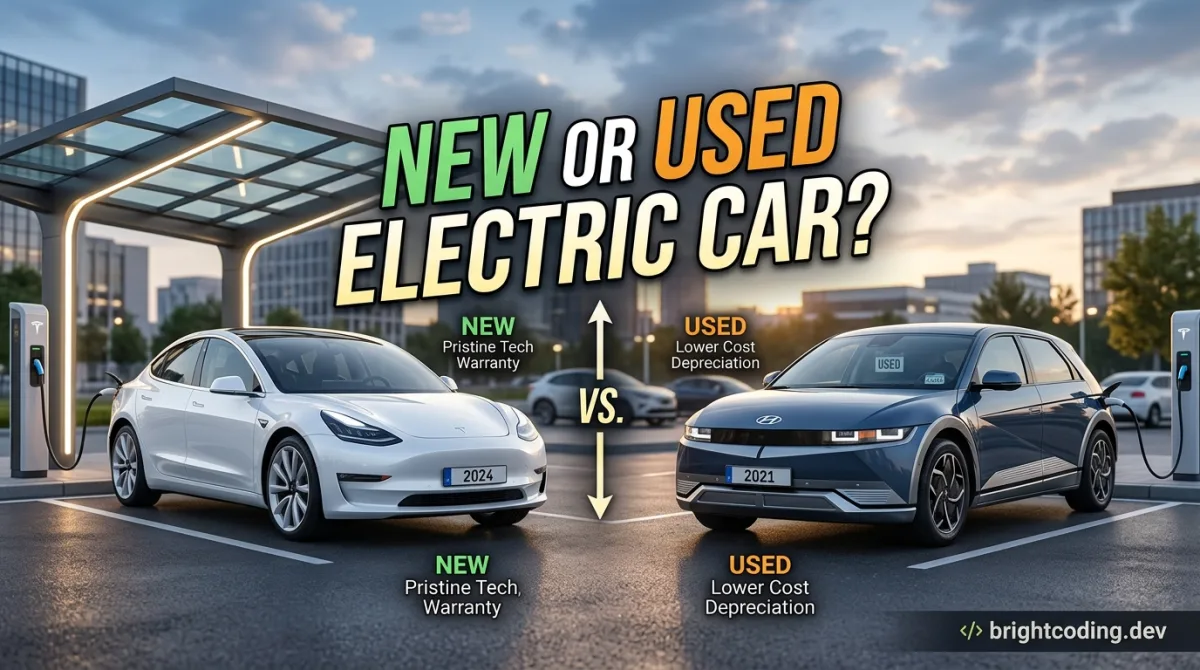
New or used: what actually changes for you?
| Criteria | New EV | Used EV |
|---|---|---|
| Purchase price | Highest | Lower, sometimes dramatically |
| Depreciation hit | You absorb the steepest years | Someone else already did |
| Battery warranty | Full term from day one | Remaining term only, verify it |
| Latest range and tech | Yes | Usually one or two generations behind |
| Tax incentives | Often larger, rules vary | Smaller or none, rules vary |
| Insurance and repairs | Predictable | Can be higher or parts-scarce |
| Risk of hidden problems | Very low | Real, unless you inspect |
| Software updates | Ongoing support likely | Depends on brand and age |
Verdict: Buy new if you keep cars a long time, want the full warranty, need maximum range and can absorb the first-years depreciation. Buy used if you want the lowest cost per mile, are willing to pay for a battery health check, and target a popular model with remaining battery warranty. The worst outcome is buying a used EV on price alone without verifying the pack.
Can you get a tax credit on a used EV?
In the US, a federal credit of up to $4,000 has applied to used clean vehicles bought from a dealer, subject to income limits, a price cap and the car being at least two model years old. It is not automatic: the dealer usually needs to report the sale through the IRS portal.
Outside the US, incentives vary enormously. Some countries and cities offer purchase grants, VAT relief, free parking, or reduced road tax for used EVs, and others offer nothing. Several European schemes have changed or closed with little warning.
Do not trust a blog, including this one, for the current numbers. Check the official tax authority for your country and confirm the rules on the exact day you buy. A credit worth $4,000 can flip a used purchase from marginal to obvious, so it is worth ten minutes of verification.
What should you check on a used EV before buying?
Beyond the battery, a used EV has a few EV-specific traps.
- Charging hardware: test AC charging and, if you can, a DC fast charge. Faulty onboard chargers are expensive.
- Software and recalls: check for outstanding recalls and whether the car still receives updates.
- 12V battery: the small auxiliary battery causes a huge share of "dead EV" complaints. A tired one is cheap to replace but a good negotiating point.
- Cooling and thermal systems: ask about any coolant service history.
- Tyres: EVs are heavy and chew through tyres faster than you might expect.
If a warning light appears on your test drive, do not shrug it off. The EV troubleshooting guides explain what common faults usually mean, and the diagnostic and fuse guides help you work out whether a problem is a cheap fix or a deal-breaker.
One hard line: anything involving the high-voltage traction battery, its cabling or its housing is professional work. Do not poke around an orange cable to save a diagnostic fee. There is no safe DIY version of that job.
Related questions buyers ask next
How old is too old for a used EV?
There is no clean cutoff. A well-kept eight-year-old EV with a healthy pack and remaining battery warranty can be a fine buy. A four-year-old one that was thrashed on fast charging and left at 100% in the sun may not be. Age matters less than SoH, warranty status and parts support. Once a model is discontinued and software updates stop, the calculus shifts against it.
Is it worth buying a used EV with a small battery?
If your driving is mostly local and you can charge at home, a smaller pack is often the smartest buy. You get the lowest price and the lightest, most efficient car. The catch is fast-charging speed and winter range, both of which hurt more on small packs. If you regularly drive long distances, spend more.
What about used electric scooters, bikes and motorcycles?
The same logic applies, scaled down. Battery health is still the main risk, but replacement packs are cheaper and more widely available than car packs, which lowers the stakes. Check the charger works, confirm the brand still exists, and budget for a new battery if the original is more than a few years old. Running costs on two wheels are trivially low, so the maths usually favours used.
Bottom line
Used is where the value is, provided you verify the battery and the warranty rather than trusting the listing. New is the safer, more expensive route that suits long-term keepers. Whichever way you lean, price the car, the incentives and the electricity before you fall in love with the badge, and use the free EV calculators to turn those guesses into actual numbers.