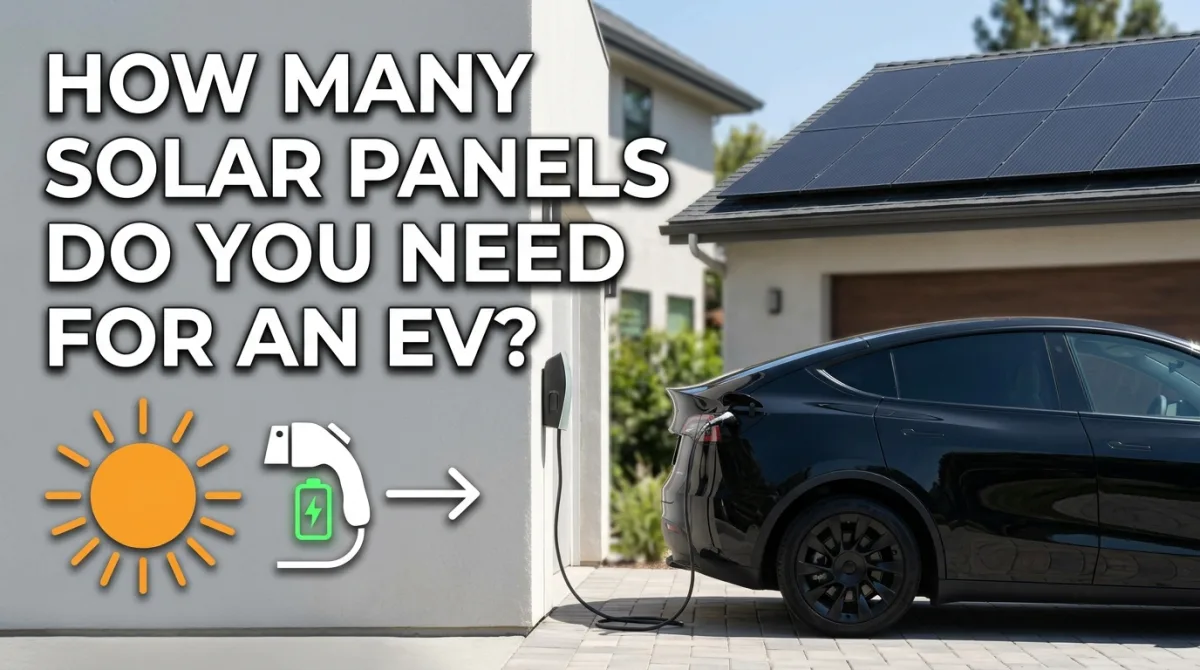
Charging your EV from the sun is the endgame of cheap, clean motoring — fuel that costs you nothing and produces zero emissions. But how many solar panels does it actually take? The answer is a straightforward math problem.
Here's the exact calculation for 2026.
The simple answer
A typical EV driven 15,000 km/year needs roughly 8–12 solar panels (400W each) to cover all its charging. Your exact number depends on three things:
- How far you drive
- How efficient your EV is
- How much sun your location gets
The math, step by step
Step 1 — Energy your EV uses
- Typical EV efficiency: ~3.5 mi/kWh (22 kWh per 100 km)
- 15,000 km/year → 3,300 kWh/year for the car
Step 2 — Energy your panels produce
- A 400W panel produces roughly 400–600 kWh/year depending on sun hours
- Sun Belt (California, Spain): ~600 kWh/panel/year
- Northern Europe (UK, Germany): ~350–450 kWh/panel/year
Step 3 — Panel count
| Location | Sun hours | kWh/panel/yr | Panels for 3,300 kWh |
|---|---|---|---|
| Sun Belt (CA, Spain, Australia) | 1,500+ | ~600 | 6 panels |
| Central Europe | 1,200 | ~480 | 7–8 panels |
| Northern Europe (UK, DE) | 1,000 | ~400 | 8–9 panels |
So the answer is 6–9 panels for a typical driver — roughly 2.4–3.6 kW of solar capacity, needing about 12–18 m² of roof space.
The efficiency effect
Your EV's efficiency moves the number a lot:
- Efficient EV (Hyundai Ioniq 6, ~4.5 mi/kWh): 15,000 km → 2,600 kWh → 5–7 panels
- Average EV (~3.5 mi/kWh): → 3,300 kWh → 6–9 panels
- Large EV (SUV, ~3.0 mi/kWh): → 3,850 kWh → 8–10 panels
The smarter question: battery or not?
You have two options:
- Grid-tied solar (no home battery) — sell excess solar, buy back at night. Simple, cheap, but you don't get to charge only from the sun.
- Solar + home battery — store the day's solar and charge the EV at night from it. True "free driving," but the battery adds $5,000–$10,000.
For most people, grid-tied solar + a night tariff is the financial sweet spot: you earn on solar you export and buy night electricity cheaply. A home battery only pays off if your electricity buy-back rate is poor.
> Run your exact numbers with the solar EV calculator.
The payback question
| Setup cost (approx) | Annual saving vs public charging | Payback |
|---|---|---|
| 8 panels + inverter: ~$8,000–12,000 | $1,500–$2,500/year | 4–7 years |
After payback, your EV effectively runs on free sun for 15+ years. And in many regions, net-metering makes excess solar a small income stream. See solar vs grid and solar payback for the details.
FAQ
How many solar panels to charge an EV? Typically 6–9 panels (2.4–3.6 kW) for an average driver covering all their EV energy. Sun-heavy regions need fewer, large EVs and cloudy regions need more.
Can I charge my EV directly from solar panels? Yes — with a solar charger like the Zappi (see best home chargers) that charges from surplus solar, or via a home battery at night.
Is solar + EV worth it in 2026? If you charge at home and have roof space, very often yes — 4–7 year payback, then free motoring for years. Combine it with night tariffs for the best deal.
The bottom line
A typical EV needs 6–9 solar panels to charge from sunlight. It's an investment that pays back in 4–7 years and turns your fuel bill into zero. If you own a home and plan to keep your EV, solar + EV is one of the best financial moves in motoring today.