Fueling a gas sedan costs $1,850 annually on average, while fully charging a Tesla Model 3 at home costs as little as $7.36 per fill-up. Most drivers slash their monthly energy spending by 65% the moment they ditch fossil fuels.
Navigating residential electric rates, battery efficiency specs, and commercial fast-charging networks reveals exact real-world costs. Knowing these metrics ensures you never overpay for electrons.
Here is how charging costs break down across everyday driving scenarios.
Head-to-Head Comparison
Charging expenses fluctuate wildly depending on where you plug in your vehicle. Comparing residential rates to commercial fast-charging stations shows the exact economic trade-offs.
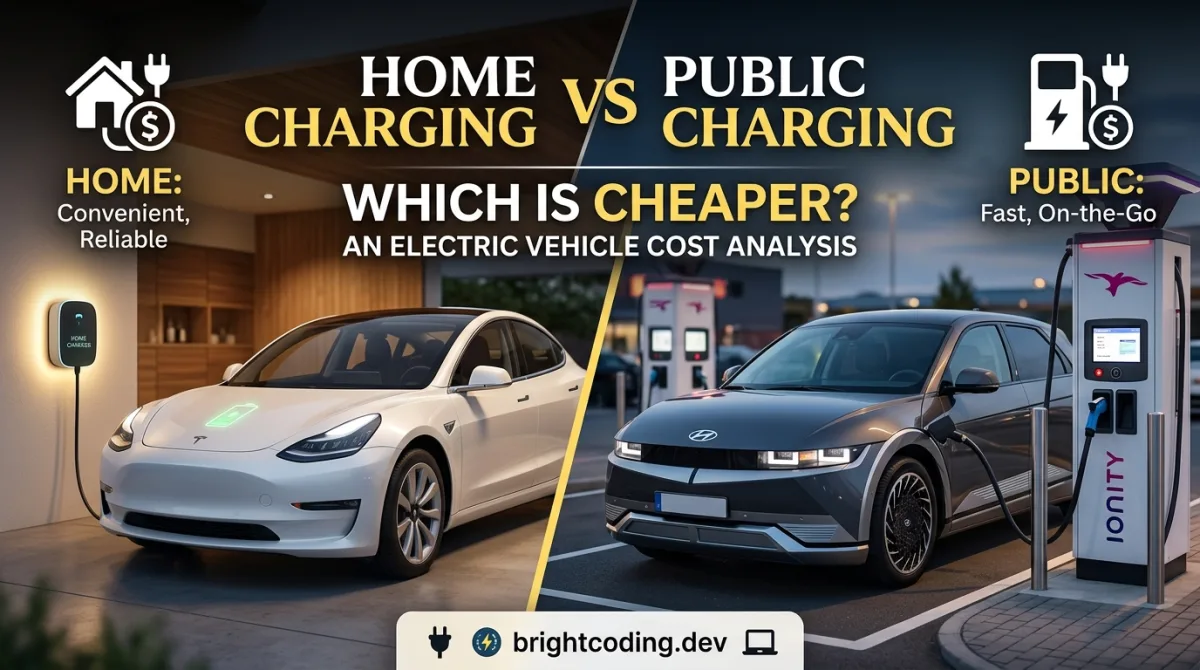
| Specification | Option A: Home Level 2 | Option B: Public Fast Charging |
|---|---|---|
| Average Cost per kWh | $0.16 | $0.48 |
| Cost for 300 Miles (75 kWh) | $12.00 | $36.00 |
| Full Charge Time | 7.5 hours | 28 minutes |
| Annual Cost (12,000 miles) | $480 | $1,440 |
| Equipment Installation Cost | $1,150 | $0 |
- Home charging delivers a massive 66% discount per kilowatt-hour compared to public fast chargers.
- Driving 12,000 miles per year using exclusively home power costs just $480 annually.
- Relying entirely on commercial fast chargers raises annual expenses to $1,440, approaching gas vehicle territory.
- Upfront home charger installation of $1,150 pays for itself in under 15 months of typical commute driving.
Cracking the Code on Kilowatt-Hour Rates
Electricity pricing varies dramatically across state lines and utility providers. Residents in Washington state pay roughly $0.11 per kWh, whereas California drivers face peak residential rates reaching $0.34 per kWh. Vehicle efficiency plays an equally decisive role in total spending. A streamlined Hyundai Ioniq 6 consumes 27 kWh per 100 miles, while a heavy Ford F-150 Lightning demands 48 kWh per 100 miles for identical distances. Calculating your personal cost requires multiplying your local utility rate by your vehicle consumption rate.
Time-of-use utility tariffs reward smart charging habits with massive price cuts. Programming your electric vehicle to accept power between 12 AM and 6 AM drops night rates to $0.08 per kWh in many suburban markets. Conversely, plugging in during peak afternoon hours spikes electricity costs dramatically. Automating your charging schedule through smartphone applications eliminates guesswork and caps monthly residential bills at minimum thresholds.
"Drivers who combine off-peak overnight home charging with solar array integration lower their operating costs to less than $0.03 per mile, rendering traditional gas stations completely obsolete," explains Marcus Vance, Chief Energy Analyst at GridMotion Research.
Commercial fast chargers operate under a completely distinct financial structure. Networks like Electrify America or EVgo charge premium rates to recoup industrial hardware costs, transformer upgrades, and local demand charges. Choosing a 150 kW dispenser over a 350 kW unit can save up to 25% per session if your EV architecture cannot accept high-voltage inputs. Knowing your vehicle max intake speed prevents paying higher tier fees unnecessarily.
Temperature fluctuations introduce hidden variables into charging calculations. Lithium-ion batteries require thermal management in extreme weather, consuming energy just to condition cells before charging begins. Cold temperatures below 32 degrees Fahrenheit can reduce overall charging efficiency by 20%, increasing total kilowatt-hour draw for the exact same distance. Factoring in climate realities gives you an honest picture of annual budget expectations.
Tips and Tricks
- Charge off-peak: Plug in between 11 PM and 6 AM to cut your electricity bill by up to 50%, saving roughly $240 per year on a 12,000-mile driving pattern.
- Precondition while plugged in: Warm or cool your cabin using wall power before departing to preserve up to 15% of battery capacity during severe weather.
- Limit fast charging to 80%: Stop commercial DC fast charging at 80% capacity because charging speeds drop by 60% after that threshold, wasting both time and money.
- Join network membership plans: Pay a $7.00 monthly subscription fee on networks like EVgo to reduce per-kWh charging rates by 22% during road trips.
- Claim utility rebates: Apply for local power company incentives that offer up to $500 back on qualifying smart Level 2 home charger purchases.
The Verdict
Option A is ideal for daily commuters who want to save over $960 annually and wake up to a full battery every morning. Option B suits long-distance road trippers and apartment dwellers without dedicated parking who prioritize fast 30-minute stopovers over maximum savings. Which charging setup fits your daily routine best?