Most owners notice it the same way: a trip that used to leave 40% on arrival now leaves 28%. Nothing is broken. The battery is just older. In the next ten minutes you will learn how to estimate your real range loss, separate normal degradation from a genuine fault, and decide whether a used EV's battery is healthy enough to buy.
You do not need a dealer diagnostic tool to get a useful answer. You need a few charge cycles, a note-taking app, and some patience.
What you need before you start
- Your car, scooter, e-bike or moped with a state of charge (SoC) display, ideally showing both percent and estimated range.
- A way to log numbers: phone notes, a spreadsheet, anything.
- A steady route you drive often, ideally 15-30 km or 10-20 miles, with mixed speeds.
- A tire pressure gauge. Under-inflated tires cost you range and will ruin your measurement.
- Your charging app or the car's own energy screen, if it shows kWh used.
- Optional: an OBD-II dongle and a battery app for cars that expose state of health (SoH). Not every model does, and cheaper scooters usually do not.
One warning before any of this: never open, probe or "rebalance" a high-voltage traction pack yourself. That work belongs to a qualified technician. Everything in this guide is done from the driver's seat.
Step 1: Understand what actually degrades
Two things fade with age, and they fade at different rates.
Capacity loss is permanent. The cells simply hold fewer kilowatt-hours than they did new. This is what people mean by battery degradation, and it is the number you are trying to measure.
Available range also drops from things that are not degradation at all: cold weather, headwinds, roof racks, aggressive acceleration, a tired 12V battery causing odd behavior, or a software update that changed how the range estimate is calculated.
Why it matters: if you confuse the two, you will panic about a healthy pack, or buy a tired one thinking it is fine. A rough rule of thumb quoted by many manufacturers is a few percent loss in the first couple of years, then a slower decline, but real numbers vary widely by chemistry, climate and charging habits. Verify against your own model's warranty terms, which often guarantee a minimum capacity for 8 years or 100,000 miles (or similar) on cars.
Step 2: Run a controlled range test
Pick a mild day, ideally 15-25°C. Charge to your normal daily limit, usually 80% or 90%, not 100%.
Reset your trip meter. Note the starting state of charge and the range estimate. Drive your steady route at normal speeds. Note the ending state of charge and range.
Now do the arithmetic: percent used divided by distance gives you percent per kilometre (or per mile). Flip it and you get your real-world efficiency. Compare that with the car's official consumption figure. A car rated at 16 kWh/100 km using 19 kWh/100 km in your hands is not necessarily degraded; it may just be your driving and route.
Practical tip: write the temperature and weather in your log. A number without conditions is useless six months later.
Step 3: Measure capacity, not just range
Range estimates are guesses. Capacity is closer to a fact, when your vehicle exposes it.
For cars with an energy screen, charge to a known state of charge, drive a measured distance, and read the kWh consumed. Then work out the full-pack figure. If you used 12 kWh to go from 80% to 30%, that is 12 kWh across 50% of the pack, so roughly 24 kWh usable. Compare that with the usable capacity when new (often lower than the "gross" marketing number).
For e-bikes and scooters, the battery is usually rated in watt-hours (Wh) or amp-hours (Ah) at a stated voltage. A 48V 20Ah pack is about 960 Wh nominal. If your real-world consumption suggests you are getting far less than that, note it, then check whether your charger or controller is the limiting factor rather than the cells.
If your model reports state of health directly, note it. If it does not, do not guess. A dealer or a specialist with the right diagnostic software can read it for you.
Step 4: Compare against a baseline, not a brochure
The official range figure is a lab number. Your baseline should be your own first measurement, taken when the vehicle was new or when you bought it. If you bought used, you have no baseline, so use two things instead: the vehicle's rated usable capacity and any state of health reading you can obtain.
Head-to-head data helps here. It is one thing to know your car has lost 8% capacity; it is another to know whether that is typical for its age and chemistry. Comparing models side by side on this site's EV comparison pages and browsing the model directory gives you context for what a 5-year-old pack of that type usually looks like.
Practical tip: log your measurement every 3-6 months. A single number tells you little. A trend line tells you everything.
Step 5: Decide whether the loss is normal or a fault
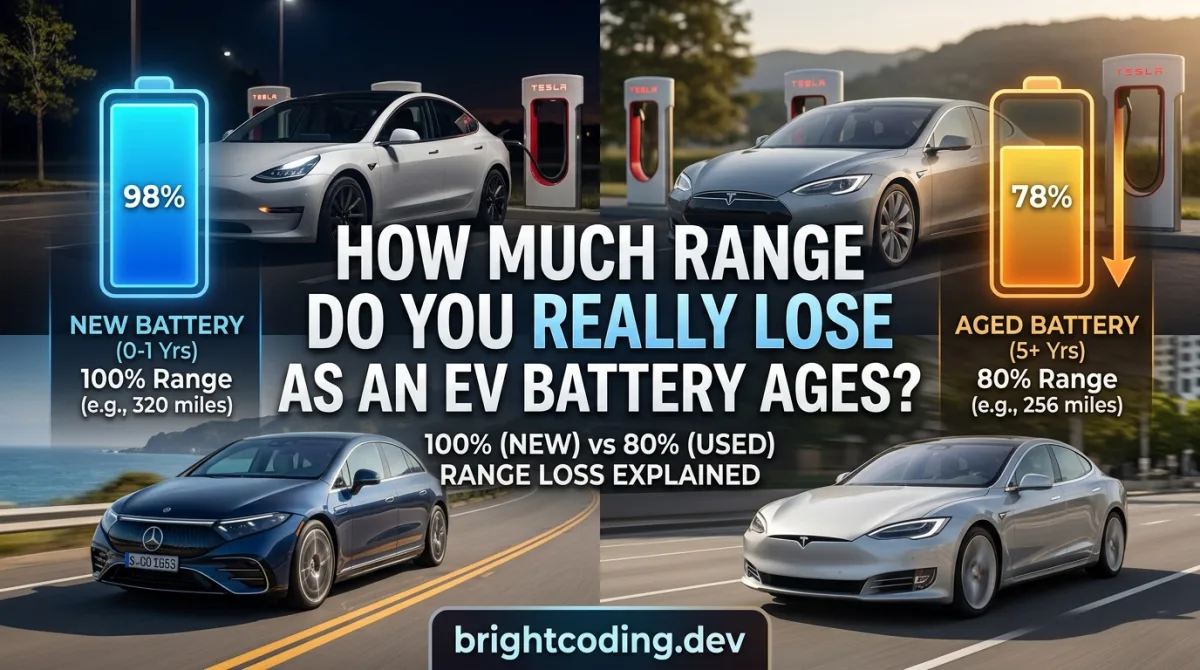
Rough bands, and treat these as cautious guides rather than rules: a few percent in the first year or two is common; somewhere in the region of 5-15% after 5 years is not unusual for a well-treated car; beyond roughly 20-30% you should start asking hard questions. These figures vary enormously by brand, climate and charging behavior, so verify against your warranty and owner community.
Red flags that suggest a problem rather than ageing:
- A sudden drop, not a gradual one.
- One module or cell group reading far out of line with the rest.
- Range that falls faster in the cold than the same model owned by a friend.
- A car that refuses to charge past a certain percentage.
- Warning lights, reduced power messages, or the vehicle limiting acceleration.
If you see any of these, stop guessing and get it diagnosed. Our EV troubleshooting guides and the diagnostic and fuse guides walk through common symptoms in a safe order. Anything involving the high-voltage pack itself goes to a qualified technician. No exceptions.
Step 6: Slow the decline from here
You cannot reverse capacity loss. You can absolutely influence the rate.
Keep the pack in the middle of its range for daily use, often 20-80%. Save 100% for trips where you need it, and do not leave it sitting full for days. Avoid DC fast charging as your default when a slower charger is available. Do not park a hot pack in direct sun all summer if you can avoid it. If your vehicle is going to sit for months, store it around 50%, not empty and not full.
Practical tip: check whether your car has a charge limit setting and actually use it. Many owners never touch it and then wonder why the pack is tired at four years old.
Pro tips
- Measure at the same temperature every time. Cold weather can knock a chunk off usable range on its own, and it will look exactly like degradation.
- Use a route with a known elevation profile. A hilly loop makes your numbers noisy.
- Reset your trip meter before every test, every single time. It is the easiest step to forget and the one that wastes the most time.
- If you have a fleet of two similar vehicles, test them the same day on the same route. The comparison is far more revealing than either number alone.
- On a used car, ask for the state of health reading and a charging history if the seller has one. A seller who will not provide either is telling you something.
- For scooters and e-bikes, check the charger output voltage and the connector condition before blaming the cells.
Common pitfalls
- Trusting the dashboard range estimate. It is a prediction based on recent driving, not a measurement of capacity.
- Testing in winter and concluding the battery is dying. Test in mild weather before you draw conclusions.
- Charging to 100% before every test. That skews the top of the pack and is also harder on it.
- Comparing your 6-year-old car to a new model's brochure figure. That is not a degradation measurement, that is a marketing comparison.
- Trying to "fix" a high-voltage pack yourself. Rebalancing, module swaps and BMS work are professional jobs. Low-voltage 12V checks are fine for a careful owner; traction battery work is not.
Useful resources
For quick maths on consumption, cost per kilometre and charging time, the site's free EV calculators and tools will save you a spreadsheet. For background on how packs behave over time and what owners report, the EV blog is a good place to start. Manufacturer warranty documents, your owner's manual and owner forums for your specific model are the three sources worth trusting most.
FAQ
How much range do I lose per year? There is no single number. Many cars lose a few percent in the first year or two, then decline more slowly. Climate, chemistry and charging habits move this a lot. Measure your own vehicle rather than assuming.
Does fast charging kill my battery? Frequent DC fast charging tends to be harder on a pack than slow charging, particularly in hot weather. Occasional fast charging on a road trip is normal use. Making it your daily habit is not ideal.
Can I restore lost range? You cannot restore lost capacity. You can sometimes recover range by fixing non-battery causes: tire pressure, a dragging brake, a failing 12V battery, a software update, or a bad charger.
Is a car with 85% state of health worth buying? It can be, if the price reflects it and the degradation is gradual rather than sudden. Get an independent inspection and a state of health reading before you commit.
My range dropped suddenly. Is that degradation? Usually not. Degradation is gradual. A sudden drop points to a fault, a sensor, a charging issue or a software change. Get it checked.
One last thing
Battery degradation sounds scary until you measure it. Once you have a baseline and a trend line, you stop guessing and start making decisions: whether to keep the car, whether to buy the used one, or whether to change your charging habits. Do the test this month, log the result, and repeat it in three months. That is the whole trick.