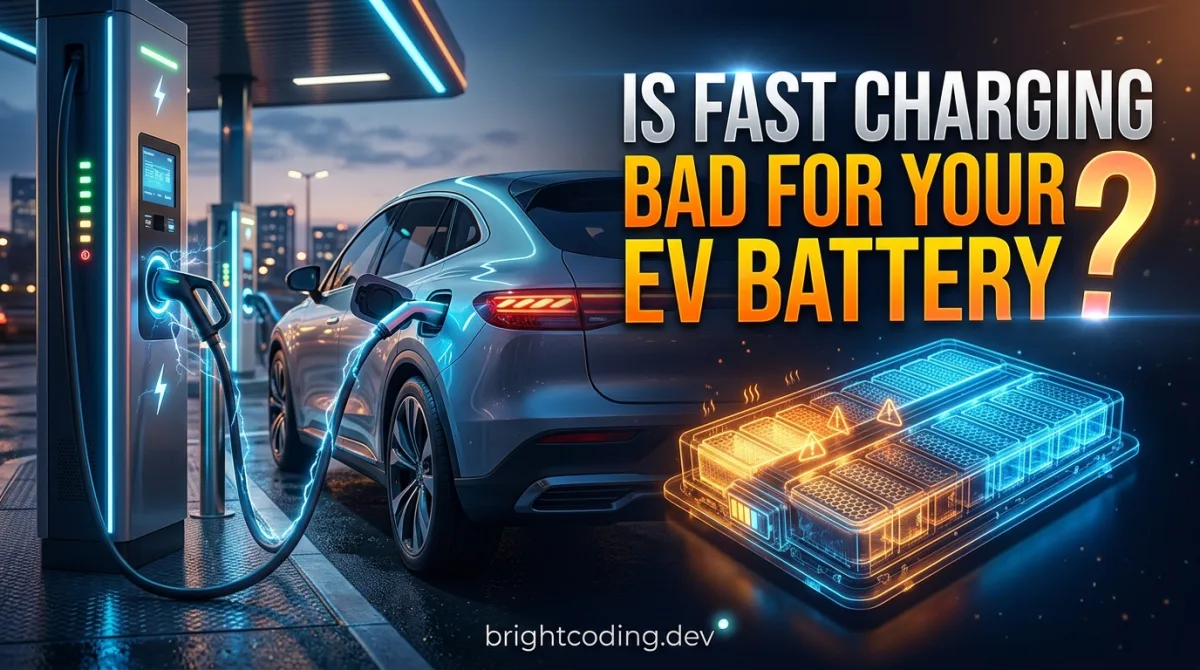
Short answer: fast charging is not automatically bad for your battery, but doing it constantly, in the heat, and on a battery that is already near full or nearly empty will wear it out faster than slow charging. The longer answer is that "bad" depends on your chemistry, your climate, and how often you actually need the speed.
If you are searching because something already feels wrong (range dropping, charge stopping early, a fault light), this guide walks through a safe diagnostic routine. You will measure the low-voltage side, learn what the numbers mean, and know exactly when to stop and hand the car to a qualified technician.
Symptom: what this actually presents as
Fast charging problems rarely announce themselves with one clean fault code. They show up as a cluster of symptoms:
- The car charges fast up to a point, then throttles hard or stops before your target state of charge.
- Range at 100% has quietly dropped over months, even though you charge the same way.
- A "charging fault", "battery temperature", or "reduced charging power" message appears on the dash or app.
- The DC session aborts after a few minutes, and a restart works only briefly.
- AC charging (Level 1 or Level 2) behaves normally while DC fast charging is unreliable.
That last pattern is your biggest clue. If AC charging is fine and DC is not, the fault is often in the DC path: the charger's communication, the inlet, the thermal management, or a protection circuit. If both are flaky, suspect the onboard charger, the 12V system, or the battery management system (BMS).
On e-bikes, scooters, and mopeds, the same story plays out at smaller scale: a fast charger that runs hot, a pack that sags under load, or a BMS that cuts off early.
Safety first
Stop and read this before you touch a multimeter.
High-voltage traction battery work is for qualified technicians only. On a full-size EV, the traction pack runs in the hundreds of volts DC and can kill you. Do not open the pack, do not remove the orange high-voltage cables, and never probe a live high-voltage connector. If your diagnosis points inside the pack, your job ends here.
The work a careful owner can safely do is low-voltage (12V) diagnostics: checking the auxiliary battery, fuses, and the charger's control wiring. Even then, isolate the circuit first: turn the vehicle off, remove the key or fob, wait the manufacturer's specified time for capacitors to discharge (often 5-10 minutes, confirm it in your manual), and disconnect the 12V negative terminal before probing.
The articles in our EV troubleshooting guides cover isolation routines for common platforms if you want a walk-through.
What you need
- A digital multimeter you trust, ideally with a 10A DC current range.
- The vehicle's fuse map and the specified 12V battery voltage range (usually around 12.4-12.8V resting, 13.5-14.5V while charging, but confirm your exact figure in the manual).
- Insulated gloves and eye protection.
- The manufacturer's charging specifications, which list the expected DC charge curve and temperature limits for your model.
You are measuring DC volts on the 12V system and, if you go further, resistance across fuses. Do not measure resistance on a live circuit. Ever.
Measurement steps
Work in this order. Each step is safe on its own; stop if anything looks burned, swollen, or smells like hot plastic.
- Visual check. Look at the charge port, the inlet pins, and the cable connector. Look for scorch marks, melted plastic, green corrosion, or bent pins. Any of those means stop, do not charge, and book a technician.
- Resting 12V battery voltage. With the vehicle off and rested, probe the 12V battery: red probe on positive, black on negative. Expect roughly 12.4-12.8V. Below about 12.0V suggests a weak or discharged auxiliary battery, which can throw charging faults.
- Charging 12V voltage. Turn the vehicle on (or start AC charging, whichever your manual allows) and re-measure. You should see the DC-DC converter lift the system to roughly 13.5-14.5V. If it stays at resting voltage, the converter or its fuse may be at fault.
- Fuse continuity. With the circuit isolated and the 12V negative disconnected, pull the fuse that feeds the charge port or onboard charger (check your fuse map, ratings vary by model). Set the meter to resistance or continuity. A good fuse reads near 0 ohms and beeps. An open fuse reads OL or infinite.
- Charge port control pins (if accessible and safe). Some vehicles expose low-voltage communication pins at the inlet. With everything off, you can check for expected resistance or continuity to ground, but only if your service manual gives a target value. If it does not, skip this step. Guessing here is how people damage modules.
- Retest after any fix. Reconnect the 12V negative, clear the fault by cycling the vehicle if your manual says so, and log one slow charge and one fast charge. Watch the charge curve in the app.
If you want a quick way to compare your observed charge times against what your model should do, the free EV calculators and tools can help you sanity-check the numbers.
What the reading means
- 12V resting at 12.4-12.8V, rises to 13.5-14.5V when on: the low-voltage side is healthy. Your fast-charge issue is almost certainly in the high-voltage or thermal system. Stop here.
- 12V resting below 12.0V: weak auxiliary battery. This alone can cause charging aborts and phantom faults on many EVs.
- No rise when the vehicle is on: DC-DC converter, its fuse, or its control circuit is suspect.
- Fuse reads OL or infinite resistance: the fuse is blown. Replace it with the exact same rating from your fuse map, never a higher one.
- Fuse reads near 0 ohms: the fuse is good, so the fault is downstream. Do not keep swapping fuses hoping it fixes itself.
- Charge port shows heat damage or corrosion: do not charge. This is a fire risk. Technician time.
Likely causes, most to least likely
- Heat and repeated DC sessions. Battery temperature is the single biggest factor in fast-charge wear. Charging a hot pack repeatedly accelerates capacity loss.
- Charging to 100% on DC regularly. The last 10-20% is where the battery works hardest. Many owners see faster degradation from this than from the DC rate itself.
- A weak 12V auxiliary battery. Unsexy but extremely common. It causes aborts, resets, and fault codes that look like bigger problems.
- Blown fuse in the charge or converter circuit. Often a symptom of something else, so find the cause before replacing.
- Thermal management faults. A failing coolant pump, fan, or sensor makes the BMS throttle or stop DC charging.
- Charge port or cable damage. Corrosion, bent pins, or a worn latch.
- Software or BMS calibration. Sometimes a firmware update changes the charge curve, or the BMS needs a recalibration cycle.
- Genuine cell degradation. The least likely cause of a sudden change, and the one you cannot fix yourself.
Fix or next step
If you found a weak 12V battery, replace it with the correct specification and retest. If a fuse is blown, replace it with the identical rating and then ask why it blew: a fuse that fails twice is telling you something.
For everything else, your next step is a scan tool or a dealer visit. Modern EVs log charging faults in the BMS with timestamps and temperatures. A technician can pull that history in minutes, which beats weeks of guessing.
If you are still shopping and want to know which models handle DC fast charging gracefully, the head-to-head EV comparisons break down real charging behavior, and the EV model directory lets you filter by chemistry and charge rate.
When to see a professional
Stop and call a qualified technician if any of these apply:
- You see scorch marks, melted plastic, swelling, or smell burning near the charge port or pack.
- The vehicle throws a high-voltage isolation fault or a battery temperature fault.
- You need to open the traction pack, replace a high-voltage cable, or work near orange wiring.
- A fuse blows twice.
- DC charging aborts repeatedly despite a healthy 12V system.
- Your range drops sharply over a short period, which can indicate cell failure.
For low-voltage fuse and battery checks, our EV diagnostic and fuse guides go deeper without crossing into high-voltage territory.
FAQ
Does fast charging permanently damage my battery? Not by itself. The damage comes from heat, from frequent charging to 100% on DC, and from doing both together. Occasional DC sessions on a cool pack are fine for most modern EVs.
Should I avoid fast charging entirely? No. Use it when you need it. For daily driving, slow AC charging at home is gentler and cheaper. Save DC for road trips and top-ups.
Why does my car slow down after 80% on a fast charger? That is by design. The BMS tapers current to protect the cells as they fill. It is not a fault.
Can a bad 12V battery really cause fast-charge failures? Yes, and it is one of the most common causes of odd charging behavior. Check it first, it is a cheap fix.
Is fast charging worse for e-bikes and scooters? The same rules apply at smaller scale: heat and high states of charge cause the most wear. Use the charger that came with the pack, and let it cool before charging after a hard ride.