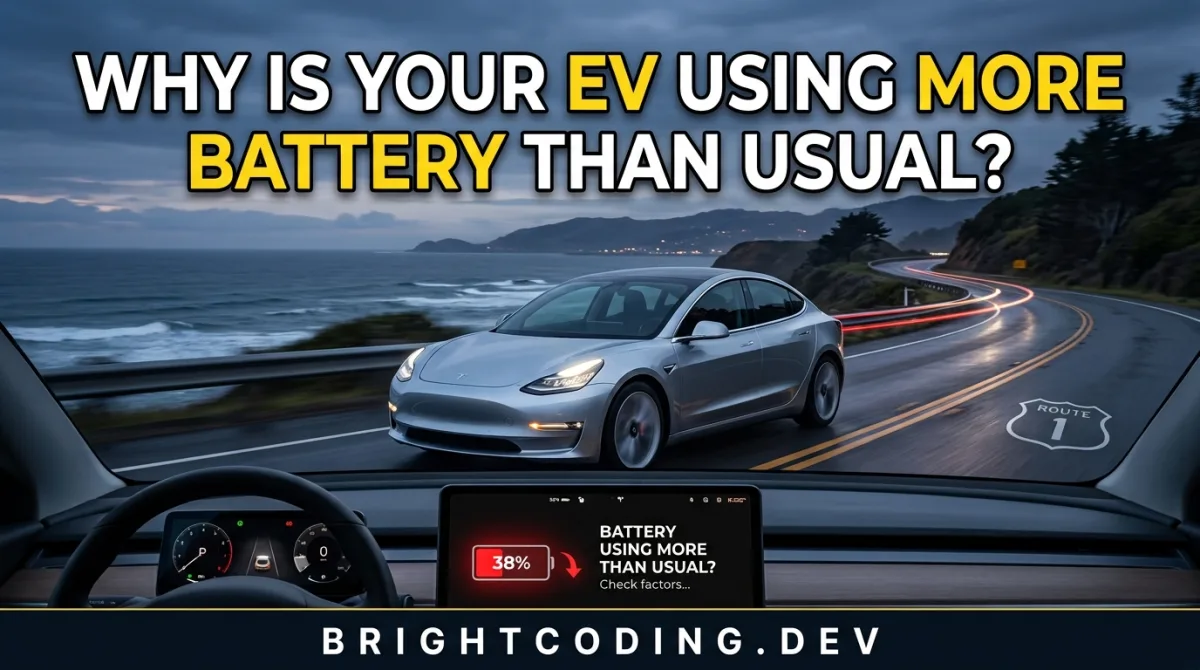
Your range dropped. Nothing broke, nothing flashed on the dash, but the same commute now eats 30 percent instead of 20. That gap between what you expect and what the battery actually delivers is where most EV owners start guessing, and guessing gets expensive.
This article walks through the mistakes that quietly drain your pack. Fix the ones that apply to you and you will usually claw back most of the lost range without touching a single component.
Why most people get this wrong
The first instinct is to blame the battery. It is the biggest, most expensive part, so it must be the culprit. In practice, the pack is often the last thing at fault. Riding style, temperature, tire pressure and a slow 12V drain explain most complaints.
The second mistake is comparing today's range to a number you remember from a mild spring day six months ago. Batteries do not perform the same in January as they do in June, and a memory is not a baseline. You need a repeatable route and a repeatable driving style before any comparison means anything.
Third, people treat every vehicle the same. A 500W e-bike, a 60V scooter and a 75 kWh car have completely different weak points. What drains a moped will not drain a crossover, and advice that ignores the vehicle type is usually wrong.
1: Blaming the battery before you check anything else
A reader emailed about his e-bike losing a third of its range in a month. He had already priced a replacement pack. The actual cause was a rear brake pad rubbing the rotor after a wheel change. The motor was fighting drag the whole time.
People jump to the battery because capacity loss is the scary story they have heard. It is also the hardest thing to test and the most expensive to replace, so it becomes the default suspicion.
The consequence is spending hundreds on a pack that was fine while the real fault, a dragging brake, a soft tire, a bad bearing, keeps eating energy. Check the cheap mechanical stuff first: spin the wheels, feel for drag, check tire pressure. If the vehicle rolls freely and pressures are correct, then start looking at the electrical side.
2: Measuring range on one trip in one set of conditions
You drove to a client site on a cold morning, into a headwind, with the heater on, and arrived with less range than usual. That single trip tells you almost nothing.
Humans are terrible at remembering conditions. You remember the number, not the 4°C temperature, the wind, or the fact that you were running late and driving harder than normal.
The fix is boring but it works: pick a fixed route, drive it the same way, and log the consumption figure your vehicle reports over several runs. Only a trend across repeated, similar trips is worth acting on. If you are comparing two models and wondering which one is genuinely thirstier, our head-to-head EV comparisons lay the criteria out side by side so you are not relying on memory.
3: Ignoring temperature, then panicking when winter arrives
Cold weather reduces usable capacity and increases internal resistance, so the same trip costs more energy. This is normal chemistry, not a fault. A cautious expectation is a noticeable range drop in cold conditions, with the exact figure depending on your vehicle and how you heat it, so verify against your own logs rather than a number you read somewhere.
People panic because nobody warned them, or because they compare a December commute to a July one. Cabin heating and battery heating both draw real power, and on a scooter or e-bike the cold also stiffens grease and reduces tire pressure.
Avoid the panic by planning for seasonal variation. Precondition while plugged in where your vehicle supports it, park in a garage if you can, and accept that winter range is simply lower. If your range is worse than the season explains, that is when you investigate further.
4: Riding or driving harder than you think
You do not feel the difference between a gentle pull away and a hard one, but the pack does. Aggressive acceleration, high sustained speed and constant stop-start traffic all raise consumption, sometimes dramatically.
The reason is simple: energy use climbs steeply with speed and with every hard launch. On a scooter or motorcycle, holding full throttle uphill is one of the biggest range killers there is.
Try this for one week: accelerate smoothly, ease off earlier for stops, and hold a steady cruise instead of surging. Most riders recover meaningful range without changing anything mechanical. It costs nothing and it is the fastest test you can run.
5: Overlooking tire pressure, load and drag
Soft tires are silent thieves. Under-inflation raises rolling resistance, and on a heavy e-bike or scooter the effect is bigger than most people expect. Add a loaded rack, a passenger, or a roof box and the picture gets worse.
Owners skip this because a tire that looks fine at a glance can still be well below the recommended pressure. Pressure also falls naturally in cold weather, so a slow loss compounds in winter.
Check pressures monthly against the figure on the tire or in the manual, and check them cold. Take off accessories you are not using. If you carry a lot of weight regularly, expect higher consumption and plan for it rather than treating it as a mystery.
6: Charging habits that quietly cost you capacity
Leaving a pack at 100 percent for days, or running it to empty repeatedly, is hard on lithium cells over time. So is charging a hot pack straight after a hard ride on a scooter or motorcycle.
People do it out of convenience or because they think topping up to full every night is "best practice". For many chemistries it is not, and the damage shows up as gradual capacity loss rather than an overnight failure.
Follow the manufacturer's guidance for your specific vehicle. As a general habit, avoid long stretches parked at full or at zero, and let a hot pack cool before charging. If you want a structured way to track how your usable capacity changes over months, the free EV calculators and tools can help you work the numbers.
7: A slow parasitic drain you never noticed
Something is drawing power while the vehicle sits. A stuck relay, a USB charger left plugged in, an alarm, a tracker, or a failing 12V battery on a car can all pull the main pack down over days.
This one is sneaky because the loss happens when you are not looking. You notice it as "the car loses range overnight" or "the scooter is always a bit lower than I left it".
On a car, a weakening 12V battery is a common culprit and it is worth testing. That is low-voltage work a careful owner can approach with a multimeter. Our EV diagnostic and fuse guides walk through safe 12V checks. Anything involving the high-voltage traction pack is a different matter entirely and belongs with a qualified technician, no exceptions.
8: Comparing your range to someone else's
A friend with the "same" model gets better range. So what? Different route, different weight, different tires, different climate, different software version. Even two identical cars from the same year can behave differently.
This mistake is psychological, but it leads to real spending. People chase a fault that does not exist because a stranger on a forum posted a bigger number.
Use your own history as the benchmark. If your range is stable across similar conditions, your vehicle is fine regardless of what anyone else reports. If you are genuinely shopping and want to compare models on equal footing, start from the EV model directory and compare real criteria.
9: Skipping software and firmware updates
Updates sometimes change how a vehicle manages charging, thermal behaviour and range estimates. A car or connected scooter that has not been updated for a year may simply be reporting or managing energy differently.
Owners skip updates because they are inconvenient or they fear change. Then they compare their range against figures from newer vehicles and assume something is broken.
Check for updates on a sensible schedule and read what changed. If range drops right after an update, that is useful information, and the EV troubleshooting guides can help you decide whether it is a bug or just a new, more honest estimate.
Do this instead
Set a baseline before you diagnose anything. Same route, same driving style, several runs, written down.
Check the simple mechanical things first: tire pressures, brake drag, wheel bearings, excess load.
Match your expectations to the season. Cold means less range, and that is normal.
Smooth inputs beat hard acceleration every time, on every vehicle type.
Follow the maker's charging guidance and avoid parking at full or empty for long periods.
Test the 12V system on a car if you suspect a slow drain, and leave the high-voltage pack to a professional.
Keep software current and read the release notes.
FAQ
Is a sudden range drop always the battery? No. In most cases it is conditions, driving style, tire pressure, drag or a slow parasitic drain. Battery degradation is usually gradual, so a sudden change points elsewhere first.
Does cold weather permanently damage my range? Cold reduces usable range while it lasts, but it does not usually cause permanent loss on its own. Some of the loss returns as temperatures rise. Verify with your own logs rather than assuming the worst.
Can I test the high-voltage battery myself? No. Traction packs carry lethal voltages. Diagnose the low-voltage side if you are confident, and take any high-voltage concern to a qualified technician.
Why does my range estimate change even when my driving does not? Estimates are based on recent history, temperature and software logic, so they drift. Treat the estimate as a guide and rely on your own logged consumption for real comparisons.
Could a new update have reduced my range? It can change how range is calculated or managed. Note the date, watch your logged consumption, and if the change is large, ask the manufacturer.
A range drop is usually a handful of small, fixable things rather than one dead pack, so measure first, fix the cheap stuff, and only then suspect the battery.
Ready to act on what you just read? Explorethe EV model directory, head-to-head EV comparisons or the free EV calculators and tools. The rest of this site is built to help you take the next step.