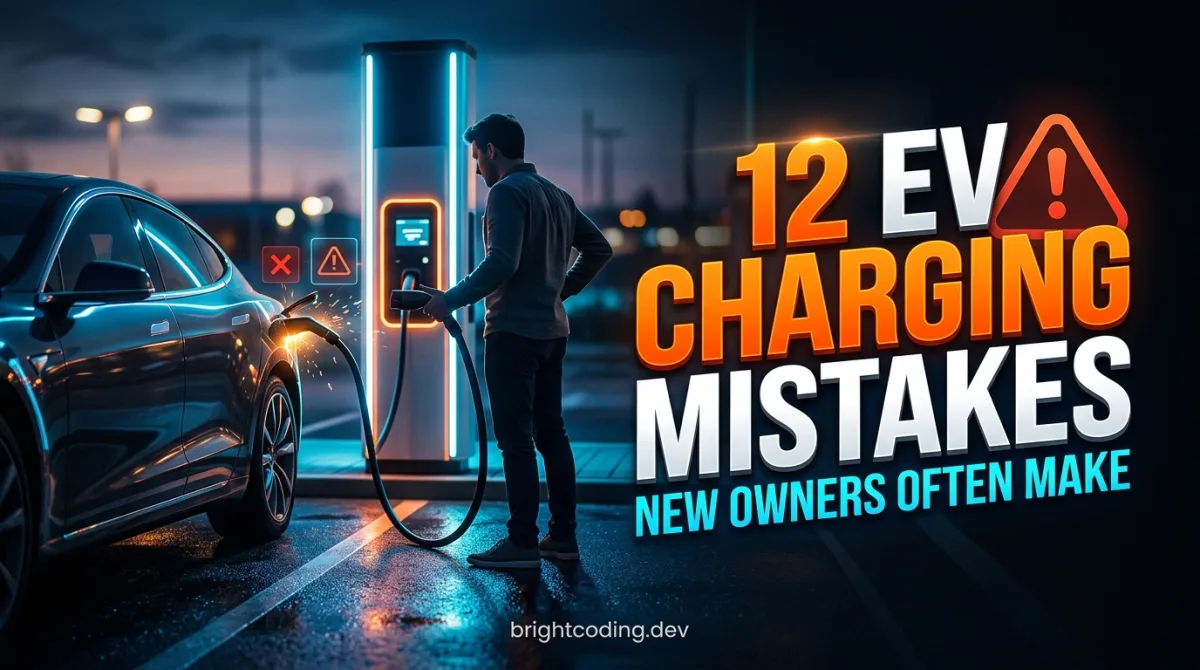
You bought an EV. You plugged it in. Something beeped, a light turned orange, and now you are standing in your driveway at 11pm wondering if you just broke a $40,000 car. Relax. Most charging mistakes are cheap to fix and easy to avoid once you know what they are.
This article is for anyone who just took delivery of an electric car, scooter, e-bike, motorcycle or moped, or who is still comparing models and wants to know what daily charging actually looks like. We will skip the marketing fluff and cover the mistakes that actually cost people time, range and money.
Why most people get this wrong
Nobody teaches you this. A dealership spends twenty minutes on the infotainment screen and hands you the keys. A scooter shop hands you a charger and a shrug. So you fall back on phone habits: charge to 100% every night, plug in whenever, assume all cables are the same.
The other half of the problem is that "EV" covers wildly different machines. A 2kW e-bike charger and a 150kW DC fast charger share a word and almost nothing else. Advice that is perfect for a Nissan Leaf can wreck a moped battery.
So here are nine mistakes I see over and over. The title says 12, and you have already spotted that. Nine is the honest number. Padding it to twelve would just waste your time.
1: Treating every charge as a full charge
You top up to 100% every single night because that is what you did with your phone. Six months later your range estimate is quietly shrinking.
Lithium batteries age fastest when they sit at full charge, especially in heat. That is true whether you drive a car or a commuter scooter. For daily use, most owners are better off living between roughly 20% and 80%, and saving the full charge for the day you actually need the range.
If your car has a charge limit setting, set it and forget it. If it does not, unplug when you hit your target rather than leaving it plugged in overnight.
2: Charging to 100% right before parking it for a week
You are flying out Sunday. Saturday night you charge to full, park at the airport, and come back to a car that has lost range it will not get back.
A full battery sitting idle is the worst-case scenario for calendar aging. If you are leaving a car or e-bike unused for more than a couple of weeks, aim for somewhere around the middle, roughly 40-60%, and store it cool if you can. Check your manual, because some manufacturers give specific storage guidance.
3: Assuming all public chargers fit your car
You pull up to a shiny new rapid charger, plug in, and nothing happens. The connector is right. The car is fine. The charger just speaks a different language.
Different regions use different standards, and even within one country you will find AC and DC, different plug shapes, and chargers that need an app before they will release the cable. Before a long trip, plan your stops rather than hoping. Our head-to-head EV comparisons list charging connectors and speeds side by side if you are still shopping.
4: Ignoring the difference between AC and DC
You hear "fast charging" and assume all fast chargers are equal. They are not.
AC charging uses the charger built into your car, so your car's onboard unit sets the ceiling. DC charging bypasses it and talks directly to the battery. A car that charges brilliantly on DC might crawl on AC, or the reverse. That is a spec worth checking before you buy, not after.
This matters most for people who cannot charge at home and rely on public AC posts overnight.
5: Buying the cheapest cable you can find
A bargain charging cable feels like a win until it overheats, trips a breaker, or refuses to talk to your car.
Cables have current ratings, and a cable rated for lower current will charge slower or not at all. Buy a cable rated for your vehicle's maximum AC current, from a reputable brand. If a cable is warm to the touch during charging, stop using it. Warm is not normal.
6: Charging in the rain without a second thought
Most modern connectors are designed to be safe in wet weather, and outdoor charge points are built for it. So the rain itself is usually fine.
The real risk is the DIY end: frayed cables, cracked housings, adapters from unknown sellers, and extension leads dangling in a puddle. Inspect your cable ends. If the insulation is damaged anywhere, replace it. Do not "just be careful".
7: Leaving a scooter or e-bike battery on the charger for days
E-bike and moped chargers are often dumb bricks with a light that goes green. Green does not always mean the charger has fully stopped working.
Leaving a small battery plugged in for days on end adds heat and stress for no benefit. Charge it, unplug it, ride it. If your charger is genuinely warm hours after the light went green, something is wrong and it is worth getting checked.
8: Never checking what your charging actually costs
You assume home charging is cheap, and it usually is. But you have never looked at the numbers, so you do not know if a public fast charger is costing you three times as much per kilometre.
Do the maths once. Our free EV calculators and tools will work out cost per charge, cost per mile or kilometre, and what a public stop really adds. Five minutes now saves real money later.
9: Panicking when the car will not charge
It is 7am. The car is at 15%. You plug in and nothing happens. You assume the worst.
Nine times out of ten it is something boring: the cable is not fully seated, a scheduled charging timer is active, the connector has a lock that did not engage, or the charge point itself is offline. Work through the simple things before you call anyone. Our EV troubleshooting guides walk through no-charge faults step by step, and the diagnostic and fuse guides cover what to check when a fault light stays on.
If you have checked the obvious causes and the car still refuses to charge, stop. Do not open the high-voltage battery pack, do not poke at orange cables, and do not "test" anything with a multimeter unless you are trained. High-voltage work is a qualified technician's job, every time.
Do this instead
Keep it simple and consistent.
- Set a daily charge limit around 80% if your vehicle allows it, and charge to full only before long trips.
- For storage beyond a couple of weeks, leave the battery around the middle, not at 100%.
- Match your cable to your vehicle's current rating, and replace anything damaged or unusually warm.
- Plan long trips around connectors you know your car accepts.
- Unplug small e-bike and moped batteries once charging finishes.
- Run the cost numbers once so you know what home and public charging really cost you.
- When charging fails, check the boring stuff first: cable seating, timers, connector lock, app status.
- Leave anything involving the high-voltage pack to a qualified technician.
If you are still choosing between models, browse the EV model directory and compare charging specs before you commit. It is much easier than discovering the limits afterwards.
FAQ
Can I leave my EV plugged in overnight?
Yes, for most cars, especially if you have set a charge limit. The vehicle manages the session. The mistake is leaving it at 100% for days, not being plugged in overnight at a sensible level.
Is it bad to use fast chargers all the time?
Occasional DC fast charging is fine and is exactly what it is designed for. Relying on it daily, especially in hot weather, adds stress compared with slower home charging. If you can charge slowly at home most nights, do that.
Why does my car charge slower than the charger's rating?
Several reasons: your car's onboard charger limit on AC, the battery being cold or hot, the state of charge being high, or the charger sharing power with another vehicle. A charger's headline number is a maximum, not a promise.
Should I charge to 100% before a long trip?
Yes, this is one of the good times to do it. Charge fully shortly before you leave so the battery does not sit at 100% for long, and plan your stops so you arrive with a sensible buffer.
My e-bike charger stays warm after the light turns green. Is that normal?
A little warmth during charging is expected. Heat that persists long after the light goes green is not. Unplug it and have the charger checked, because a failing charger is a fire risk.
Charging well is mostly about doing less: fewer full charges, fewer days on the plug, and a bit more attention to the boring details.