You just bought an EV, or you are about to, and someone has already told you that charging at home on a normal wall socket is fine, while someone else insists you need a 7 kW wallbox, and a third person says neither matters because DC fast charging exists. All three are right, for different lives. The real question is not which one is "best", it is which mix of the three fits how you actually drive.
Three criteria decide almost everything: how many kilometres you cover on a typical day, whether you can park next to a power source overnight, and whether you ever drive beyond the range of your car in a single trip. Get those three honest answers and the charging decision mostly makes itself. Everything below is about comparing those trade-offs, not selling you the most expensive option.
Level 1: the socket you already own
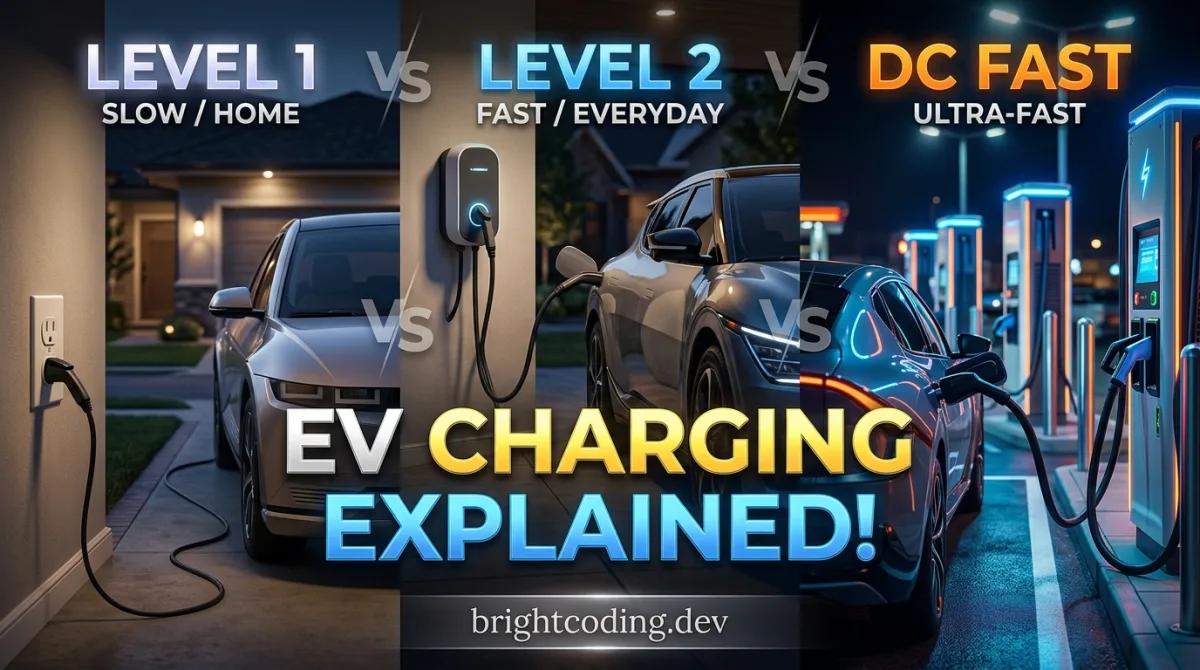
Level 1 is charging from a standard household outlet. In Europe that is typically 230V at 10A, giving roughly 2.3 kW; in North America it is 120V at 12-16A, around 1.4-1.9 kW. Treat these as typical ranges, not guarantees, because the actual current depends on your circuit, the plug and the cable supplied with the car.
What that means in practice: expect roughly 8-15 km of range added per hour for an efficient car, and less for a heavy SUV or a van. Over a 10-hour overnight park, that is broadly 80-150 km. For a small city EV, a scooter or an e-bike charged from a normal socket, this is genuinely enough.
Pros: zero installation cost, works anywhere with a socket, no electrician, no landlord permission, and it is the gentlest thing you can do to the battery because the current is low and the pack stays cool.
Cons: painfully slow for long-range cars. If you arrive home at 10 percent and need to leave at 80 percent in the morning, a big-battery EV will not make it. Old wiring, extension leads and shared circuits are a real fire risk, and a socket that is not on a dedicated circuit can trip a breaker mid-charge. Never run a Level 1 charge through a coiled extension cable.
Level 2: the home wallbox most owners end up with
Level 2 is a dedicated 240V (North America) or 400V three-phase / 230V single-phase (Europe) charger, usually wall-mounted. Typical outputs run from about 3.6 kW to 11 kW for home units, with 7.4 kW being a very common single-phase figure and 11 kW common on three-phase. The car's onboard charger is often the limiting factor: many models accept only 7.4 kW or 11 kW on AC even if the wallbox can deliver more. Check your car's onboard charger rating before buying anything.
At 7.4 kW you are adding roughly 35-50 km of range per hour for a reasonably efficient car. That turns an overnight stop into a full tank for almost any daily-use pattern. A 60 kWh pack that is nearly empty usually refills in 8-10 hours, which fits neatly into a night's sleep.
Pros: fast enough that you stop thinking about charging, cheaper per kWh than public DC if you have a favourable home tariff, schedulable to off-peak hours, and safer than a socket because it is a fixed, protected installation.
Cons: you need off-street parking and, in many cases, permission if you rent. Installation cost varies enormously with cable run length, whether your consumer unit needs upgrading, and local incentives, so get two quotes rather than trusting a number from a forum. And if you move house, the wallbox usually stays.
DC fast charging: for the days you go far
DC fast charging bypasses the car's onboard charger and feeds the battery directly, which is why it can deliver 50 kW, 150 kW, 250 kW or more depending on the car and the charger. The important caveat: the car's peak DC rate only holds for part of the session. Above roughly 80 percent state of charge, most EVs taper hard to protect the pack, so the last 20 percent can take as long as the first 60.
In real terms, a 10-80 percent stop on a modern EV commonly takes anywhere from about 18 minutes to 45 minutes, and older or smaller-battery cars can take considerably longer. Do not trust a single peak kW figure on a spec sheet; look for a charging curve if you can find one, or ask owners of that model.
Pros: the only practical way to do long journeys, and the only option if you have no home charging at all. Networks are far denser than they were five years ago on major corridors.
Cons: it costs the most per kWh, it is the hardest on the battery over years of repeated use, and reliability is uneven. A charger can be occupied, derated, or broken, and a 50 kW unit shared between two cars delivers less to each. Cold weather slows DC charging noticeably. Plan longer trips with a backup stop in mind, especially in winter.
Side-by-side comparison
| Criterion | Level 1 (household socket) | Level 2 (home wallbox) | DC fast charging |
|---|---|---|---|
| Typical power | ~1.4-2.3 kW | ~3.6-11 kW | 50-350+ kW |
| Range added per hour | Roughly 8-15 km | Roughly 20-50 km | Full 10-80% in ~18-45 min on modern EVs |
| Best use case | Small EVs, e-bikes, scooters, low daily mileage | Overnight home charging, most owners | Long trips, no home charging |
| Installation cost | None | Varies widely, get quotes | Built into public pricing |
| Cost per kWh | Usually cheapest (home tariff) | Usually cheapest (home tariff) | Typically the most expensive |
| Battery wear | Very gentle | Gentle | Highest, due to heat and high current |
| Availability | Anywhere with a socket | Needs off-street parking | Depends on network and region |
| Reliability | High, but wiring matters | High once installed | Uneven; check status before relying on it |
| Weather sensitivity | Mild | Mild | Noticeable, especially cold |
If you are still deciding which car to plug in at all, the EV model directory lets you filter by battery size and charging capability, which is exactly the spec that decides whether Level 1 is viable for you. Comparing two shortlisted cars? The head-to-head comparisons put AC and DC figures side by side.
Which one should you choose?
City commuter, under 50 km a day, small EV: Level 1 is often genuinely enough. Plug in every night and stop worrying. Add a wallbox later if your mileage grows.
Long-distance driver: Level 2 at home plus DC fast charging on the road. There is no way around this, and the home wallbox is what makes the DC stops rare and short.
Family with two cars and one charger: Level 2, sized for the larger battery. A single 7.4 kW unit can top up both cars overnight if you stagger them, but check each car's onboard charger rating first.
First EV, renting, no off-street parking: DC fast charging plus workplace or destination charging. Budget more per month for energy, and be honest with yourself about the time cost.
Tight budget: Level 1 plus occasional DC. You save the installation cost and pay a bit more on road trips. It works, but only if your daily distance is modest.
E-bike, scooter or moped owner: Level 1 is the normal answer, and the battery is small enough that charge times are short. See the troubleshooting guides if a charger behaves oddly, and the diagnostic and fuse guides before you start poking at wiring yourself.
To work out what your own numbers look like, the free EV calculators and tools will turn your daily distance and tariff into a cost per month, which is far more useful than any rule of thumb here.
Verdict
For the common case, a private owner with off-street parking and a car they drive most days, Level 2 wins. It is the only option that makes charging invisible: plug in, wake up full, and use DC fast charging only on the handful of long trips a year. Level 1 is not a compromise for everyone, though. If your daily distance is small, your car has a modest battery, or you ride an e-bike or scooter, the socket in your garage is the sensible choice and a wallbox is money you do not need to spend.
DC fast charging wins outright in one scenario only: no home charging at all. In that case it is not a preference, it is your fuel supply, and you should pick a car with a strong charging curve rather than a big peak kW claim. What tips the decision the other way is simple. If you cannot park near power overnight, home charging is off the table entirely and DC becomes the default. If you can, but your daily drive regularly exceeds about 150 km, Level 1 stops being sufficient and Level 2 becomes the practical floor.
FAQ
Can I just use a normal extension lead for Level 1 charging? Only a heavy-duty, fully uncoiled cable rated for continuous current, and ideally not at all. Household sockets are not designed for hours of sustained load, and coiled or undersized leads overheat. If a socket feels warm, stop and get an electrician to check the circuit.
Does DC fast charging ruin my battery? Occasional use does not. Daily DC charging on a car with no thermal management is where degradation accelerates. Most owners who charge at home on AC and fast charge a few times a month see no dramatic effect. Follow the manufacturer's guidance, and avoid sitting at 100 percent for long periods.
How do I know what my car can actually accept on AC? Look up its onboard charger rating, not the wallbox rating. A 22 kW wallbox will still only deliver 11 kW to a car with an 11 kW onboard charger. The EV blog covers how to read these specs without getting lost.
Is a wallbox worth it if I only drive 30 km a day? Financially, usually not. Practically, it depends on whether you value never thinking about charge levels. Run the numbers with a calculator before deciding.
Why does my car charge slowly at a 150 kW station? Common causes are a cold or hot battery, a high state of charge, a shared or derated charger, or a car that simply has a lower peak. If the same station is slow every time, check the charger's status before blaming the car.
Final takeaway
Charging is not a ranking, it is a mix. Level 1 covers small batteries and short days. Level 2 makes an EV feel like an appliance for anyone with a driveway. DC fast charging exists to cover distance and to rescue people without home charging. Pick your mix from your daily distance and your parking situation, verify your car's onboard charger rating before buying hardware, and never treat a spec-sheet peak figure as a promise.