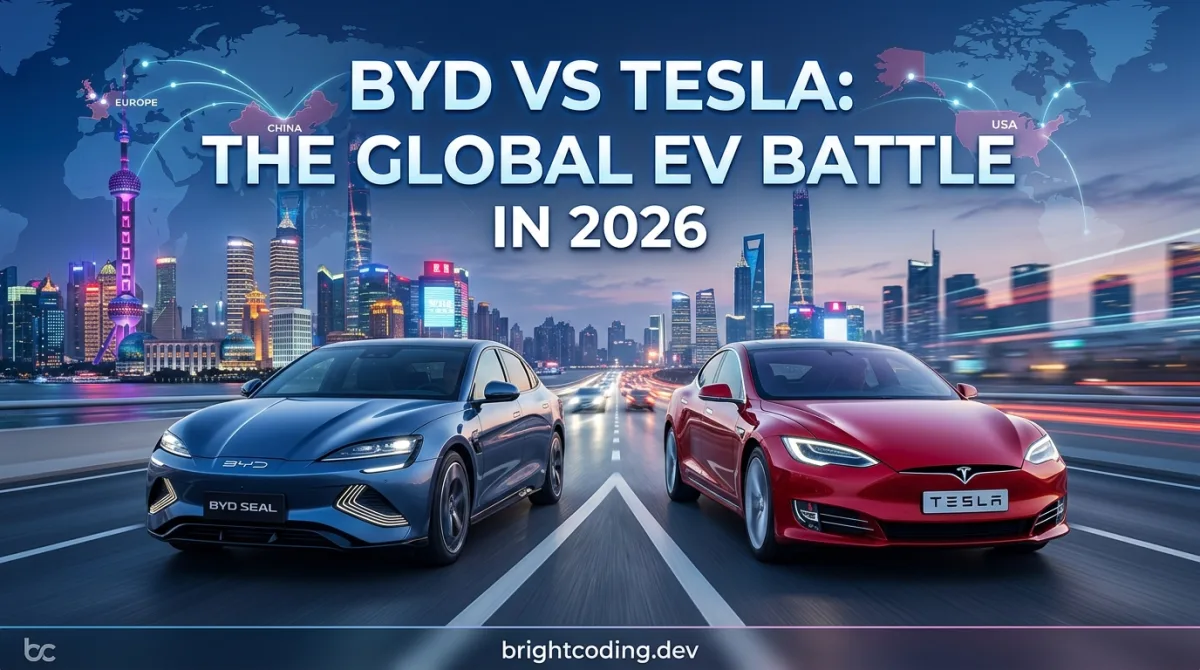
For years, Tesla stood alone at the top of the electric vehicle world. That changed in 2025, when BYD officially surpassed Tesla in global battery-electric vehicle sales for the first time. Now, in 2026, the rivalry between these two giants has evolved into the most closely watched contest in the automotive industry.
If you are trying to understand who is really winning the BYD vs Tesla battle, the answer depends on which numbers you look at, which markets you care about, and what kind of electric vehicle you want to drive. This article breaks down the latest sales data, strategies, and market shifts defining the global EV race in 2026.
How the Sales Numbers Stack Up in 2026
The headline figures shift almost every quarter, which is exactly what makes this rivalry so compelling.
In 2025, BYD sold 2.26 million battery-electric vehicles compared to Tesla's 1.64 million deliveries, giving the Chinese automaker its first annual global BEV crown.
2026 started with a twist. Tesla delivered 358,023 vehicles in the first quarter, up 6.5% year-over-year, while BYD's pure EV sales dropped 25% to 310,389 units. That briefly put Tesla back on top.
But BYD roared back in the second quarter. The company delivered 557,090 BEVs, well ahead of Tesla's 480,126. That quarterly gap of roughly 77,000 units put BYD back in the lead for pure electric volume.
For the first half of 2026 overall, BYD holds a slim cumulative edge with 867,479 BEVs sold versus Tesla's 838,149.
If you include plug-in hybrids, BYD's lead becomes overwhelming. In the first half of 2026 alone, the company sold 1.81 million new-energy vehicles in total, while Tesla remains exclusively battery-electric.
Two Very Different Playbooks
Tesla and BYD are not really playing the same game. They are competing for some of the same customers, but their business models diverge sharply.
Tesla: The Premium Software Ecosystem
Tesla's strength has always been its integrated technology stack. The company controls everything from battery management to infotainment to its Supercharger network. That vertical software integration creates a sticky user experience that keeps owners loyal and attracts buyers who prioritize technology and long-distance driving convenience.
Tesla's lineup is also deliberately narrow. The Model 3 and Model Y remain the backbone of global deliveries, with performance variants and the Cybertruck adding niche appeal. This focused approach keeps production efficient but limits Tesla's reach in price-sensitive segments.
In 2026, Tesla posted its strongest second quarter ever and reduced excess inventory by roughly 28,000 units, signaling improved demand alignment.
BYD: Volume, Vertical Integration, and Global Expansion
BYD's strategy is built on scale and cost efficiency. The company manufactures its own batteries through its Blade Battery technology, produces motors in-house, and offers vehicles across nearly every price segment. From the budget-friendly Seagull to the premium Yangwang U9 supercar, BYD covers the market in a way Tesla simply does not.
This breadth comes with trade-offs. BYD's net profit fell 18.97% in 2025 to roughly $4.7 billion, squeezed by an intense domestic price war in China and a gross margin that narrowed to 17.7%.
However, BYD's overseas business tells a different story. International sales generated a 28.1% gross margin in 2025, far above the 17.2% earned in China. That explains why the company is pushing so aggressively into Europe, Latin America, Southeast Asia, and the Middle East.
Europe: The New Front Line
If there is one market where the BYD vs Tesla rivalry is rewriting expectations, it is Europe.
In the first five months of 2026, BYD captured 2.3% of European new vehicle registrations, edging out Tesla's 2.0% share. BYD has been ahead of Tesla in European registrations every month of the year so far.
The growth is striking. In Germany, BYD registrations surged 318% year-on-year in the first half of 2026, already beating the company's full-year 2025 total by mid-year. France saw registrations jump 398% in June alone.
BYD is backing this growth with local manufacturing. Its plant in Szeged, Hungary, is set to begin series production in late 2026 with an annual capacity of 300,000 vehicles. A second plant in Turkey is also planned. Local production helps BYD sidestep tariffs and strengthens its position as a long-term European player.
What Buyers Actually Get: Value vs. Technology
For consumers, the choice between BYD and Tesla often comes down to priorities.
BYD generally wins on upfront value. Models like the Dolphin and Seal come generously equipped from the factory, with advanced driver-assistance features, comfortable interiors, and the durable LFP Blade Battery as standard. The pricing undercuts comparable Tesla models in most markets, sometimes significantly.
Tesla wins on efficiency and ecosystem. The Model 3 and Model Y consistently deliver more kilometers per kilowatt-hour, and the Supercharger network remains the most reliable fast-charging experience available. Over-the-air software updates and a minimalist, tech-forward interior appeal to buyers who view their car as a connected device.
In the family SUV segment, the BYD Seal U competes directly with the Tesla Model Y. The Seal U offers either pure electric or plug-in hybrid powertrains depending on the market, while the Model Y remains fully electric with longer range and faster acceleration.
The Bigger Picture: A Maturing Market
The BYD vs Tesla rivalry is unfolding against a backdrop of slowing global EV growth. Industry estimates project around 22.7 million EV sales worldwide in 2026, only a modest increase from 2025. That means the fight is no longer about expanding the pie. It is about capturing share from competitors.
In this environment, cost efficiency and supply chain control matter more than ever. BYD's vertical integration, from batteries to semiconductors, gives it pricing power that few rivals can match. Tesla's software and charging advantages give it defensibility in premium segments.
Both companies are also facing pressure from below. Geely, Volkswagen Group, and a wave of Chinese newcomers are all fighting for position. Tesla's share of the global BEV market sat at 13% in Q2 2026, while BYD Auto held 12%, according to Counterpoint Research. The "others" category now claims two-thirds of the market.
What Happens Next?
BYD has set a full-year target of 5.0 to 5.5 million new-energy vehicle sales for 2026, and raised its overseas export goal to 1.5 million vehicles. After selling 1.81 million NEVs in the first half, the company will need a very strong second half to hit that guidance.
Tesla, meanwhile, continues to push production efficiency and expand its energy storage business. The company is expected to provide updated guidance on upcoming earnings calls, and any new model announcements could shift momentum quickly.
The rivalry is likely to remain tight and volatile. Tesla may lead in some quarters. BYD may lead in others. What is clear is that the era of Tesla's uncontested dominance is over, and the global EV market is now a genuine two-horse race.
FAQ
Who sold more electric cars globally in 2025, BYD or Tesla? BYD sold more battery-electric vehicles in 2025, with 2.26 million BEVs compared to Tesla's 1.64 million. This was the first time BYD claimed the annual global BEV crown.
Is BYD cheaper than Tesla? Generally, yes. BYD offers a wider range of price points, from budget city cars to premium sedans and SUVs. Tesla focuses on the premium segment, with higher starting prices across its lineup.
Which brand has better technology, BYD or Tesla? Tesla leads in software integration, over-the-air updates, charging infrastructure, and energy efficiency. BYD excels in battery durability, value for money, and manufacturing vertical integration. The "better" choice depends on what you prioritize.
Are BYD cars available in the United States? Not in the passenger vehicle market. BYD currently focuses on buses and commercial vehicles in the US, while its passenger EVs are sold in Europe, Asia, Latin America, Australia, and other regions.
What is BYD's Blade Battery? The Blade Battery is BYD's proprietary lithium iron phosphate (LFP) battery design. It is known for strong safety credentials, long cycle life, and cost efficiency. BYD is now rolling out a second-generation version with faster charging capabilities.