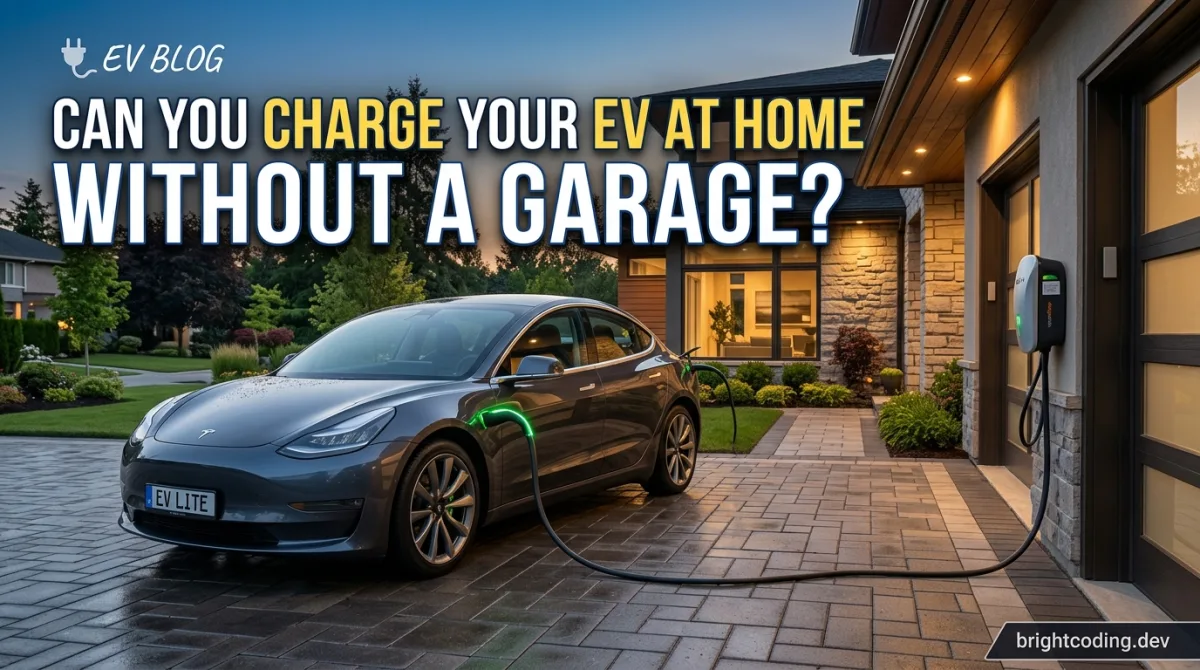
The first time I charged my car at home, I ran the cable out of the kitchen window, through the garden, and under the wheel of my neighbour's van. It rained that night. I woke up at 3 a.m. thinking about water and 230 volts and lay there for an hour doing maths in my head.
That was two years ago. The car is still here, the cable is still here, and I have not burned anything down. But it was not obvious at the start that this would work, and I want to be honest about the parts that were annoying.
Why I even tried this
I live in a terraced house with no garage, no driveway, and a single parking space on the street that I do not legally own. On a good night I get it. On a bad night I am parked forty metres away next to a hedge.
I bought the car anyway because my commute is short, roughly 30 km round trip, and I was spending too much on petrol. I told myself I would figure out charging later. That is not advice. That is just what happened.
The first month was mostly about cables
I started with what EV people call "granny charging", which is the slow cable that plugs into a normal domestic socket. Mine came with the car. It adds something like 2 to 3 kW, which on my car works out to roughly 10 to 15 km of range per hour. If you drive 40 km a day, that is fine. If you drive 120 km a day, it is not.
The socket mattered more than I expected. The first one I used was an old outdoor socket on a spur from the kitchen ring. It got warm. Not hot, but warm enough that I stopped trusting it. I had an electrician look at it, and he moved me to a dedicated circuit with its own breaker. That cost me money and I resented it at the time. I do not resent it now.
Two things I learned the hard way:
The cable should never sit in a puddle, and it should never be coiled tightly while it is carrying current. Coiled cable gets warm. Warm cable is a warning.
Also, and this is the boring bit, check the rating of the socket before you trust it for eight hours straight. A 10 A socket and a 13 A socket are not the same thing, and older wiring is not always what the label says.
The winter changed the numbers
Everything I read said charging slows down in the cold. I nodded at that and moved on. Then December arrived and my usual overnight top-up, which got me from about 30% to 80%, started landing at 55% by morning instead. Same cable, same socket, same car.
Cold batteries accept charge more slowly, and if you are preheating the cabin on the same supply, you are splitting a very small slice of power between two jobs. I stopped preheating while plugged in on the slow cable. That helped a little. Not a lot.
The honest fix was accepting that winter is a different regime. In summer I could be relaxed about planning. In winter I had to think a day ahead, the way you think ahead about putting the bins out.
Getting a proper home charger without a garage
After about four months I gave up on the slow cable as my main method and had a wall-mounted charger installed. Mine is a 7 kW unit. On my car that is roughly 30 to 40 km of range per hour, which means a proper overnight charge is genuinely overnight, not "hopefully by lunchtime".
The installation was the awkward part. The charger went on the outside wall by the front door, and the cable reaches the street only because my parking spot is close to the house. If I had to park on the far side of the road, this would not work at all. That is the real limit of no-garage charging: it is not about the car, it is about the distance from your wall to where you actually park.
If you are still choosing a car and this matters to you, it is worth checking real-world range and charge speeds rather than brochure numbers. The model directory on this site is a reasonable place to start comparing what different cars actually claim, and the head-to-head comparisons are useful if you are stuck between two.
I also ran the numbers before buying the charger, using one of the free EV calculators here, mostly to check how much of my charging I could realistically shift to cheap overnight hours. It was less dramatic than the sales pitch suggested, but it was not nothing.
When the street parking fails
Some nights I cannot park near the house. When that happens I have three options: public charging, a friend's driveway, or not driving much the next day.
Public charging near me is roughly two to three times the cost per kWh of charging at home, and the fast ones are worse. I use them maybe twice a month. It is fine. It is not cheap.
I also learned to stop treating 100% as the goal. Most of the time I charge to 80% and leave it. The car is happier, the charging is faster, and I am not waiting around for the last slow percentage points.
If something does go wrong, and it will eventually, the troubleshooting guides here have saved me a phone call more than once. A charging fault is usually a sequence of checks, not a mystery. The diagnostic and fuse guides are useful for the 12V side, which is the part a careful owner can actually inspect. Anything involving the main traction battery is not something you touch. That is a qualified technician's job, every time, no exceptions.
Honest pros and cons
What worked: I charge while I sleep, I almost never visit a petrol station, and my running costs dropped noticeably. I like walking past the car in the morning and knowing it is ready.
What did not: I think about parking more than I ever did with a petrol car. I have a cable to manage in the rain. I spent money on an electrician and a charger that a garage owner would not have needed to spend. And on the handful of nights I park far away, the whole system just does not work.
What it actually cost
| Item | Approximate cost |
|---|---|
| Electrician to check and add a dedicated circuit | Roughly £150 to £400 |
| 7 kW home charger, supplied and installed | Expect around £800 to £1,500 |
| Overnight charging, per full-ish charge | Roughly £8 to £15 depending on tariff |
| Public charging, per kWh | Often 2 to 3 times the home rate |
Prices vary a lot by country, by electrician, and by whether you need a long cable run. Treat these as ballpark figures and get a real quote.
What I would do differently
I would measure the distance from my wall to my usual parking spot before buying the car, not after. That single number decides whether any of this is practical.
I would get the dedicated circuit sorted first, before I ever plugged in overnight. I got lucky with the warm socket. I would rather not rely on luck twice.
I would buy a charger with a longer cable than I thought I needed. Mine reaches, but only just, and on the nights I park slightly further along it does not.
I would stop chasing 100%. Slower, hotter, and pointless for my driving.
I would accept that winter is a different plan, and build in a buffer from November onward instead of being surprised every year.
Quick practical tips
- Check your socket rating and get an electrician to look at the circuit before you charge overnight on a normal plug.
- Never run a charging cable through a doorway where it can be pinched, and never leave it coiled while charging.
- Charge to 80% for daily driving unless you genuinely need the full range.
- Keep the connector clean and dry, and store the cable somewhere it will not sit in water.
- If you park on the street, work out your fallback public charger before you need it, not during a flat battery.
FAQ
Can I charge an electric car at home with no driveway at all? Yes, if you can safely run a cable from a socket to where you park. Many people do this. The catch is distance, weather, and whether your parking is reliable. If you park far from your house, it is much harder.
Is granny charging safe overnight? It can be, on a properly rated socket and circuit in good condition. It is slow, and it puts continuous load on wiring that may not have been designed for it. Have an electrician check before you make it a habit.
How much slower is a normal socket than a wall charger? Very roughly, a domestic socket gives you around 10 to 15 km of range per hour, while a 7 kW charger gives you 30 to 40 km per hour. Exact numbers depend on your car. Check your own model's figures rather than trusting mine.
Do I need a garage to install a home charger? No. You need an exterior wall, a suitable electrical supply, and a cable run that reaches your car. Plenty of chargers are fitted to the outside of houses with no garage at all.
Two years in, I still unplug in the rain and still glance at the socket before I go to bed. It works. It is just a bit more of a routine than I expected, and honestly, I have grown to like the routine.
Ready to act on what you just read? Explorethe EV model directory, head-to-head EV comparisons or the free EV calculators and tools. The rest of this site is built to help you take the next step.