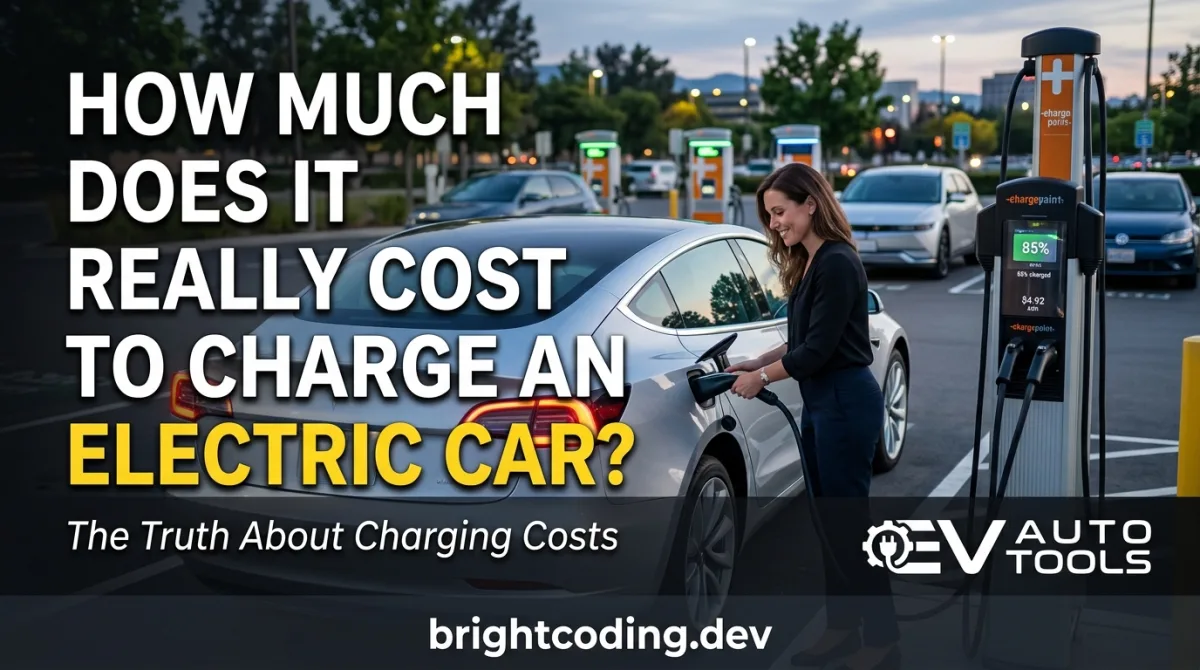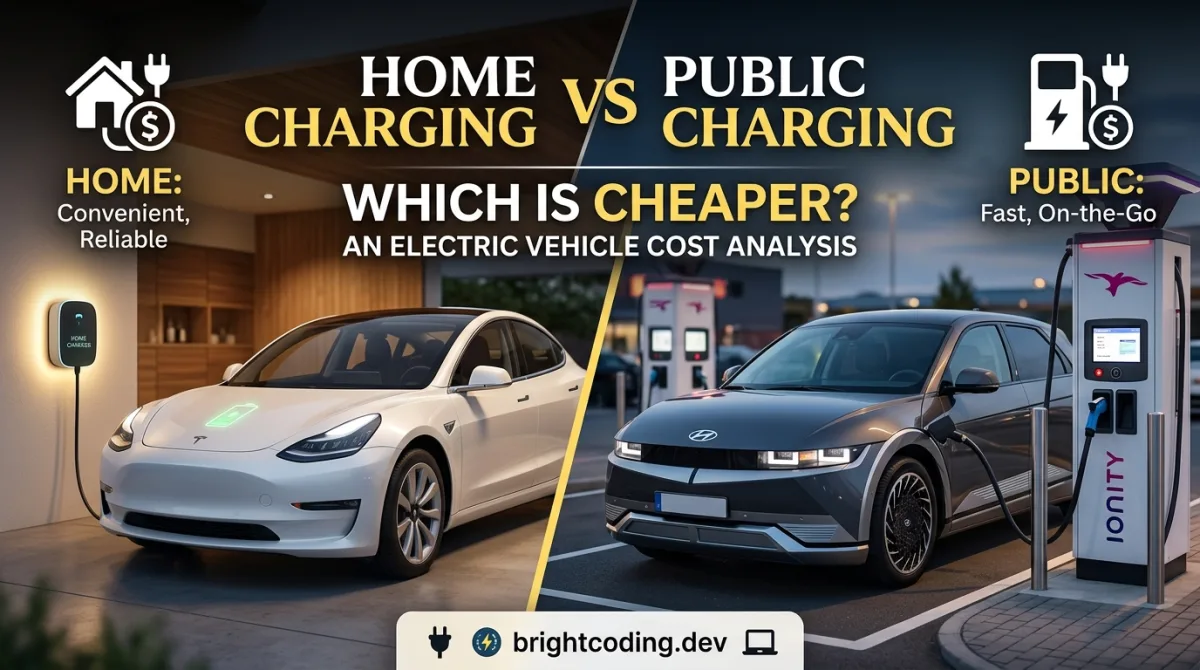
Short answer: home charging usually wins on cost, but only if you can actually charge at home and you pick the right electricity tariff. Public charging can be cheaper in a few specific situations, and it is almost always more expensive per kWh than plugging in overnight.
By the end of this guide you will know how to work out your real cost per kWh for both options, which one suits your weekly driving or riding, and how to cut your charging bill without buying anything fancy. It takes about 10-15 minutes with a calculator and your last few charging receipts.
This applies whether you drive a car, ride a scooter, or charge an e-bike or moped. The maths is the same. Only the size of the battery changes.
What you need before you start
- Your electricity bill, or access to your supplier's tariff page, so you can find your price per kWh (not the monthly total).
- An idea of your vehicle's efficiency: miles per kWh for a car, or Wh per mile for a scooter, e-bike or moped. Check your manual or the model page in the EV model directory.
- Your battery capacity in kWh (or Wh). This is on the spec sheet or the charger label.
- A charging app or two, so you can see public charging prices near you. Prices change often, so verify them yourself.
- No account needed for the maths. You can do all of this on paper or in your phone's calculator.
One warning before we go further: never open a high-voltage traction battery pack, and never work on the orange cables or the onboard charger internals. That is a qualified technician's job. Everything below is about pricing and behaviour, not opening anything up.
Step 1: Find your true home electricity price per kWh
Look at your bill and find the unit rate, not the standing charge. If you are on a flat rate, that is your number. If you are on a time-of-use tariff, you need two numbers: your daytime rate and your off-peak rate.
This matters because the whole comparison hinges on this figure. A home rate of, say, 15-30 pence or cents per kWh is common in many markets, but it varies hugely by country and by tariff, so check yours rather than trusting a number you read online.
Practical tip: if your supplier offers a cheap overnight window, write down the exact hours. Most EV owners do the bulk of their charging in that window, and it can cut the cost dramatically compared to charging whenever you get home.
Step 2: Work out your cost per mile (or per km)
Take your home price per kWh and divide it by your vehicle's efficiency in miles per kWh. That gives you cost per mile.
Example: if you pay 20p per kWh and your car does 4 miles per kWh, you pay about 5p per mile. Change the numbers to match your own tariff and vehicle. Do not copy mine.
For scooters, e-bikes and mopeds, efficiency is often quoted in Wh per mile. Divide your price per kWh by 1000 to get price per Wh, then multiply by your Wh per mile. Same idea, smaller numbers.
Why this matters: cost per mile is the only figure that lets you compare a car, a scooter and a public charger fairly. A big battery is not automatically expensive to run if the vehicle is efficient.
Step 3: Do the same for public charging
Open your charging app and find the price per kWh at the public points you would realistically use. Note that public charging often has three cost layers:
- Price per kWh.
- A connection or session fee.
- Possible idle fees if you stay parked after charging finishes.
Add the session fee into your calculation. If a charger charges a flat 1 pound or 1 dollar to start, and you only add 10 kWh, that fee alone adds 10p or 10 cents per kWh.
Public rapid chargers are usually the most expensive per kWh. Slower destination chargers, workplace charging and some supermarket points can be much cheaper, sometimes free, but do not rely on free charging as a long-term plan because it comes and goes.
Practical tip: check whether the price in the app includes tax or VAT. Some networks show it before tax, which makes the comparison misleading.
Step 4: Compare the two side by side
Now put your real numbers in a table. Here is the structure to use, with typical patterns rather than fixed figures:
| Criterion | Home charging | Public charging |
|---|---|---|
| Price per kWh | Usually lowest, especially off-peak | Usually higher, rapids highest |
| Extra fees | None beyond your bill | Session fees, idle fees possible |
| Speed | Slow to moderate (3-22 kW typical) | Slow to very fast (up to 150 kW+) |
| Convenience | Charge while you sleep | Depends on network and queues |
| Availability | Only if you have a driveway or garage | Works if you cannot charge at home |
| Wear on battery | Gentle, good for long-term health | Frequent rapid charging is harder on cells |
| Best for | Daily top-ups, most owners | Long trips, no-home-charging owners |
Fill the left and right columns with your own figures. If your home rate is high and your local public slow chargers are cheap, the gap can shrink to almost nothing.
Step 5: Factor in your real weekly mileage
Cheap per mile means little if you barely drive. Work out your weekly distance and multiply by your cost per mile for each option.
Someone doing 100 miles a week will save a modest amount by charging at home. Someone doing 400 miles a week, or a delivery rider on a scooter, will see a much bigger difference.
This is also where you spot the awkward cases. If you live in a flat with no off-street parking, home charging may simply not be available, and public charging becomes your baseline rather than a comparison.
Step 6: Add the cost of getting a home charger
A home charger is not free to install. You may need a dedicated unit, an electrician, and possibly an upgraded supply or permit. Costs vary widely by country and by how far the cable has to run, so get a local quote rather than guessing.
Then divide that upfront cost by your estimated annual saving from charging at home instead of publicly. That gives you a rough payback period in years.
Practical tip: if you only do low mileage, the payback can be long. In that case a standard household socket with a proper, safe charging cable may cover your needs, though it is slow. Always check that your socket and wiring are rated for continuous charging, and have an electrician inspect it if you are unsure.
Step 7: Decide, and plan a hybrid
Most owners end up with a hybrid: home charging for daily use, public charging for longer trips. That is usually the cheapest and least stressful setup.
If home charging is not an option, lean on the cheapest public points you can reach, charge during off-peak windows where networks offer them, and avoid idling on a rapid charger after the session ends.
If you are narrowing down which vehicle to buy, the head-to-head comparisons on this site can help you weigh battery size, efficiency and charging speed before you commit: compare EVs side by side. Efficiency matters more than battery size for running costs.
Pro tips
- Charge in your supplier's off-peak window whenever you can. This single habit often beats every other saving.
- Precondition or preheat while still plugged in, so the energy comes from the grid rather than the battery. Not every vehicle supports this, so check your manual.
- Use the slowest charger that gets the job done. Rapid charging is for journeys, not routine top-ups.
- Check your app for a per-session fee before you plug in. A short top-up at a fee-charging point can cost more per kWh than a bigger charge.
- Keep a simple note of your cost per mile each month. It makes tariff changes and price hikes obvious fast.
- If you are troubleshooting a charging fault, do not guess with high-voltage parts. Start with the troubleshooting guides and the diagnostic and fuse guides, and hand anything involving the traction battery to a qualified technician.
Common pitfalls
- Comparing total monthly bills instead of cost per kWh. One month you drive more, the next you drive less, and the comparison becomes meaningless. Fix the unit first.
- Ignoring session and idle fees. A cheap headline rate with a flat fee can be more expensive than a slightly higher rate with no fee.
- Assuming public charging is always terrible. Some workplace, destination and off-peak public rates are genuinely competitive. Check before you dismiss them.
- Forgetting installation costs. A home charger that saves you a little each month may take years to pay back. Run the numbers honestly.
- Trusting a price you saw six months ago. Public charging prices move, sometimes quickly. Verify in the app on the day.
Useful resources
For quick sums on range, cost per mile and charging time, the free EV calculators and tools do the arithmetic for you. If you are still choosing a vehicle, browse the EV model directory to compare efficiency and battery size, and read the EV blog for ownership and maintenance topics.
For general reference, your electricity supplier's tariff page and your charging network's own app are the only sources you should trust for current prices.
FAQ
Is home charging always cheaper than public charging? Almost always on a per kWh basis, assuming you have off-street parking and a reasonable tariff. But add in the cost of installing a charger and the gap narrows for low-mileage owners. Some cheap public or workplace chargers can beat an expensive home tariff.
Can I charge an e-bike or scooter at home cheaply? Yes. Small batteries mean small bills. A typical e-bike or moped battery holds far less energy than a car battery, so a full charge usually costs very little even at a high unit rate. Check your charger's output and never leave a damaged charger plugged in.
How long does home charging take? It depends on your charger and battery size. A standard household socket is slow, often taking many hours for a car. A dedicated 7 kW home charger is much quicker. Scooter and e-bike batteries typically charge in a few hours. Always check your own manual.
Do rapid chargers damage my battery? Occasional rapid charging is fine for most vehicles. Frequent rapid charging is harder on battery cells over time than slow charging. If you can, do the daily top-ups slowly and save rapids for longer trips.
What if I cannot charge at home at all? Then public charging is your baseline. Focus on the cheapest reliable points near home or work, use off-peak windows where offered, and avoid paying session fees for tiny top-ups. It costs more, but it is workable for many riders and drivers.
Final word
Run your own numbers once, with your real tariff and your real mileage, and this question stops being a debate. For most owners the answer is simple: charge at home when you can, charge in public when you must, and never trust a price you have not checked this month. Get the unit cost right and the rest follows.