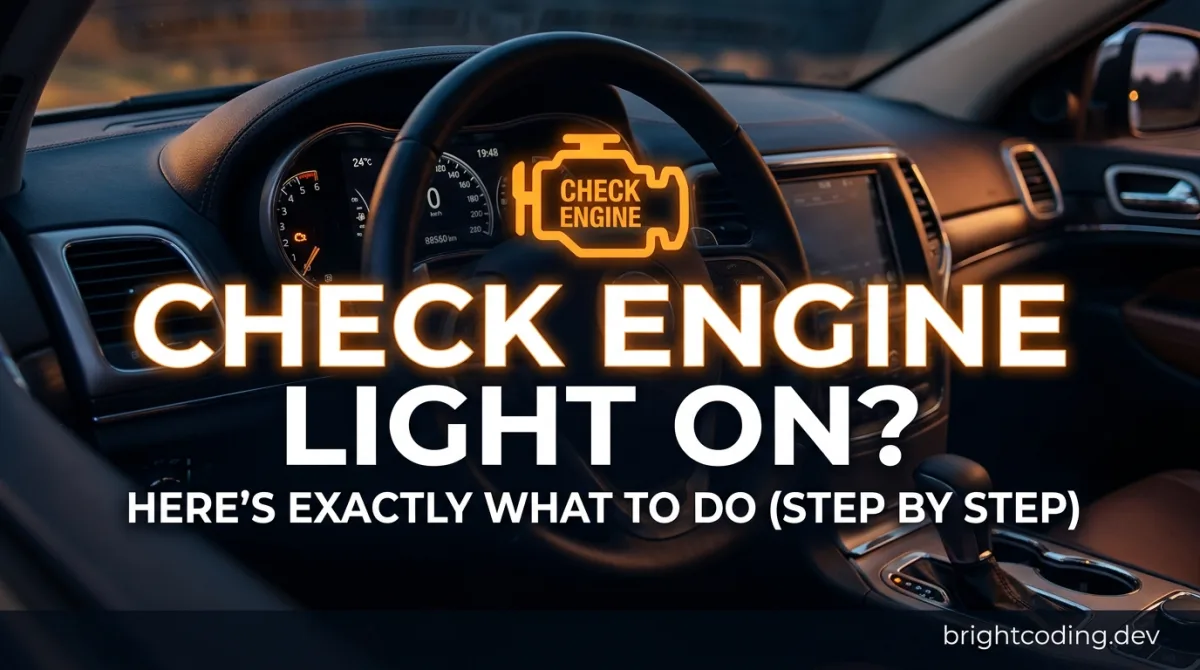
The little orange light appears and your heart sinks. Before you panic — or pay for a "diagnosis" — understand what it's really telling you.
Rule #1: Steady light = read it soon. Flashing light = stop driving when safe. A flashing light means a severe misfire that can destroy the catalytic converter.
Step 1: The 3 Free Checks First
- Check the fuel cap. A loose cap triggers EVAP codes (P0442, P0455) — a 10-second fix.
- Note how the car drives. Feels fine? Then it's probably a sensor or emissions issue. Shaking or losing power? Treat it as more urgent.
- Is the light steady or flashing? Flashing → stop driving.
Step 2: Read the Code (It's Free)
Behind every check engine light is a 5-character code. You can read it two ways:
- Any OBD-II scanner (cheap ones cost under $20)
- The free OBD code lookup — type in the code and get the meaning, likely causes, checks and tools
A code is a clue, not a verdict. P0301 (cylinder 1 misfire) could be a spark plug, a coil, an injector, or a vacuum leak. Codes share causes — always confirm before replacing.
Step 3: The 5 Most Common Codes
- P0300–P0304 — misfire: spark plugs, ignition coils, injectors, vacuum leaks
- P0171 / P0174 — too lean: vacuum leak, MAF, fuel pressure
- P0420 / P0430 — catalyst efficiency: worn converter or oxygen sensor
- P0128 — thermostat stuck open (engine runs cold)
- P0442 / P0455 — EVAP leaks: check the fuel cap first
Want it explained in plain English? The AI explainer rewrites any code for a non-mechanic.
Step 4: Confirm Before You Buy
The biggest mistake DIYers make is "parts-cannon" diagnosing — replacing the coil, then the plugs, then the injector hoping something works.
Instead:
- Read the code
- Check the live data (fuel trims, RPM, temperature) — the free OBD live data tool shows it live
- Confirm the cause with a measurement (swap a coil and see if the code moves, smoke-test for leaks, check fuel pressure)
Step 5: When to Clear the Code
Only clear the code after you've fixed the cause. Clearing it earlier just hides the light — it comes back if the fault is still there, and you lose the freeze-frame data that helps diagnose it.
❓ Quick FAQ
Will the light go off by itself? Sometimes, if the fault clears, after a few drive cycles — but the code stays stored.
Can I drive with it on? A steady light with a normal-feeling car: yes, for a short trip. A flashing light: no — stop when safe.
Do I need an expensive scanner? No. A basic reader reads codes for under $20, and the free lookup explains them.
✅ The Bottom Line
The check engine light is your car talking to you — and you now speak the language.
Read the code, confirm the cause, fix it right. You'll save money and keep your car healthy.
👉 Decode your check engine light for free →
This article contains partner links to free tools. We may earn advertising revenue if you visit — at no cost to you.