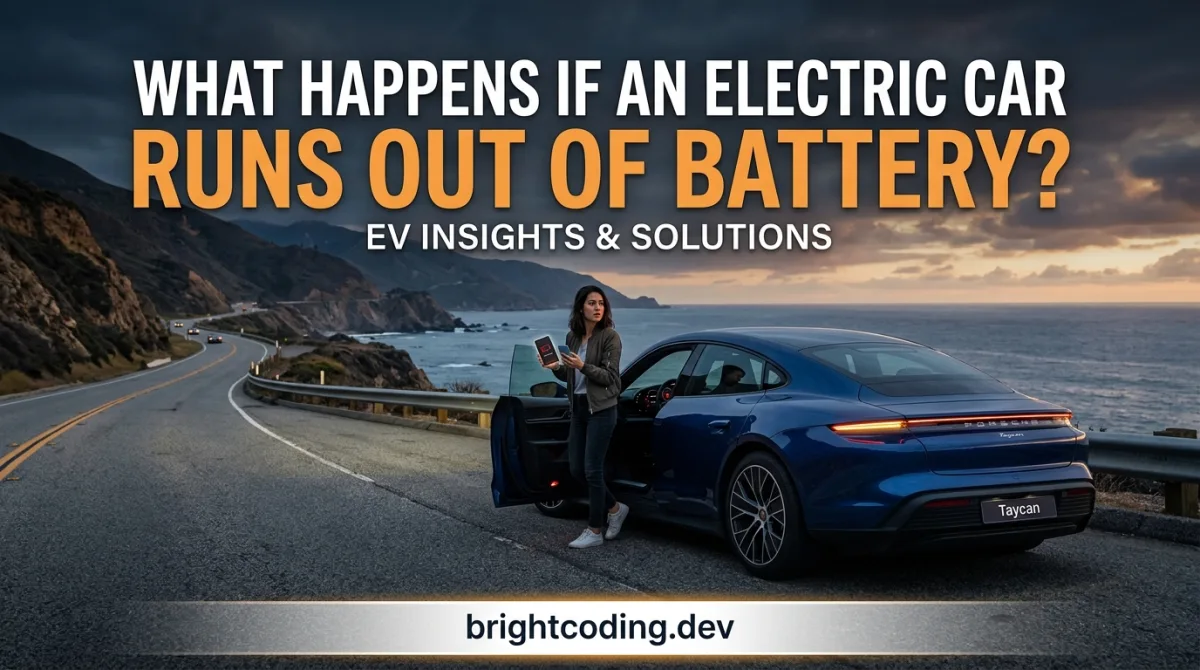
You are watching the range estimate tick down faster than the miles you are covering. The dashboard says 12 miles. Your exit is 15 away. We have all done the mental math and hoped it was wrong.
Here is the short answer: a modern electric car that hits zero does not usually die instantly in the middle of a lane. It enters a limp mode, cuts power, and coasts. Then it stops, and you need a tow to a charger. That is the realistic outcome for most drivers, and it is annoying rather than dangerous, as long as you handle it correctly.
This guide covers what actually happens when an electric car runs out of battery, why the range estimate lies to you, and what to do in the first five minutes. It also covers how to avoid ever being in that position again.
What actually happens when the battery hits zero?
Most EVs are designed to protect themselves. As the state of charge falls below roughly 10 percent, the car starts throttling power. Acceleration gets sluggish. Top speed drops. Climate control may shut off or reduce to save energy. Warning messages appear, sometimes with a turtle icon.
Below about 5 percent, you are in what manufacturers call turtle mode or limp mode. You can typically crawl a few more miles at low speed. If you are lucky, that is enough to reach a charger.
Then the pack reaches its true minimum. The contactors open, which physically disconnects the high-voltage battery from the drive system. The motor stops producing torque. You coast. Power steering may still work briefly, and brakes always work because they are mechanical, though you lose regenerative braking. You roll to a stop.
Some cars keep a small reserve below the displayed zero. Others do not. That reserve is a buffer the manufacturer builds in, and it is not something you should ever plan around.
Why does the range estimate drop so suddenly?
The number on your dashboard is a guess, not a measurement. It is calculated from recent driving, temperature, terrain, and battery state. Change any of those and the guess changes.
Cold weather is the biggest culprit. A cold battery holds less usable energy and takes longer to release it. Cabin heating and defrost draw serious power. You can easily lose 20 to 40 percent of your expected range in winter, and more in a short-trip pattern where the pack never warms up.
Highway speed is the second. Aerodynamic drag rises with the square of your speed, so going from 60 to 75 mph costs you far more than the extra 15 mph suggests. Wind, rain, roof racks, and loaded cars all make it worse.
The third cause is the "guess-o-meter" itself. It is optimistic after gentle city driving, then you merge onto a highway with a headwind and it collapses. That sudden drop is not a fault. It is the estimate catching up with reality.
What should you do right now if you are about to run out?
Stay calm and plan the stop. Do not swerve or brake hard.
- Reduce load immediately. Turn off climate control, heated seats, and audio. On many cars, eco mode also caps speed and softens throttle response.
- Drop your speed. If you can safely go 45 to 50 mph instead of 70, do it. Slower is more efficient, right up to the point where you are a hazard.
- Find the nearest charger on your in-car map or an app. Sort by distance, not by speed.
- If you cannot reach it, pull off at the next safe place: a service area, a parking lot, a wide shoulder. Get as far from traffic as you can.
- Once stopped, put the car in park, turn on hazards, and set out a warning triangle if you have one.
Do not keep restarting and creeping forward hoping for a few more yards. Every restart costs energy and you may strand yourself somewhere worse.
Can you charge a dead EV on the roadside?
This is where EV ownership differs from petrol. You cannot carry a jerrycan of electrons.
There are three realistic options.
A mobile charging service. Some regions have vans that carry a battery pack and give you enough charge to reach a real charger. Availability varies wildly by country and city. Expect a callout fee plus a per-kWh charge, and check whether your breakdown cover includes it before you need it.
A flatbed tow to a charger. This is the most common outcome. Your car gets winched onto a flatbed and taken to the nearest compatible charger. Never let anyone tow a stranded EV with two wheels on the ground. That can damage the drive unit. Insist on a flatbed.
A jump start for the 12V battery. This is a different problem entirely, and it is worth understanding. The high-voltage traction battery moves the car. The 12V battery runs the computers, lights, and contactors. If your 12V battery is flat, the car may appear completely dead even with a full traction pack, and the contactors will not close. A careful owner can jump-start a 12V system with a booster pack, following the manufacturer's instructions exactly. That is low-voltage work. Anything involving the traction battery, its cables, or its enclosure is high-voltage work and requires a qualified technician. Do not touch it.
If your car is dead but you are not sure which battery is at fault, the fault-finding steps in the EV troubleshooting guides are a sensible place to start before you call anyone.
How much does running out actually cost you?
It depends on where you are and who you call.
A tow to a nearby charger might cost anywhere from a modest callout to a few hundred in local currency. A mobile charge service often adds a premium on top. If you are on a motorway in a remote area, expect the higher end.
The real cost is time. You can lose two to four hours between the call, the wait, the tow, and the charge. That is the argument for treating the last 15 percent of your range as a reserve you never touch, the same way you would not run a petrol car to fumes on a motorway.
How do you avoid this entirely?
The honest answer is that running out of charge in an EV is almost always a planning failure, not a car failure. A few habits remove the risk.
Charge at 20 percent, not 5. Treat 20 percent as your new empty. It gives you a buffer for detours, traffic, and cold snaps.
Use the tools, not your gut. Before a long trip, plan your charging stops properly. The free EV calculators and tools on this site help you estimate real-world consumption rather than relying on the optimistic dashboard figure.
Know your car's real winter range. If you are shopping, compare real-world figures rather than brochure numbers. The head-to-head EV comparisons break down range, charging speed, and efficiency side by side.
Check the terrain and the wind. A mountain pass or a stiff headwind can erase a comfortable margin. Route planners that account for elevation are worth the two minutes.
What if you are still choosing a car?
Range anxiety is heavily influenced by the car you buy, not just your habits. Two EVs with the same claimed range can behave very differently in winter, at highway speed, and on a fast charger.
If that is your situation, the EV model directory lets you filter by range, charging speed, and body style so you can shortlist cars that fit your actual commute rather than a laboratory test. Being honest about your worst-case day, not your average day, is the single best filter.
The best option for your situation
There is no universal answer here, because the right move depends on where you are and what you drive.
| Situation | Best option | Why |
|---|---|---|
| Limp mode, charger within a few miles | Crawl to the charger in eco mode | Fastest and cheapest fix |
| Stopped on a safe shoulder, mobile service available | Call a mobile charging van | Gets you moving without a tow |
| Stopped far from any charger | Flatbed tow to the nearest compatible charger | Safe for the drivetrain |
| Car completely dead but traction pack full | Check the 12V battery first | Likely a low-voltage fault, not an empty pack |
| Recurring low-range stress | Change charging habits and use a route planner | Solves the cause, not the symptom |
Verdict: if you can still move, crawl to a charger. If you cannot, call for a flatbed and be specific that it is an EV. If the car seems dead with charge showing, suspect the 12V battery before you assume the worst. And if this keeps happening, the problem is your planning routine, not the car.
Step-by-step action plan
- At 20 percent, start looking for a charger. Do not wait for the warning light.
- At 10 percent, switch to eco mode and reduce speed.
- At 5 percent, navigate directly to the closest charger and cut all non-essential power.
- If you cannot make it, pull off safely and stop.
- Hazards on, park, warning triangle if you have one.
- Call breakdown cover and request a flatbed tow to a charger.
- Do not attempt any work on the high-voltage system. Ever.
- After you recover, note what went wrong and adjust your reserve.
Common mistakes to avoid
- Trusting the range estimate on a cold morning. Fix: assume 20 to 40 percent less range in winter and plan around that.
- Driving fast to reach a charger sooner. Fix: slow down. Speed costs more energy than the time you save.
- Letting a tow truck lift your EV by two wheels. Fix: insist on a flatbed, every time.
- Assuming a dead car means an empty traction battery. Fix: check the 12V battery first, since it causes identical symptoms.
- Touching high-voltage cables or the pack enclosure. Fix: stop and call a qualified technician. This is not owner-level work.
- Running to single-digit percentages regularly. Fix: treat 20 percent as empty and charge earlier.
Expert takeaway
An electric car that runs out of battery will almost always protect itself, slow down, and stop safely. The car is not the problem. The estimate is. Treat 20 percent as your real empty, respect winter and highway speed, and you will likely never experience a roadside stranding at all.
FAQ
Does an electric car shut down immediately at 0 percent? No. Most enter a reduced-power limp mode first, then coast to a stop when the pack reaches its minimum. Some cars keep a hidden reserve, but you should never rely on it.
Can you jump-start an electric car? You can jump-start the 12V battery, which runs the computers and contactors, using a booster pack and the manufacturer's procedure. You cannot jump-start the high-voltage traction battery. That requires charging or a tow.
Is it bad for the battery to run it to zero? Occasional deep discharge is not catastrophic, but repeated deep discharges and long periods sitting at very low charge can stress the pack over time. Charging at 20 percent protects both your range and your battery health.
How far can you drive an EV in limp mode? It varies by model and conditions, often just a few miles at low speed. Treat it as a last resort to reach a charger, not a plan.
Will my breakdown cover tow an EV? Many policies do, but not all, and some exclude EVs or require a specific flatbed. Check your policy wording before a long trip rather than after you stop.
Ready to act on what you just read? Explorethe EV model directory, head-to-head EV comparisons or the free EV calculators and tools. The rest of this site is built to help you take the next step.