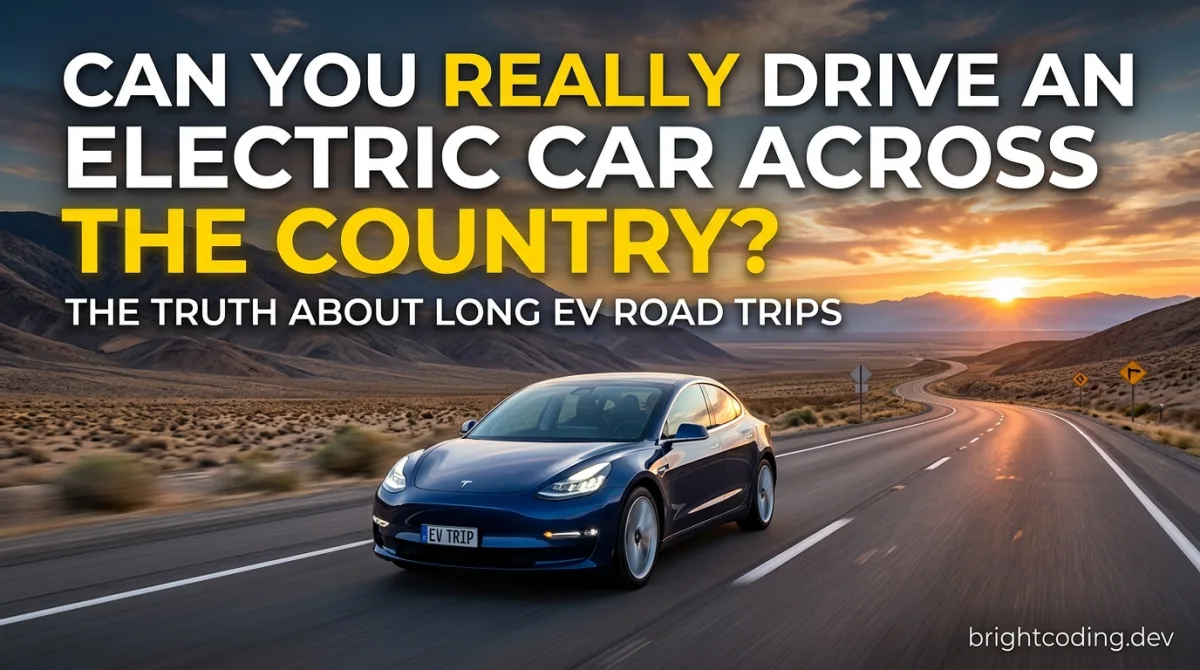
Yes, people do it every week. But the gap between "technically possible" and "actually pleasant" is where most road trips fall apart. This article walks through the mistakes that turn a cross-country EV drive into a long, stressful day, and how to sidestep every one of them.
Why most people get this wrong
Gas-car habits are hard to shake. You think in terms of "fill up when the tank is low," "drive until you need a break," and "any exit will have fuel." None of that maps cleanly onto an EV road trip.
The second problem is planning software. Route planners are optimistic by design. They assume ideal temperature, no headwind, a charger that works on the first try, and a car that hits its rated range. Real trips involve all four of those going sideways at least once.
The third issue is that nobody tells you the boring truth: a cross-country EV trip is mostly a charging logistics problem, not a driving problem. Get the logistics right and the drive is easy.
1: Trusting the rated range number
Your car says 320 miles. You plan a 280-mile leg. You arrive with 6 percent and a racing heart.
Rated range comes from a controlled test, not from 75 mph into a headwind with the heater on. Real-world highway range commonly lands somewhere in the 70-85 percent band of the rating, and worse in cold weather. Treat the window sticker as a ceiling, not a promise.
Avoid it: plan legs at roughly 60-70 percent of rated range, then adjust after your first two charging stops once you see your actual consumption.
2: Charging to 100 percent every stop
New owners plug in and wait for the full bar. On a road trip, that last 20 percent can take as long as the first 60.
DC fast charging tapers hard above roughly 80 percent state of charge, because the battery management system is protecting the cells. You are paying in minutes for miles you do not need.
Avoid it: charge to 60-80 percent, leave, and stop more often. Two short stops usually beat one long one.
3: Assuming every charger on the map works
You roll into a rural fast charger at 11 pm. The screen is dark. The app says "available." There is no phone number that answers.
This is the single most common cross-country complaint, and it is not a car problem. Network reliability varies a lot by region, and older or isolated sites are the usual offenders.
Avoid it: check recent driver check-ins in your charging app, not just the status flag. If a site has no recent successful sessions, treat it as down and pick a backup.
4: Planning the route around the map, not the chargers
Google Maps will happily route you through a 200-mile charging desert because it does not care about electrons.
People plan the scenic route first and hunt for chargers second. That order guarantees detours, backtracking, and 40-minute detours to a slow charger behind a hardware store.
Avoid it: build the route around charging hubs, then pick the scenery between them. If you are still choosing a car, the head-to-head EV comparisons on this site are a good place to filter by real fast-charging behaviour rather than brochure range.
5: Ignoring charging speed and curve
Two cars both claim 250 kW peak. One holds it for four minutes; the other holds a strong rate for twenty.
Peak kilowatts sell cars. What matters on a road trip is the charging curve, the shape of power delivery from 10 to 80 percent, and how the car preconditions the battery before you arrive. A car with a modest peak but a flat curve can beat a headline-grabber over a full day.
Avoid it: before you buy, look for real 10-80 percent charge times, not peak kW. Our EV model directory is a reasonable starting point for comparing those numbers side by side.
6: Skipping cabin pre-conditioning and battery pre-conditioning
You leave the hotel with a cold battery and a cold cabin. The car charges slowly and the heater eats range for the first hour.
Battery pre-conditioning warms the pack so it accepts a faster charge. Cabin pre-conditioning, done while still plugged in, means you leave with a comfortable interior without draining the traction battery.
Avoid it: set the charger as your destination in the nav so the car preps the pack, and warm or cool the cabin while plugged in. It is free range.
7: Overpacking the roof
A roof box or bike rack can knock a meaningful chunk off highway range, and highway range is exactly where you have the least margin.
Owners add a cargo box "just in case," then wonder why every leg is 15 percent shorter than planned. Aerodynamics dominate at speed.
Avoid it: use the trunk and the frunk first. If you must carry a roof load, cut your planned leg length and expect to charge more often.
8: Not having a backup plan at each stop
You arrive at your only planned charger with 9 percent. It is occupied by two cars and one is at 100 percent, parked.
Single-point plans fail. Backup plans do not.
Avoid it: for every charging stop, identify one alternative site within a comfortable detour. A simple note on your phone is enough. If something does go wrong, the EV troubleshooting guides can help you tell a charger fault from a car fault before you panic.
9: Doing zero maths on cost and time
People assume an EV road trip is always cheaper. Sometimes it is. Sometimes DC fast charging at peak rates costs close to petrol, especially in a thirsty EV at highway speed.
Time is the other blind spot. A 500-mile day in a gas car is one stop. In an EV it might be two or three, and that is before anything goes wrong.
Avoid it: run your actual route through the free EV calculators and tools here to estimate energy, cost, and stop count before you commit. Ten minutes of maths beats four hours of surprise.
Do this instead
- Plan legs at 60-70 percent of rated range, then tighten or stretch after your first stop.
- Charge to 60-80 percent and move on. Save the full charge for home.
- Check recent driver check-ins before trusting any charger.
- Build the route around charging hubs, not the other way round.
- Pre-condition the battery and cabin while still plugged in.
- Keep the roof clear unless you have no choice.
- Always know your backup charger before you arrive at the primary.
- Run the numbers for cost and time before you leave, not after.
FAQ
How long does a cross-country EV trip actually take? Expect to add roughly 15-30 percent to your driving time compared with a gas car, mostly from charging stops and short detours. Cold weather, headwinds, and a busy charger network push that toward the higher end. Verify with your own route planner, since it varies a lot by car and region.
Can I do it in a shorter-range EV? Yes, if the car has decent fast charging and you are patient. A 200-mile-rated car works fine on corridors with dense charging; it gets painful in rural stretches with long gaps. Match the car to the route, not the other way round.
Is it cheaper than driving a petrol car? Sometimes. Home charging is usually much cheaper per mile. Public DC fast charging can narrow or erase that advantage, especially at peak rates. Run your specific route through a calculator rather than assuming.
What if a charger is broken when I arrive? Go to your backup. Report the fault in the network's app so the next driver knows. If several chargers in a row fail, that points to a network issue rather than your car, and the diagnostics and fuse guides can help you confirm whether the fault is on your side.
Do I need a special adapter? In some regions, yes, particularly for certain networks or connector standards. Check what your car ships with and what the corridors you plan to use require. Do not assume the adapter you bought for home will cover every public site.
A cross-country EV trip is not a gamble if you plan charging first and range second, and the drivers who hate it are almost always the ones who skipped that step.
Ready to act on what you just read? Explorethe EV model directory, head-to-head EV comparisons or the free EV calculators and tools. The rest of this site is built to help you take the next step.