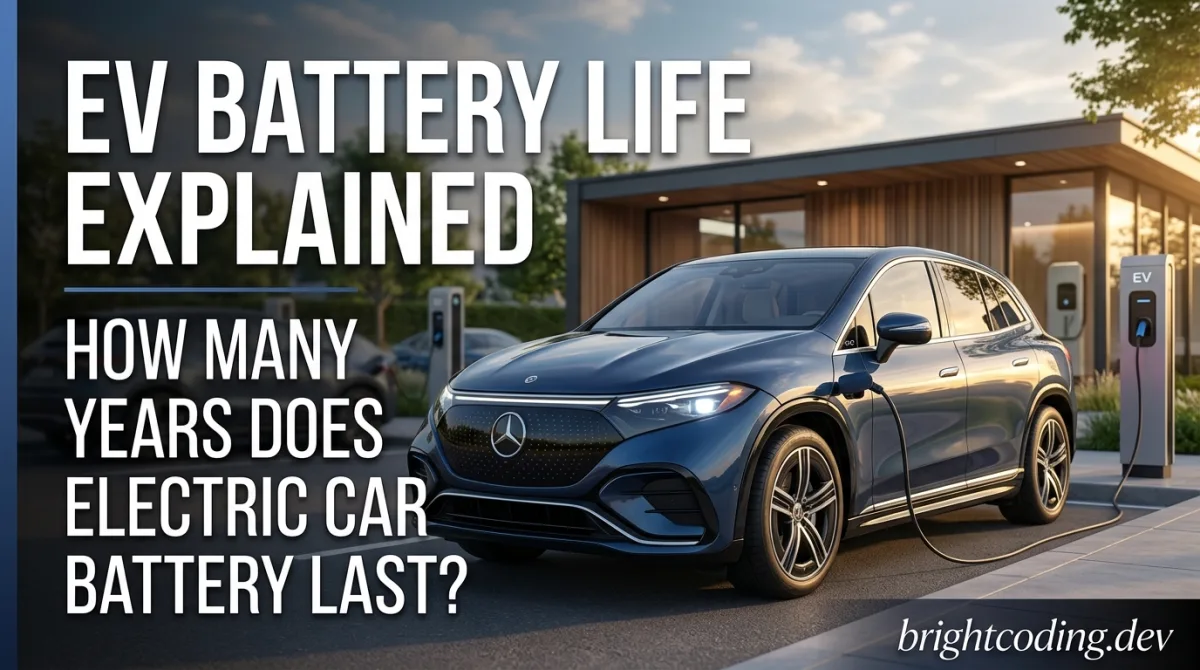
The short answer: Most modern EV batteries last 15 to 20 years in typical driving conditions. In fact, large-scale real-world data suggests your battery will likely outlast your ownership of the vehicle, and possibly the car itself.
But here is what the dealerships will not tell you: not all EV batteries age the same way. Your charging habits, local climate, and even the brand you choose can mean the difference between a battery that dies at year 8 and one that still holds strong at year 20.
In this guide, we break down the latest 2026 data from over 22,700 real-world electric vehicles, expose the hidden warranty traps, and give you the exact playbook to maximize your battery's lifespan.
The Real Numbers: How Fast Do EV Batteries Actually Degrade?
Let us cut through the internet myths with hard data.
According to Geotab's landmark 2025-2026 study analyzing 22,700+ EVs across global fleets, the average electric vehicle battery loses approximately 2.3% of its capacity per year.
What does that mean in plain English?
If you buy a new EV today with a 75 kWh battery and 300 miles of range, here is how the math plays out over time:
| Year | Battery Health (SOH) | Effective Capacity | Estimated Range |
|---|---|---|---|
| New | 100% | 75 kWh | 300 miles |
| Year 3 | ~94% | ~70.5 kWh | ~282 miles |
| Year 5 | ~90% | ~67.5 kWh | ~270 miles |
| Year 8 (warranty end) | ~82% | ~61.5 kWh | ~246 miles |
| Year 10 | ~77% | ~57.8 kWh | ~231 miles |
| Year 15 | ~67% | ~50.3 kWh | ~201 miles |
The key insight: Even after 15 years, your battery still holds roughly two-thirds of its original charge. For the average American driver who covers just 37 miles per day, that is still more than enough range for a full week of commuting on a single charge.
EV Battery Warranties: The 70% Rule You Must Know
Every major automaker offers a battery warranty, but the fine print matters more than the marketing headline.
The industry standard in 2026: 8 years or 100,000 miles, whichever comes first. Some brands like Hyundai and Kia extend this to 10 years / 100,000 miles. Tesla offers up to 8 years / 150,000 miles on certain models.
But here is the critical part: these warranties do not promise a perfect battery forever. They promise your battery will not drop below a specific State of Health (SOH) threshold, typically 70% of original capacity, within the warranty period.
Why this matters: If your battery is at 71% SOH the day before your warranty expires, the manufacturer owes you nothing. But if it hits 69%, you are entitled to a free repair or replacement, often with a refurbished pack.
The good news? Real-world data shows most batteries stay well above that 70% floor. The warranty is a safety net, not a performance forecast.
2026 Warranty Comparison by Brand
| Manufacturer | Warranty Period | Transfers to 2nd Owner? | Degradation Threshold |
|---|---|---|---|
| Tesla | 8 yr / 120k mi | Yes | 70% SOH |
| Hyundai / Kia | 10 yr / 100k mi | Yes | 70% SOH |
| Ford | 8 yr / 100k mi | Yes | 70% SOH |
| Chevrolet | 8 yr / 100k mi | Yes | 60-70% SOH |
| Nissan | 8 yr / 100k mi | Partial | 66-70% SOH |
| BMW / Mercedes | 8 yr / 100k mi | No (1st owner only) | 70% SOH |
Pro tip for used EV buyers: Always verify warranty transfer rules before buying. If the warranty does not transfer (looking at you, BMW and Mercedes), negotiate $5,000 to $8,000 off the asking price to cover your risk.
The #1 Battery Killer (And It Is Completely Under Your Control)
If there is one factor that separates a battery that lasts 8 years from one that lasts 20, it is this: how you charge it.
Geotab's 2026 data reveals a dramatic difference based on charging behavior:
| Charging Profile | Avg. Annual Degradation | Projected Capacity After 8 Years |
|---|---|---|
| Mostly home AC charging | 1.5% | ~88% |
| Mixed charging, occasional DC fast | 2.3% | ~82% |
| Frequent high-power DC fast charging (>100 kW) | 3.0% | ~76% |
The verdict is clear: Relying on high-power DC fast charging as your default fueling method can double your degradation rate compared to gentle home AC charging.
Think of it like this: AC charging is a slow sip of water for your battery. DC fast charging is a fire hose. Both fill the tank, but one creates significantly more thermal and chemical stress.
Climate Reality: Hot Weather Is Harder on Batteries Than Cold
Lithium-ion batteries have a comfort zone, and it is surprisingly narrow: 50°F to 86°F (10°C to 30°C).
Hot climates accelerate chemical degradation. EVs in consistently hot regions degrade approximately 0.4% faster per year than those in mild climates. This is why early Nissan Leaf models (which used passive air cooling) suffered catastrophic degradation rates of 4.2% per year in hot states like Arizona, while liquid-cooled Teslas held steady at ~2.3%.
Cold weather is different. It temporarily reduces range and slows charging, but it does not permanently damage the battery. Modern EVs use active thermal management systems to heat and cool the pack, protecting it from extremes. The energy used to condition the battery does reduce your winter range, but it preserves long-term health.
The Replacement Cost Nobody Wants to Think About
Let us address the elephant in the room: what if your battery does need replacement?
In 2025-2026, out-of-warranty battery replacement costs range from $5,000 to $20,000 depending on the vehicle model and pack size. A Tesla Model 3 pack runs roughly $10,000-$15,000, while a Ford F-150 Lightning can climb to $15,000-$25,000.
But here is the statistic that should calm your anxiety: only about 2.5% of all EVs on the road have ever needed a battery replacement.
For context, that is lower than the rate of transmission failures in many gas-powered vehicles. And as battery production scales up, these costs are projected to drop significantly over the next decade.
5 Proven Habits to Make Your EV Battery Last 20+ Years
You do not need to baby your EV. These five habits, backed by fleet data, will maximize your battery's lifespan with minimal effort:
1. Charge to 80%, Not 100%
Lithium-ion batteries experience the most stress at the very top and bottom of their charge range. For daily driving, set your charge limit to 80%. Save 100% charges for road trips. Many EVs let you set this limit directly in the vehicle's charging menu.
2. Do Not Let It Sit Below 20%
Deep discharges strain the battery chemistry. If you are parking for more than a few days, leave your car plugged in with the charge limit set to 50-60%. A parked EV at 5% for a month is a recipe for accelerated degradation.
3. Use DC Fast Charging Sparingly
Treat DC fast charging like an energy drink: great for emergencies, terrible as a daily habit. For your daily routine, Level 2 home charging is gentler, cheaper, and better for long-term health.
4. Precondition in Extreme Weather
Use your EV's app to preheat or precool the cabin and battery while still plugged in. This draws power from the grid, not your battery, and ensures the pack starts at its ideal temperature.
5. Park in the Shade (or a Garage)
Heat is the silent killer. In summer, park in shaded areas or garages whenever possible. If your EV has an "overheat protection" or "cabin overheat" feature, enable it.
What Happens When an EV Battery "Dies"?
Here is the beautiful part: EV batteries rarely die suddenly. Instead, they fade gracefully.
When a battery reaches roughly 70-75% SOH, it may no longer meet the range needs of a daily driver. But that does not mean it is trash. These "spent" EV batteries are increasingly being repurposed for stationary energy storage (powering homes, businesses, and even sports arenas) for another 10 years.
After their second life, the materials inside (lithium, cobalt, nickel) are recycled into new batteries. The EU has set a target of recycling 70% of lithium-ion batteries by 2030, and the US is rapidly expanding recycling infrastructure.
Your EV battery is not just a power source. It is a multi-decade asset.
The Bottom Line: Stop Worrying About Battery Life
If you take one thing from this article, let it be this: modern EV batteries are more durable than almost every other component in your vehicle.
The 2026 data is unambiguous. With an average degradation rate of just 2.3% per year, a standard 8-10 year warranty, and only 2.5% of vehicles ever needing replacement, the "battery anxiety" that plagued early EV adoption is officially obsolete.
An electric car battery is not a phone battery. It is not designed to be replaced every three years. It is engineered to survive hundreds of thousands of miles, two decades of calendar aging, and still have enough juice to power your home after it retires from the road.
Drive it. Charge it smartly. And stop worrying.
Related Reads:
- [Used EV Buying Guide: What to Check Before You Buy]
- [DC Fast Charging vs. Home Charging: The Real Cost Difference]
- [EV Battery Warranties Explained: Every Brand Compared]
Last updated: August 2026. Data sourced from Geotab 2025-2026 fleet analysis, Recurrent Auto, and manufacturer warranty disclosures.