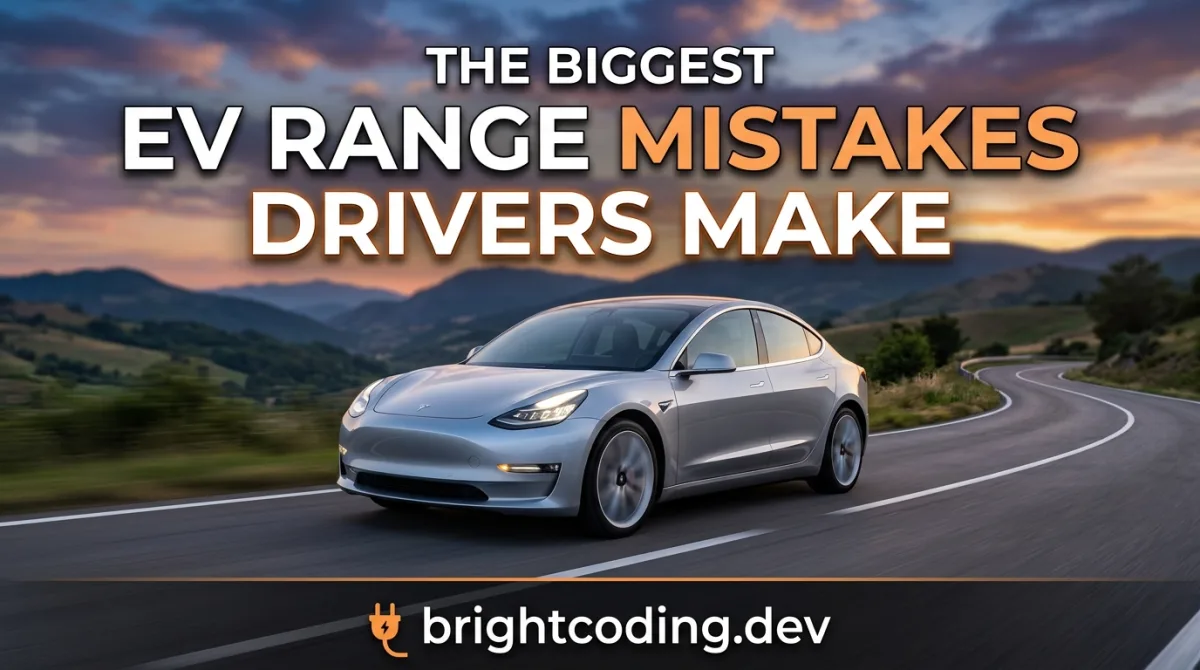
Range anxiety is mostly self-inflicted. I say that as someone who has watched a rider push a scooter the last two miles home and a driver sweat a 12-mile gap to the next charger. The car or bike is rarely the villain. The habits are.
This piece walks through seven range mistakes I see over and over, across cars, e-bikes, scooters and mopeds. Fix a few and you will stop treating the range estimate like a weather forecast you can't argue with.
Why most people get this wrong
The number on your dashboard is not a promise. It is a guess, recalculated constantly from recent driving, temperature, terrain and how you use the throttle. Change any of those and the guess changes too.
People also confuse two different things: the battery's actual capacity and the range you get from it. A pack can be perfectly healthy and still deliver disappointing range if you drive it badly. Conversely, a tired pack can still cover your commute if you treat it gently.
The third trap is treating range like a fixed spec. It is not. It is an outcome. Once you accept that, the whole game shifts from "how far can this thing go" to "how do I get more out of what I have."
1: Trusting the range estimate as gospel
A driver leaves home showing 180 miles, drives 40 miles uphill into a headwind, and panics when the estimate reads 120. Nothing is broken. The car simply recalculated using worse conditions.
The estimate is a running average, and it lags behind reality. Cold mornings, a loaded car or a steady climb all drag it down faster than the miles you actually cover.
Use the estimate as a trend, not a contract. Watch how it changes over the first few miles of a trip and plan your charging stop on the pessimistic version, not the optimistic one.
2: Charging to 100% out of habit
If your commute is 30 miles and your car does 250, filling to 100% every night buys you nothing and costs you a little battery life over years. Many packs are happiest living between roughly 20% and 80% for daily use.
Save the full charge for the morning of a long trip. On most modern cars you can set a charge limit in the app or the charging menu. If you are comparing models and want to know which ones make this easy, the head-to-head EV comparisons at https://ev.brightcoding.dev/compare break it down by feature.
And no, you do not need to top up "just in case" every single day. That habit is anxiety, not planning.
3: Ignoring temperature like it doesn't matter
Cold is the single biggest range thief most people underestimate. A pack that gives you 200 miles in mild weather might give noticeably less on a freezing morning, and that gap is normal, not a fault. Heat is gentler on range but harder on long-term battery health.
The fix is not to avoid driving in winter. It is to precondition while still plugged in, use seat and steering heating instead of blasting the cabin, and accept a shorter realistic range when the temperature drops.
For e-bikes and scooters, the same logic applies to storing and charging the pack. A cold battery charged in a freezing garage behaves worse than one brought indoors to warm up first.
4: Driving like the range doesn't depend on you
Speed is expensive. On the highway, pushing from a steady cruise to a much faster cruise can cut your range substantially, because aerodynamic drag climbs steeply with speed. Hard acceleration and late braking do the same in stop-start traffic.
You do not have to crawl. But if range matters on a given trip, back off a few mph, use eco mode, lean on regenerative braking and keep your speed steady. On two wheels, smooth throttle control is worth more than any accessory.
If your range suddenly drops with no change in how you drive, that is a different conversation. The EV troubleshooting guides at https://ev.brightcoding.dev/troubleshooting help you separate a habit problem from a hardware one.
5: Carrying weight and drag you forgot about
Roof boxes, bike racks, under-inflated tyres, a boot full of stuff you never unload. None of it feels heavy, and all of it costs range. A roof rack alone can take a measurable bite out of highway range, and soft tyres quietly rob you mile after mile.
Check your tyre pressures monthly. Take the rack off when you are not using it. Empty the boot of the junk that has lived there since last summer. These are boring fixes that actually work.
On scooters and mopeds, the same principle applies to how you load the bike and whether you are fighting unnecessary drag from a loose cover or a badly fitted top box.
6: Planning charging stops badly
Two mistakes live here. The first is arriving at a charger with almost nothing left, which leaves you no margin if the stall is broken or busy. The second is charging to 100% at a fast charger when 80% would get you to the next stop, because the last 20% takes far longer than the first.
Plan to arrive with a buffer, and treat fast charging as a tool for the middle of the pack, not the top. At home, slow charging overnight is cheaper and kinder to the battery.
If you are buying and want to model this properly, the free EV calculators and tools at https://ev.brightcoding.dev/tools let you play with real trip maths instead of guessing.
7: Blaming the battery for everything
Sometimes the range really has dropped and it is not your driving. A failing cell, a stuck brake, a dragging bearing, a software issue or a charging fault can all show up as lost range. The temptation is to assume the pack is dying when the cause is something cheaper.
Do the simple checks first: tyre pressures, brake drag, unusual noises, whether the drop appeared suddenly or gradually. Sudden losses point to a fault. Gradual losses over years are usually normal degradation, and a healthy pack losing a few percent a year is not a crisis.
Anything involving the high-voltage traction battery is a stop sign. Do not open packs, probe high-voltage cables or attempt cell-level repairs yourself. Low-voltage 12V checks, fuses and connectors are within reach for a careful owner, and the EV diagnostic and fuse guides at https://ev.brightcoding.dev/diagnostics walk through that safely. High-voltage work needs a qualified technician, every time.
Do this instead
- Set a daily charge limit around 80% and only go to 100% before a long trip.
- Precondition in cold weather while plugged in, and lean on seat heating over cabin heating.
- Check tyre pressures monthly and strip off racks and dead weight when not needed.
- Drive smoothly, keep highway speed steady, and use eco mode when range matters.
- Plan to arrive at chargers with a buffer, and fast charge in the middle of the pack.
- Investigate sudden range drops as faults, not as normal ageing.
- Leave high-voltage battery work to a qualified professional.
FAQ
Does fast charging ruin my range? Occasional fast charging is fine. Doing it constantly, especially to 100%, is harder on the pack over time. For daily use, slow charging at home is gentler.
Why is my range worse in winter? Cold reduces how much energy the battery can deliver and increases heating demand. Expect a real drop in freezing conditions, and precondition while plugged in to soften it.
Can I improve range without changing my driving? Partly. Correct tyre pressures, less weight, no roof rack and smarter charging all help. But driving style and speed remain the biggest levers.
Is a sudden range drop always a bad battery? No. Dragging brakes, under-inflated tyres, cold snaps and software glitches can all look like battery problems. Rule those out before assuming the worst.
Should I charge to 100% before every trip? Only before a genuinely long one. For everyday driving, a lower limit is better for the battery and just as practical.
Range is a habit, not a spec, and the drivers who get the most out of their EV are the ones who stop fighting the estimate and start working with it.
Ready to act on what you just read? Explorethe EV model directory, head-to-head EV comparisons or the free EV calculators and tools. The rest of this site is built to help you take the next step.