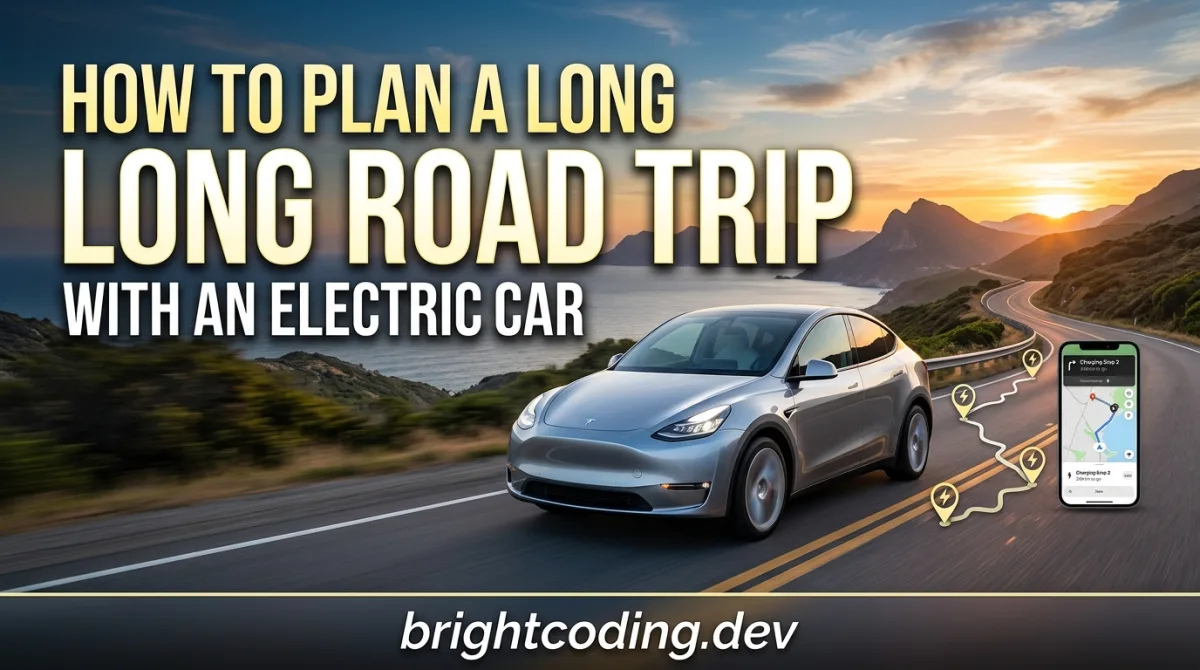
A long EV road trip is not harder than a petrol one, it is just planned differently. Instead of driving until the tank runs low and looking for a station, you plan around charging stops, elevation, temperature and how fast your car actually accepts power. Get that right and a 600-mile day feels calm.
By the end of this guide you will be able to map a route, pick the right charging stops, estimate your real range and build a buffer for cold weather and headwinds. Reading it takes about 10 minutes. Doing it for your first trip takes maybe an hour, and most of that is spent staring at a map app.
What you need before you start
- Your car's realistic highway range, not the brochure figure. Expect 15-30% less at steady motorway speeds, and more in cold weather.
- The usable battery size in kWh and your car's peak DC charging rate in kW. Both are usually in the manual or the spec sheet.
- A charging network app or two. Most major networks let you browse without an account and only ask you to register when you pay. Check which ones your car has plug-and-charge access to.
- A route planner that understands chargers. Most built-in navigation systems do this now, and several third-party apps do it better.
- A phone mount, a charging cable and a spare RFID card if your network still issues them.
- A tyre pressure gauge. Under-inflated tyres quietly steal range.
One thing you do not need: a spreadsheet. A route planner plus a notebook app is enough.
Step 1: Work out your real-world range
Take the official range and knock off 20% for motorway driving as a starting point. A car rated at 300 miles will realistically do around 240 at 70 mph in mild weather. In winter, with the heater on, treat 180-200 as your planning number.
Why it matters: every later decision depends on this figure. If you plan on 300 miles you will strand yourself on the first leg.
Practical tip: on your next long-ish drive, note the consumption in miles per kWh (or kWh per 100 km, depending on your car's units) at a steady speed. Multiply that by your usable battery capacity. That number is your real range. If your car shows "since last charge" consumption, use it.
Step 2: Choose your route around chargers, not just distance
Open your route planner and switch the vehicle profile to your exact model, not a generic EV. If the planner lists your car, it usually knows the battery size and charging curve already. If it does not, enter the capacity and consumption manually.
Look at the charger density along the route before you commit. A 500-mile route with ten fast-charging sites spread across it is easy; a 300-mile route with two is stressful.
Practical tip: compare a couple of route options side by side, even if one is slightly longer. A 20-mile detour that puts you on a corridor with reliable 150 kW+ chargers beats a shorter, charger-poor road every time.
Step 3: Plan charging stops around 10-80%, not 0-100%
Battery charging is not linear. The fastest part of the curve is usually between roughly 10% and 60-80%, depending on the car. Above 80% it tapers hard, and on many cars the last 20% takes as long as the first 60%.
So instead of one long stop, plan two shorter ones. Arrive with 10-15%, leave at 70-80%. You will spend less total time charging and more time driving.
Practical tip: in your planner, set the arrival state of charge (SoC) to 10% and the departure SoC to 80%. Most apps let you set both as minimum and maximum percentages. This single setting changes the whole trip.
Step 4: Build in a buffer for weather and terrain
Cold reduces range, and so does climbing. A mountain pass can pull 10-20% more energy than the same distance on flat ground, though you get some of it back on the descent if your car has regenerative braking.
Set your planner's arrival buffer to at least 15% in summer and 20-25% in winter. If the app has a temperature or climate setting, use it.
Practical tip: preheat or precool the cabin while still plugged in at home or at a charger. You are using grid power instead of battery power for the HVAC, which is free range.
Step 5: Book accommodation with charging, or at least a nearby charger
A hotel with a slow AC charger overnight is worth more than a fast charger 20 minutes away. You wake up full and skip the first public charging stop entirely.
If your hotel has no charger, check what is within walking distance of where you are sleeping. An AC charger at 7-11 kW adds roughly 20-40 miles of range per hour on most cars, so an overnight stop covers almost any car.
Practical tip: call ahead. Chargers get iced, broken or shared. A 60-second call to reception saves an hour of detouring at 11 pm.
Step 6: Confirm your payment and access before you leave
Decide now which charging networks you will use and make sure your payment method works. That means an account, a saved card, or plug-and-charge if your car supports it.
Check whether the chargers on your route are CCS, NACS, CHAdeMO or Type 2, and whether you need an adapter. Some regions are mid-transition and an adapter is genuinely required.
Practical tip: keep one physical RFID card or app with a saved card as backup. Phones die, apps log you out, and cell coverage has gaps.
Step 7: Pack for efficiency and for the wait
Weight costs range, but the real range killer is roof boxes and bike racks. A roof box at motorway speed can cut range noticeably, sometimes by 10% or more, depending on the car and speed.
Pack what you need, keep the car clean and aerodynamic, and bring something to do at charging stops. A 25-minute stop is fine; a 45-minute one needs a book, a coffee or a walk.
Practical tip: if you must carry a roof box, reduce your planned leg lengths by around 15% and recheck your stops.
Step 8: Do a dry run in the app the night before
The night before, open your route planner and run the whole trip. Check each stop: charger type, power in kW, number of stalls, recent check-ins or reviews, and whether it is at a services with facilities.
Then screenshot the plan. If cell signal drops, you still have the list.
Practical tip: plan one alternative charger near each stop. If your first choice is full or broken, you already know where to go next. This is the single biggest stress reducer on a first EV road trip.
Step 9: Drive the plan, then adjust in real time
On the day, drive at a steady speed and let the car's range estimate settle. Recheck your arrival SoC about 30 minutes before each stop and adjust if consumption is higher than expected.
If you are running ahead, skip a stop or shorten it. If you are behind, slow down 5-10 mph; that alone can add meaningful range.
Practical tip: use your car's built-in navigation for charging stops if it preconditions the battery. Battery preconditioning warms the pack before you arrive, which can dramatically improve charging speed in cold weather. Not all cars do this, so check your manual.
Pro tips
- Charge where you sleep, not where you drive. Overnight AC charging is the cheapest and fastest way to start every day full.
- Aim to arrive at fast chargers below 20%, not at 5%. The car charges fastest in that band, and you have buffer if the site is busy.
- Watch the charger's rated power versus what your car can accept. A 350 kW charger does nothing extra for a car that peaks at 100 kW.
- In winter, charge more often and for shorter periods. Cold packs accept power more slowly, and a warm pack after driving charges better than a cold one.
- If a charger is slow, unplug and try the next stall. Cable cooling faults and shared power are common, and moving stalls often fixes it.
- Keep tyre pressures at the recommended level. It is the cheapest range gain available.
Common pitfalls
Trusting the official range. The brochure number is a lab result. Plan on 70-80% of it for motorway driving and less in winter.
Charging to 100% at every stop. You will spend twice as long charging for the same distance. Save 100% for home or overnight AC.
Leaving no buffer. Arriving at 2% is not brave, it is a gamble on the charger being free and working. Keep 15% minimum.
Ignoring charger reliability. A site can be listed as working and still be down. Check recent user reports and have a backup stop planned.
Skipping preconditioning. In cold weather, arriving with a cold battery can cut your charge speed substantially. Use the car's route guidance to a charger so it can warm the pack.
Useful resources
For comparing how different models handle highway range and charging speed, our head-to-head EV comparisons put the numbers side by side, and the EV model directory lets you filter by range and charging rate. If you want to check your own consumption, battery capacity or cost per mile, the free EV calculators and tools do the maths for you. And if something misbehaves on the road, the EV troubleshooting guides cover the common faults.
For general route planning, most built-in navigation systems now handle charger stops, and several well-known third-party route planners let you filter by connector type and charging speed. Check which networks operate in your region and whether they support plug-and-charge.
FAQ
How much range do I lose in winter? It varies by car and temperature, but 20-35% is a realistic range for cold weather with the heater running. Preheat while plugged in and plan shorter legs.
Can I tow with an electric car on a long trip? Some EVs are rated for towing, but range drops sharply, often by 40% or more depending on the load and speed. Check your car's towing rating and plan much shorter legs.
Do I need an adapter? Only if your car's connector does not match the chargers on your route. This depends on your region and the car's market. Verify before you travel, not at the charger.
Is it cheaper to fast charge or charge at home? Home charging is almost always cheaper per kWh. Fast charging is for the road. Exact prices vary by network and region, so check your local rates.
What if a charger is broken when I arrive? Use your backup stop. This is why planning one alternative charger near each planned stop matters. Report the fault in the network's app so others know.
Final word
Your first long EV road trip feels like a puzzle, and the second one feels routine. Plan your stops around the 10-80% band, keep a buffer, and let the car do the preconditioning. Do that and the charging stops become the part of the trip where you actually stretch your legs.