The dashboard said 18 miles of range left. My brother's driveway was 22 miles away, and it was 9pm in a part of the country where the next fast charger was a 15-minute detour in the wrong direction. I did the thing every new EV owner eventually does: I turned off the climate control, dropped my speed to 60, and drove the last stretch with cold hands and a quiet sense of embarrassment.
I got there with 4 miles showing. That trip taught me more about Ford's electric lineup than any spec sheet ever did.
Why I ended up in a Ford EV at all
I didn't set out to be a Ford person. I'd been driving a tired diesel estate and wanted something quieter for the daily commute. What pulled me toward Ford was boring and practical: a dealer network that's actually everywhere, parts that don't require a waitlist, and a Mustang Mach-E that looked like a normal car rather than a science project.
I test-drove three EVs that month. Two felt like driving a phone. The Ford felt like a car that happened to be electric, which mattered more to me than I expected.
The Mach-E, warts and all
I ended up with a used Mustang Mach-E, standard range, rear-wheel drive. Ford has sold these with a few different battery sizes, but as a rough guide the smaller packs land somewhere in the low-to-mid 200s of miles on a good day, and the bigger ones push into the 300s. Cold weather eats into that, sometimes by 20-30% depending on how you drive and how much you use the heater.
The first month was a honeymoon. The second month I learned what "range anxiety" actually means, and it wasn't what I thought.
What range actually looks like day to day
In summer, my commute of roughly 30 miles round trip barely dented the battery. I'd charge once or twice a week on a standard home plug and forget about it. In winter, the same commute plus a heater meant I was plugging in most nights. Not a crisis, just a rhythm change.
The real lesson: published range is a ceiling, not a promise. If you routinely do more than 70% of your car's quoted range in a day, budget for charging stops or pick a bigger battery.
Charging, honestly
Home charging on a normal 3-pin plug is slow. Expect single-digit miles of range added per hour, which is fine overnight and maddening if you're in a hurry. A proper home wallbox changes everything; mine adds something in the region of 20-30 miles per hour, which covers almost any daily need.
Public fast charging is where the maths gets interesting. On a 150kW charger, I've gone from around 20% to 80% in roughly 35-45 minutes in good conditions. That last 20% takes forever, because charging slows down as the battery fills. If you're planning a road trip, plan around 10-80% stops, not 0-100%.
Costs vary wildly by region and tariff, so treat any number as a rough guide. At home on a cheap overnight rate I was paying a fraction of petrol prices. On a motorway fast charger during peak hours, it stung closer to petrol. Check your own tariff before assuming EVs are always cheap.
The other Fords I looked at
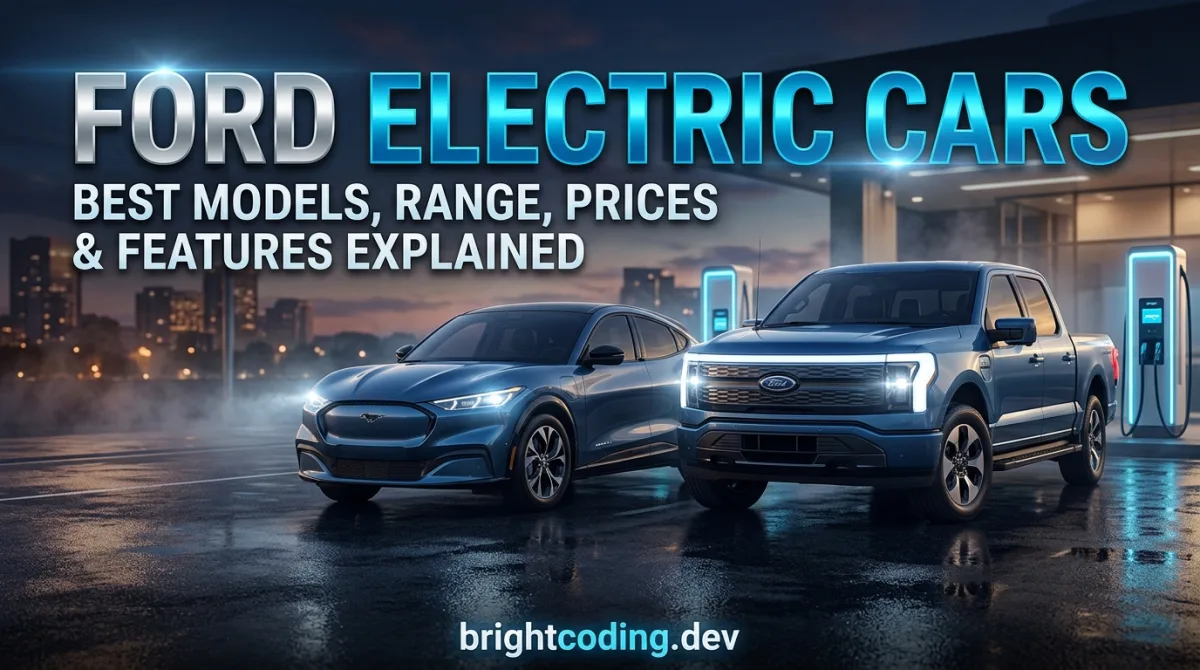
The Mach-E gets the attention, but Ford's electric range has moved on. There's the F-150 Lightning if you need a truck, the E-Transit for van work, the Puma Gen-E and Explorer EV as more compact options, and the smaller electric models aimed at city driving. Range and price vary a lot between them, and Ford has shuffled trim names more than once, so the safest move is to check the current lineup in an EV model directory rather than trust a blog post from two years ago.
I spent an afternoon comparing the Mach-E against a couple of rivals using a head-to-head comparison tool, and it was the most useful hour of the whole buying process. Spec sheets hide the things that annoy you daily: boot shape, seat height, where the charge port sits.
Honest pros and cons
What I actually liked:
- It drives like a normal car. No weird one-pedal learning curve unless you want it.
- The dealer network means servicing isn't a treasure hunt.
- Interior space is genuinely good for a car this size.
- Software updates have quietly improved things I'd complained about.
What annoyed me:
- Real-world range in winter is a different animal from the brochure.
- The app can be sluggish when you most want it, like pre-warming on a frosty morning.
- Some trim levels feel expensive for what you get once you add options.
- Fast charging still isn't as seamless as it should be, especially at older stations.
What it actually cost me
| Item | Approximate cost |
|---|---|
| Used Mach-E purchase | Roughly mid-to-high £20,000s at the time |
| Home wallbox install | Expect around £700-£1,200 |
| Monthly charging (home) | Roughly £30-£60 depending on tariff |
| Public fast charging (occasional) | Roughly £15-£25 per top-up |
| Servicing | Cheaper than petrol, but budget £150-£300/year |
Treat all of these as ballpark. Prices move, grants change, and your electricity tariff matters more than anything else on this list.
What I'd do differently
- Buy the bigger battery if you can stretch. The smaller pack was fine 90% of the time and stressful the other 10%.
- Get the wallbox installed before the car arrives. I spent three weeks on a 3-pin plug and regretted every day of it.
- Check the charge port location against your driveway. Sounds trivial. It isn't.
- Test the app before you buy. Sit in the car and try pre-conditioning. If it's slow, that's your life now.
- Learn basic 12V checks. A flat 12V battery causes a surprising number of "my EV is dead" mornings, and it's often something a careful owner can diagnose. Anything involving the high-voltage traction battery is a different matter entirely, and that's strictly a job for a qualified technician.
Quick practical tips
- Charge to 80% for daily use and save 100% for trips. Your battery will thank you.
- Pre-condition the cabin while still plugged in. It costs grid power, not range.
- Keep a tyre pressure gauge handy. Under-inflated tyres quietly shave miles off your range.
- If something feels wrong, stop and read the fault properly before poking at anything. Ford's diagnostic guides are worth a look before you book a dealer visit.
- Plan long trips around charger locations, not around your car's quoted range.
FAQ
Is a Ford EV good for a first electric car? Yes, mostly. The controls feel familiar, the dealer support is broad, and you won't be learning a whole new driving style unless you want to.
How much range do I actually need? Match it to your worst regular day, not your average one. If your longest normal trip is 80 miles, a car quoting 250 gives you comfortable margin in winter.
Can I just plug it into a normal socket? You can, and it works, but it's slow. Fine as a stopgap, frustrating as a permanent solution.
Do Ford EVs need special servicing? Less than a petrol car, but not none. Brakes, tyres, coolant and software all still need attention.
I still think about that cold 22-mile drive. Not because the car failed me, but because I'd assumed the number on the screen was the number I'd get. It wasn't, and once I stopped trusting the guess-o-meter and started planning properly, the whole thing got a lot less dramatic. That's the honest version of owning an electric Ford: brilliant most days, and occasionally a lesson in humility.
Ready to act on what you just read? Explorethe EV model directory, head-to-head EV comparisons or the free EV calculators and tools. The rest of this site is built to help you take the next step.