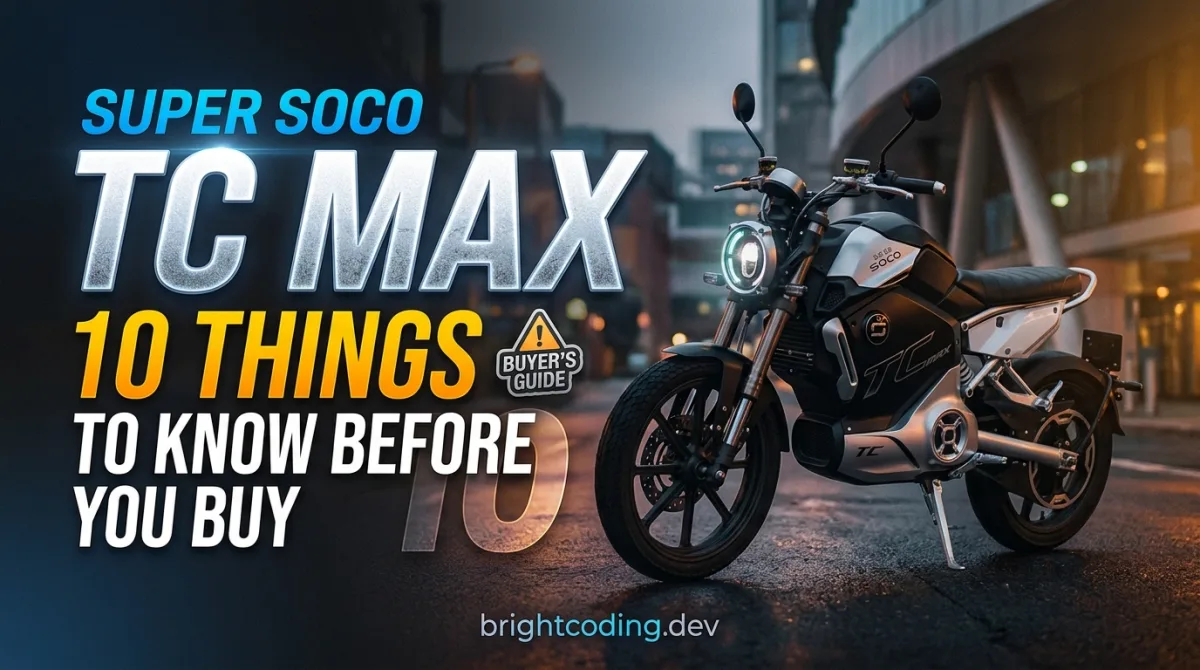
The rain started about four minutes before I got home. I remember because the dash on my TC Max showed 11 percent, and I was doing the maths on whether 11 percent was enough for the last two hills. It was. Barely. I rolled onto my driveway with the motor cutting in and out on the final climb, which is the electric equivalent of running on fumes. That was month three of ownership, and it taught me more about this bike than the dealer ever did.
So here is the honest version, ten things I wish someone had told me.
Why I bought it
I wanted something that looked like a small motorcycle, not a scooter, and I wanted to avoid a full petrol bike licence. In the UK the TC Max sits in the 125cc-equivalent category, which meant a CBT and L-plates rather than a full test. That was the whole pitch for me: motorcycle-shaped, twist-and-go, no gears, cheap to run. I did not want a project. I wanted transport.
I also made the classic mistake of reading spec sheets instead of riding one first. More on that later.
What it is actually like to live with
The first week: quieter than you expect
The thing that surprised me most was not the speed. It was the silence at low speed. Pulling away from a junction, all you hear is a faint electrical whine and the tyres. Pedestrians do not hear you. This sounds charming for about two days, then you realise you need to ride defensively because people step out in front of you constantly. I learned to watch wing mirrors and body language at crossings rather than relying on anyone hearing me coming.
The other early surprise: it is heavy for what it is. Roughly 100 kg depending on spec, and pushing it backwards up a slight slope to park is genuinely awkward. If you are short or not strong, test that specific manoeuvre before you buy. It matters every single day.
Range, and the gap between the claim and the road
The headline range figures you see quoted are optimistic. On my commute, which is a mix of 30 mph zones and a couple of faster stretches, I got somewhere in the region of 40-50 miles in warm weather riding normally, and noticeably less in cold weather or with a lot of full-throttle work. That is a cautious range, not a precise one, because it swings a lot with temperature, hills and how heavy your right hand is.
Treat any single range number with suspicion. If you want to compare how different EVs behave in the real world, the head-to-head comparisons on this site are a good sanity check before you commit.
The removable battery is the saving grace here. It is heavy, maybe 10-12 kg, but you can carry it inside and charge it at a desk. I did this for months in a flat with no garage. It is not elegant, but it works.
Charging: slower than you think
This is the bit that catches people out. The TC Max is not a fast-charging vehicle in the sense a car owner would understand. From near-empty to full on the standard charger took me somewhere around 5-7 hours. Overnight charging is the realistic pattern. If you are expecting a top-up in 45 minutes at a service station, you will be disappointed.
My routine became: plug in when I get home, unplug in the morning. That works fine. What does not work is forgetting to charge and then needing to do a 25-mile round trip the next day. I did that twice and both times ended up planning my route around a friend's house with a socket.
The small failures nobody warns you about
Two things went wrong in my first year. The first was a loose connection that made the dash flicker intermittently. I traced it to a connector under the seat that had worked slightly loose, tightened it, and it never came back. The second was a brake light that stopped working, which turned out to be a blown fuse.
Both were fixable at home, and both taught me to keep a basic multimeter and a fuse kit. If you are going to own one of these, learning to check a fuse is genuinely worthwhile. The diagnostic and fuse guides here walk through the safe version of that process. Just be clear on the boundary: 12V circuits and fuses are fair game for a careful owner. The traction battery pack is not. Do not open it, do not probe it, do not "have a look". That is a job for a qualified technician, full stop.
Honest pros and cons
What I liked: it looks the part, it is cheap to run (a full charge costs pennies), no gears makes city riding effortless, the removable battery solves the flat-dweller problem, and maintenance is minimal compared with a petrol bike.
What annoyed me: the real-world range is shorter than the marketing suggests, charging is slow, it is heavy to push, the silence is a genuine safety consideration, and cold weather noticeably dents both range and performance. Parts availability can also be patchy depending on where you are, so check your local dealer support before buying.
What it actually cost me
These are approximate figures from my own experience, and prices vary by region and year, so treat them as rough.
| Item | Approximate cost |
|---|---|
| Purchase price (new) | expect around £2,500-£3,500 |
| Insurance (annual, dependent on age and area) | roughly £150-£400 |
| Electricity for daily commuting | a few pounds per month |
| Basic tools (multimeter, fuses) | roughly £30-£60 |
| Replacement battery (if ever needed) | expect several hundred pounds, verify locally |
The running costs are the strong point. The purchase price is not cheap for what is essentially a 125-equivalent, so be honest with yourself about whether the styling and the electric drivetrain are worth the premium over a used petrol alternative.
What I would do differently
- Test ride the exact route I commute on. Not a lap of the car park. Range and comfort only reveal themselves over real distances.
- Measure my parking situation properly. I underestimated how much the weight would annoy me daily.
- Check dealer and parts support in my area first. A bike you cannot get fixed is a very expensive ornament.
- Buy the right charger setup from day one. Faffing around with cables later is a waste of evenings.
- Stop trusting headline range figures. Assume less, always.
Quick practical tips
- Charge overnight, every night, even if you think you have enough.
- Learn where your fuses are and keep spares. It is a five-minute fix that saves a recovery call.
- Ride as if nobody can hear you, because they cannot.
- Weigh the battery before you buy if you plan to carry it upstairs. It is heavier than it looks.
- If anything smells hot or the pack looks swollen, stop riding and get it checked by a professional.
FAQ
Can I ride it on a car licence? In many regions it falls into the 125cc-equivalent category, which usually means a CBT or equivalent rather than a full licence. Rules differ by country, so verify your local requirements.
Is it good for a long commute? For short-to-medium distances, yes. For anything over roughly 25-30 miles each way, the charging time and real-world range become a genuine problem.
Can I maintain it myself? Basic 12V checks, fuses and tyres, yes. High-voltage battery work, no. Ever.
The last word
I still ride mine most days, and I would probably buy one again, but I would go in with my eyes open and a multimeter in the shed. If you are weighing up options first, browse the EV model directory and run your own numbers through the free calculators before you hand over any money. It is a good bike. It is just not the bike the spec sheet promises.
And yes, I now charge it every night. Lesson learned the wet way.
Ready to act on what you just read? Explorethe EV model directory, head-to-head EV comparisons or the free EV calculators and tools. The rest of this site is built to help you take the next step.