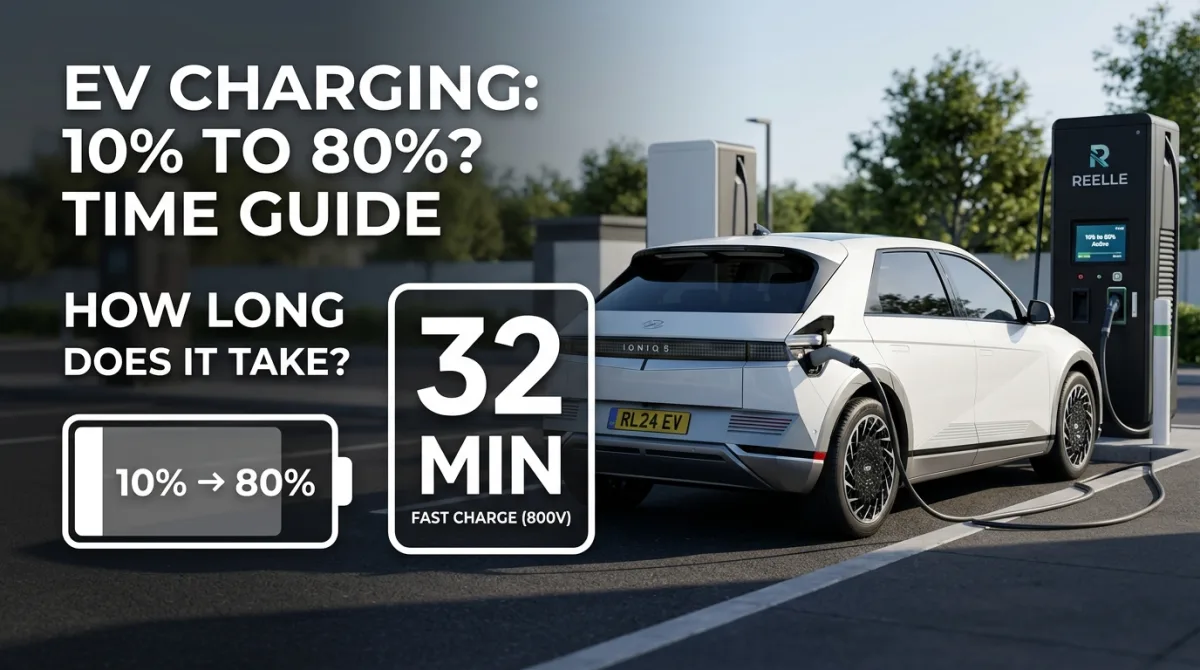
"How long does it take to charge an EV?" has one answer: it depends entirely on the charger. From a 12-hour overnight top-up to a 20-minute road-trip splash-and-dash, the range of possibilities is enormous.
Here's every realistic charging scenario, from 10% to 80%, in 2026.
Charging speed at a glance
| Charger type | Typical power | 10–80% time (60 kWh car) | Best for |
|---|---|---|---|
| Level 1 (home wall socket) | 2–3 kW | 14–20 hours | Emergency / last resort |
| Level 2 home wallbox | 7–22 kW | 3–6 hours | Overnight charging |
| Level 2 public | 11–43 kW | 2–4 hours | Destination charging |
| DC fast (50 kW) | 50 kW | 60–75 min | Quick top-up |
| DC fast (150 kW) | 150 kW | 25–35 min | Standard road trips |
| DC ultra-fast (350 kW) | 350 kW | 15–20 min | 800V cars on long trips |
> The times assume a typical 60 kWh battery. Bigger batteries take proportionally longer; 800V cars charge the fastest (see 800V explained).
The two charging worlds
Home charging (Level 1 & 2) — overnight, while you sleep
- A 7kW wallbox adds ~25–35 miles of range per hour
- Plug in at 20%, wake up at 100% — the car is always full
- 90% of all EV charging happens at home
Public fast charging (DC) — road trips, on the move
- A 150 kW charger adds ~150 miles of range in 15–20 minutes
- The 10%→80% window is the sweet spot: fastest power, then it slows
- 80%→100% can take as long as 10%→80% — avoid it on road trips
Why 80% is the magic number
Fast charging tapers dramatically above 80% state of charge to protect the battery:
- 10–50%: near-maximum speed
- 50–80%: gradually slowing
- 80–100%: very slow (often ~30-40 kW)
On a road trip, charging to 80% and moving on is almost always the fastest strategy. The charging cost calculator and trip planner both use this real curve.
Real-world examples
| Scenario | Time to add 150 miles |
|---|---|
| Home wallbox (7kW) | ~5 hours (overnight) |
| Home wallbox (22kW, if your car supports it) | ~1.5 hours |
| Public AC charger (11kW) | ~3 hours |
| 50 kW DC fast | ~40 min |
| 150 kW DC fast | ~15 min |
| 350 kW DC (800V car) | ~10 min |
How to always charge as fast as possible
- Use the car's navigation to a charger — it preconditions the battery, unlocking full speed
- Arrive low (10–15%) — charging is fastest at low state of charge
- Leave at 80% on road trips
- Check the charger's real power — many "150 kW" units deliver less
- Use an 800V car on 250 kW+ chargers if speed is your priority
FAQ
How long does it take to charge an EV from empty? With a home wallbox: 6–10 hours overnight. At a 150 kW fast charger: ~40 minutes to 80%. There's no single answer — the charger defines the time.
Is it OK to charge an EV every night? Yes — this is the recommended pattern. Charge to your daily limit (usually 80%, or 100% for LFP) nightly and top up as needed. See EV battery degradation.
Why is my EV charging slower than advertised? Cold battery, high state of charge, a busy or derated charger, or a 400V car on a very high-power charger. Preconditioning fixes most of it.
The bottom line
Charge at home overnight and your EV is always full — that's the experience 90% of owners live. Use DC fast charging at 10→80% for road trips, and you'll stop for coffee-length breaks. The golden rule: overnight at home, 10-to-80 fast, and never chase the last 20%.