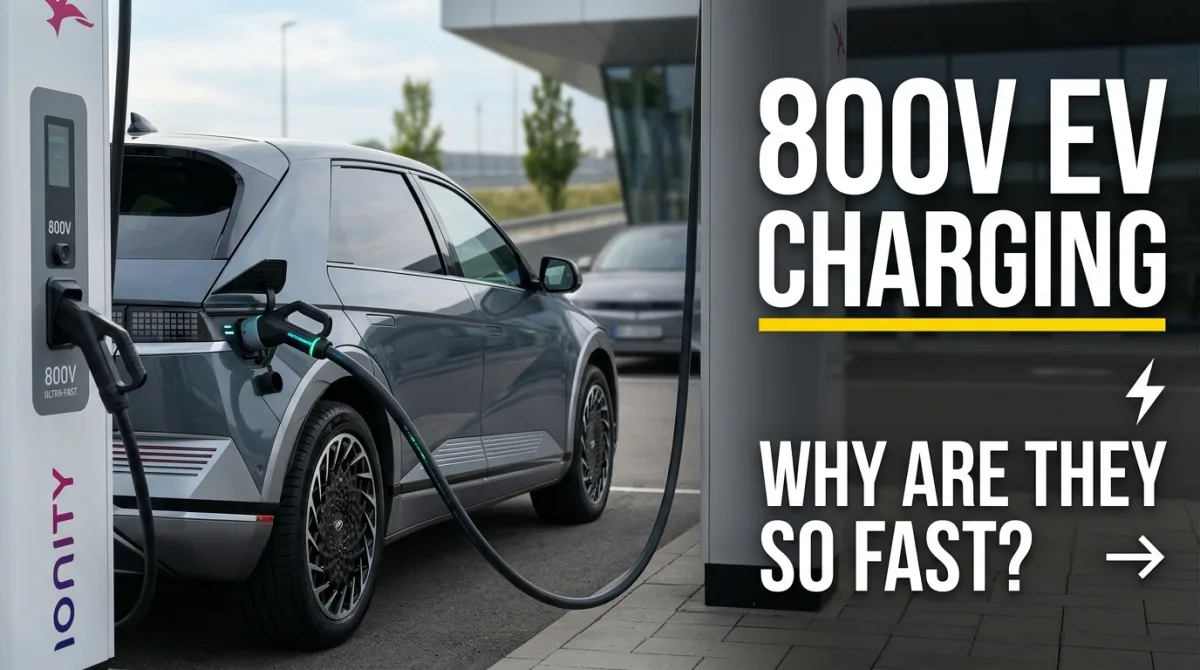
If you've seen an EV add 200 miles of range in the time it takes to get a coffee, you've seen 800V architecture in action. It's the tech behind the fastest-charging cars on the road — and in 2026 it's spreading to mainstream EVs.
Here's what 800V actually is, why it charges so fast, and whether you should care.
The basics: volts, amps, and why it matters
Charging power = voltage × current. Simple math:
- 400V car at 250A → 100 kW
- 800V car at 250A → 200 kW
- 800V car at 500A → 400 kW
Doubling the voltage lets you double the charging power at the same current — and high current is what generates heat and requires thick, heavy cables. That's the whole trick.
Why 800V charges so much faster
| 400V system | 800V system | |
|---|---|---|
| Typical charging voltage | 400 V | 800 V |
| Charging power at 300A | 120 kW | 240 kW |
| Peak charging | 150–250 kW | 300–400 kW |
| Cabling | Heavier, more losses | Lighter, less losses |
| Charging heat | More | Less |
Higher voltage = more power, less heat, less weight. That's why 800V cars can sustain high charging speeds for longer — the charging curve stays flat where 400V cars taper off.
The other 800V benefits
Fast charging is the headline, but 800V helps elsewhere:
- Better efficiency — less energy lost as heat in the wiring and powertrain
- Lighter wiring — thinner cables save weight (and cost)
- Faster acceleration — motors can be more powerful for the same current
- Smaller, cheaper motors — the same output with less material
Which cars use 800V in 2026?
Pioneers: Porsche Taycan, Audi e-tron GT, Hyundai Ioniq 5/6, Kia EV6/EV9
Newcomers: Volvo EX90, Polestar 3, Lucid Air (900V), and a wave of Chinese EVs (BYD, Nio) that adopted it early
Still 400V: most Teslas, BMW i4, VW ID.4, and budget EVs (where cost matters more than speed)
The industry is converging on 800V for new premium/mid-range platforms — it's becoming the new normal rather than a luxury extra.
Does 800V matter for you?
Yes, if you road-trip. The difference is real:
- 400V EV: ~20–30 minute charging stops
- 800V EV: ~15–20 minute stops, more often at full speed
Less important if you mostly charge at home. An overnight AC charge takes hours either way — voltage architecture is irrelevant. Home chargers are limited to 7–22 kW regardless.
Budget consideration: 800V adds cost. LFP + 400V (like budget EVs) delivers excellent value for city driving.
One honest caveat
800V only helps if the charger delivers the power. Many public chargers are capped at 150–350 kW, and the car needs a warm battery. On a 150 kW charger, a great 800V car charges at exactly the same speed as a good 400V car. The 800V advantage only appears on 250+ kW chargers.
FAQ
What does 800V mean on an EV? It's the voltage of the car's battery/electrical system, around 800 volts instead of the older 400V standard. It enables much faster DC charging and better efficiency.
Is 800V better? For fast charging and efficiency — yes. For budget or city driving — the practical difference is small.
Which 800V EV should I buy? The Hyundai Ioniq 5 and Kia EV6 are the value picks; Porsche Taycan is the performance benchmark. See the fastest-charging EVs of 2026.
The bottom line
800V is the reason EV road trips stopped being a chore. It doubles charging speed, improves efficiency and is quickly becoming standard on new EVs. If you travel long distances, it's worth the premium; if you charge at home, treat it as a nice-to-have rather than a must-have.