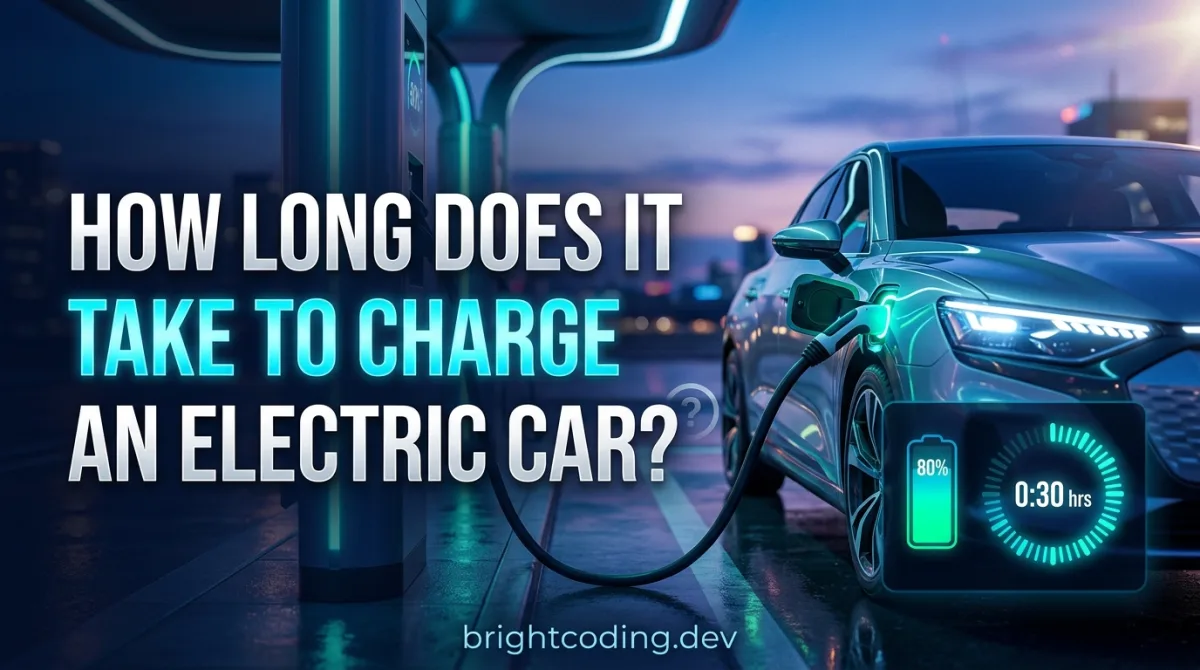
Short answer: anywhere from about 20 minutes to more than 30 hours, and both numbers can be true for the same car. Charging time is not a fixed spec. It depends on three things you control or can look up: the size of the battery, how empty it is, and how much power the charger and the car can actually deliver together.
By the end of this guide you will be able to estimate your own charging time in a couple of minutes, pick the right charge level for the situation, and spot the bottlenecks that make people think their car is broken when it is just charging on a weak outlet. Working through the steps below takes about 10 minutes with a phone and your car's manual or app.
What you need before you start
Grab these, nothing exotic:
- Your car's usable battery capacity in kilowatt-hours (kWh). It is in the manual, the door jamb sticker, or the car's app. If you cannot find it, search your exact model.
- Your car's onboard charger rating in kilowatts (kW) for AC charging. This is the number that limits home charging, not the wallbox rating.
- Your car's maximum DC fast-charging rate in kW. Often quoted as a peak, and it only holds at low state of charge.
- The charger's output in kW, or its amps and volts if it is a plain socket.
- A charging app or the car's own screen to read state of charge (SoC) in percent.
- No account needed for the maths below. You can do all of it on a calculator.
A quick unit reminder: kWh is energy (the size of the tank), kW is power (the speed of the pump). Divide kWh by kW and you get hours. That one division is the whole method.
Step 1: Find your battery size and your starting state of charge
Write down two numbers: usable battery capacity in kWh, and current SoC as a decimal. If you are at 30 percent, that is 0.30.
Energy you need to add = capacity x (target SoC - current SoC).
Say you have a 60 kWh usable battery, you are at 20 percent, and you want 80 percent. That is 60 x (0.80 - 0.20) = 36 kWh to add. That figure, not the full battery size, is what drives your time. People who quote "it takes 8 hours to charge my car" are usually quoting a 0 to 100 percent figure they never actually use.
Tip: usable capacity is lower than the marketing number on some cars because the pack reserves a buffer at the top and bottom. Use the usable figure if you can find it, or accept that your estimate will be a little optimistic.
Step 2: Identify which charging level you are on
There are three practical levels, and mixing them up is the number one source of confusion.
- Level 1: a normal household outlet, typically 1.2 to 2.4 kW depending on your region and circuit. Add roughly 5 to 15 km of range per hour. Fine for a plug-in hybrid or a very low-mileage week.
- Level 2: a dedicated wallbox or public AC post, commonly 3.6 to 22 kW. The car's onboard charger caps what it can accept, so a 22 kW post does nothing extra for a car limited to 7 kW or 11 kW.
- DC fast charging: 50 kW up to 350 kW and beyond. This is the only level that charges a car in the time it takes to drink a coffee, and only in the right conditions.
Tip: check the onboard charger rating before you buy a wallbox. Buying a 22 kW box for a car with an 11 kW onboard charger is money spent on a number you will never see.
Step 3: Do the division for AC charging
For AC charging, the maths is honest and predictable:
Time (hours) = energy to add (kWh) / the lower of (charger output, onboard charger rating).
Our 36 kWh example on an 11 kW onboard charger with an 11 kW wallbox: 36 / 11 = about 3.3 hours. On a 7 kW setup: about 5.1 hours. On a 2.3 kW household outlet: roughly 15 to 16 hours, which is realistically an overnight-plus situation.
Charging efficiency costs you something, typically in the region of 5 to 15 percent, because the onboard charger and battery conditioning consume power. So add a little to your result. If you want this done for you, the free calculators and tools on this site include charging-time and cost estimators that handle the unit conversion and efficiency for you.
Tip: AC charging is almost linear. If you are at 50 percent and want 100 percent, it really does take about as long as the maths says. This is why home charging is boring in the best way.
Step 4: Understand why DC fast charging is not linear
DC fast charging follows a curve, not a straight line. It is fastest when the battery is low and progressively slower as it fills. A car that peaks at 150 kW might only hold that figure between roughly 10 and 40 percent SoC, then taper hard above 80 percent. That is why the last 20 percent can take as long as the first 60.
A realistic planning figure: expect a 10 to 80 percent DC session to take somewhere in the 20 to 45 minute range for many current models, and longer in cold weather or on a 50 kW charger. Your exact figure depends on the model and conditions, so verify against your car's spec and a real-world test if it matters.
Tip: for road trips, plan to arrive at a charger low and leave around 80 percent. You will spend less total time charging than if you chase a full battery at every stop.
Step 5: Check the conditions that slow you down
Before you blame the car, check these:
- Battery temperature. A cold pack charges much more slowly. Many cars precondition the battery when you navigate to a fast charger, and that is worth using.
- State of charge. Above roughly 80 percent, DC speed drops by design to protect the pack.
- Shared power. Some DC sites split output between two stalls. If someone plugs in next to you, your rate can halve.
- Charger derating. Hot cables, faulty cooling or a software limit on the post can cap you well below the advertised figure.
- Cable and connector limits. A tethered cable or adapter rated below your car's maximum will be the bottleneck.
Tip: if a DC session is far slower than expected, try a different stall before assuming a fault. It is frequently the equipment, not your car.
Step 6: Confirm against your own car, then set a routine
Once you have your numbers, sanity-check them with the car's app or the charging screen. Most show both the current power in kW and the estimated time remaining, which lets you verify your estimate in one session.
Then build a routine around it. If your daily drive uses 15 kWh and your home charger delivers 7 kW, you need a bit over 2 hours a night, so a cheap overnight tariff window is plenty. If you cannot charge at home, your charging time is really a scheduling problem, and the model directory is a good place to filter cars by real-world charging behaviour before you commit.
Pro tips
- Charge to 80 percent for daily use and save 100 percent for the day you actually need it. It is faster and gentler on the pack.
- Use the car's route planner to precondition the battery before a fast charger. It is the single biggest free speed-up in cold weather.
- At a busy DC site, pick a stall that shares power with an empty neighbour.
- On AC, the onboard charger is the ceiling. Match your wallbox to it rather than overspending.
- If you only need a small top-up, do not bother with DC. A 30-minute AC stop at a shopping centre is often enough for the trip home.
- Track your real consumption in kWh per 100 km or miles per kWh. It turns all of this from guesswork into arithmetic.
Common pitfalls
- Confusing kW and kWh. This causes every bad estimate. kW is speed, kWh is volume.
- Believing the peak DC number. A 250 kW headline is a peak, not an average. Plan around the 10 to 80 percent window instead.
- Charging to 100 percent on DC every time. It is slow, it stresses the pack, and you rarely need it.
- Assuming a bigger wallbox is always better. The onboard charger caps you, so check that rating first.
- Ignoring temperature. A car that charges fine in summer can feel broken in a cold snap. That is normal behaviour, not a fault.
Useful resources
If your charging is genuinely slower than the maths predicts, and you have ruled out temperature, SoC and the charger itself, move to diagnostics rather than guessing. The troubleshooting guides cover common charging faults in plain steps, and the diagnostic and fuse guides help you check the low-voltage side safely. For anything involving the high-voltage traction battery or its wiring, stop and use a qualified technician. That work is not a DIY job.
If you are still choosing a car, the head-to-head comparisons put charging speed side by side with range and cost, and the blog has practical ownership pieces that go deeper than spec sheets.
FAQ
How long does it take to charge an electric car from empty to full at home? For a typical 60 kWh car on a 7 kW home charger, roughly 8 to 10 hours including efficiency losses. A smaller battery or a faster onboard charger shortens it. Verify with your own capacity and charger rating using the division in Step 3.
Why does fast charging slow down after 80 percent? The battery management system reduces current at high state of charge to protect the cells from heat and stress. It is deliberate, and every modern EV does it to some degree.
Can I charge an EV from a normal wall socket? Usually yes, and it is slow. Expect roughly 1.2 to 2.4 kW, which on many cars means overnight or longer. Check that the circuit is suitable and not shared with heavy loads, and have an electrician confirm if you plan to do it regularly.
Does fast charging damage my battery? Occasional DC charging is normal and expected. Frequent DC charging to 100 percent, especially in extreme temperatures, is harder on the pack than AC charging. Follow the manufacturer's guidance.
Why is my car charging slower than the charger's rating? The car's onboard charger, the battery's state of charge and temperature, a shared stall, or a derated post are the usual causes. Test another stall before assuming a fault.
One last thing
Charging time stops being mysterious the moment you stop thinking in "full" and start thinking in kilowatt-hours added. Do the division once for your car, note your real-world figure, and you will plan trips and overnight charges with confidence. If a number ever looks wrong, check the simple causes first, then work through the diagnostics.
Ready to act on what you just read? Explorethe EV model directory, head-to-head EV comparisons or the free EV calculators and tools. The rest of this site is built to help you take the next step.