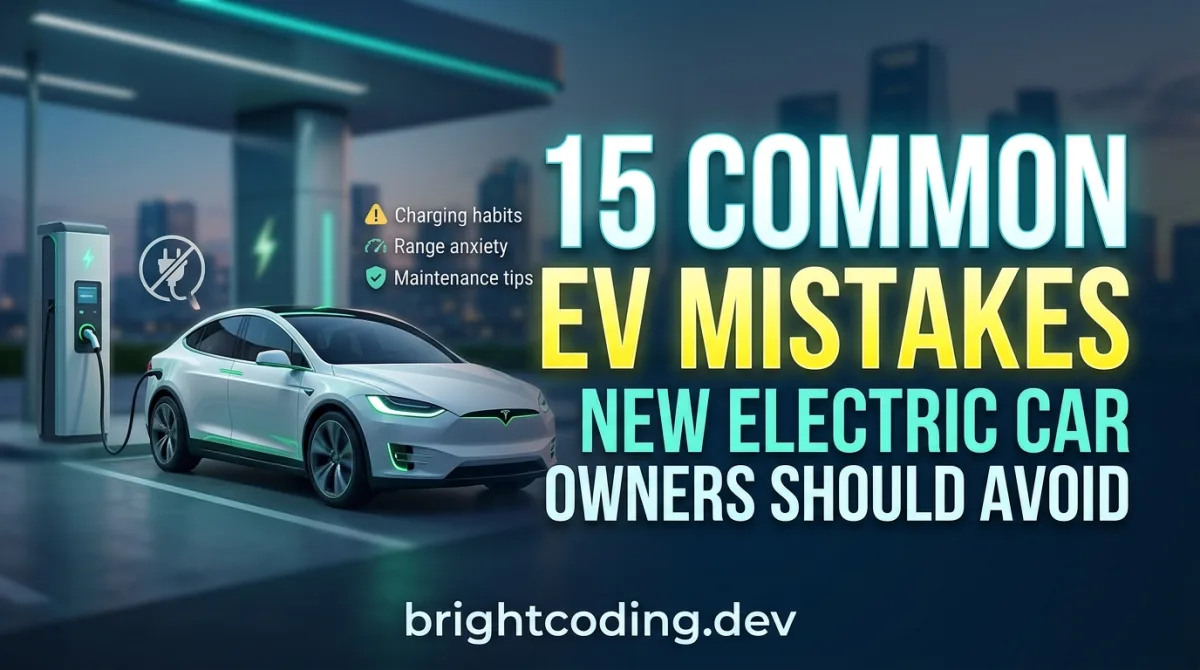
You've signed the paperwork, the car is on the driveway, and you are already second-guessing how you'll charge it, whether the battery is dying, and why the range number keeps changing. Most of these worries come from treating an EV like a petrol car. This piece walks through seven mistakes that trip up first-time owners, what each one actually costs you, and how to sidestep it before it turns into a habit.
Why most people get this wrong
You learned to drive on a car with a fuel gauge, a warm engine, and a petrol station on every corner. An EV plays by different rules: the battery is happiest in a certain temperature window, range estimates move around, and "full" isn't always what you want before a long trip.
Dealers don't help much. A handover usually covers pairing your phone and setting a home-charge schedule, then you're off. Nobody tells you that charging to 100% every night is pointless for daily driving, or that a cold morning can knock a visible chunk off your range estimate before you've moved a metre.
None of this is complicated once you know it. It just isn't obvious.
1: Treating the range estimate as a promise
You charge to 100%, the dash says 320 km, you drive 60 km and it now says 240. Panic sets in.
The estimate is a guess based on recent driving, temperature and how you're using the heater. It's not a fuel gauge with a fixed tank. The consequence is needless anxiety and unnecessary charging stops.
Treat the number as a forecast, not a contract. Watch how it behaves over a week of your normal routes and you'll learn its moods.
2: Charging to 100% every single night
A common one, especially for people coming from a "fill it up" mindset. Plugging in nightly and charging to max feels responsible. It isn't, for daily use.
Most lithium-ion packs are happiest sitting somewhere in the middle of their range. Many manufacturers suggest an 80% cap for routine charging and a full charge only before a long trip. Check your own manual, because chemistries differ.
Set the charge limit once in the car or app and forget it. Save 100% for the morning of a big drive.
3: Buying on range alone and ignoring charging reality
You compare two models, one wins on paper range, and you buy it. Then you discover you can't charge at home because you're in a flat with no driveway, and the nearest rapid charger is a 20-minute detour.
Range gets the headlines, but charging access decides whether EV ownership is easy or annoying. Before you commit, check what you can actually do at home, at work, and on your regular routes.
If you're still weighing models, the head-to-head EV comparisons are a better starting point than a spec sheet, and you can browse the full EV model directory by body style and use case.
4: Running the battery near empty "to test it"
A new owner decides to see how far it really goes. They roll into a charger on 2%, sweating.
Doing this once is a story. Doing it regularly is a bad habit. Deep discharges stress the pack, and some cars limit power or climate control when the battery is very low. You also lose the buffer you might need for a detour or a broken charger.
Keep a comfortable floor, say 15-20%, and charge before you get close to it.
5: Believing you can service the whole car yourself
An EV has fewer moving parts, so it's tempting to assume it's simpler to maintain at home. Brakes, tyres, cabin filters, wipers, 12V checks: yes, much of that is within reach for a careful owner.
The traction battery and its high-voltage cabling are a different world. That's not a DIY zone, full stop. If a fault points there, stop and book a qualified technician.
For the low-voltage side, the EV diagnostic and fuse guides cover the checks that are safe to do yourself, and the EV troubleshooting guides help you sort warning-light worries from real faults.
6: Ignoring the 12V battery because "it's an EV"
The big battery gets all the attention, but the small 12V battery still runs the electronics, lights and computers. When it fades, you can get a car that won't start even with a healthy traction pack.
People miss it because they assume an EV has no "car battery" to worry about. The consequence is a no-start on a cold morning and a confusing warning light.
Have the 12V battery checked at service intervals, and learn where it lives. Jump-starting procedure varies by model, so read your manual first.
7: Assuming public charging is always plug-and-go
You pull up to a rapid charger, plug in, and nothing happens. The app wants an account, the session fails, or the cable is too short to reach your port.
New owners often assume public charging works like a petrol pump. It doesn't. Networks differ, apps differ, and a charger can be down without any sign saying so.
Plan a long trip with a backup charger in mind, and test one public charge before you need it in anger. Ten minutes of practice now saves an hour of frustration later.
Do this instead
A short list of habits that make the first few months easy:
- Set a daily charge limit, usually around 80%, and raise it only for long trips.
- Keep the battery between roughly 20% and 80% in normal use.
- Learn your real range over a week of your own driving, not the dashboard's best guess.
- Sort out home or workplace charging before you rely on public networks.
- Test one public charger on a quiet day so the first time isn't a trip.
- Check the 12V battery at service time and know where it is.
- Leave high-voltage work to a qualified technician, always.
- Use the free EV calculators and tools to work out charging costs and running figures before you commit to a model.
FAQ
Is it bad to charge my EV to 100% every day? For most lithium-ion packs, daily full charges aren't ideal. Many makers recommend an 80% limit for routine use and a full charge before long journeys. Check your manual for your specific car.
Why does my range drop so much in cold weather? Cold slows the battery's chemistry and the cabin heater draws power. A noticeable drop is normal. Preconditioning the car while plugged in helps.
Can I jump-start an EV like a petrol car? You can usually jump the 12V battery, but the procedure differs by model. Follow your manual exactly, and never touch the high-voltage system.
Do EVs need less maintenance? Fewer fluids and no oil changes, but tyres, brakes, cabin filters and the 12V battery still need attention. Budget for those.
What should I check before buying a used EV? Battery health, charging history, software updates and whether the car can still use current public chargers. A pre-purchase inspection by an EV-aware technician is worth it.
The biggest mistake is treating an EV like a petrol car; learn its habits early and the rest gets easy.