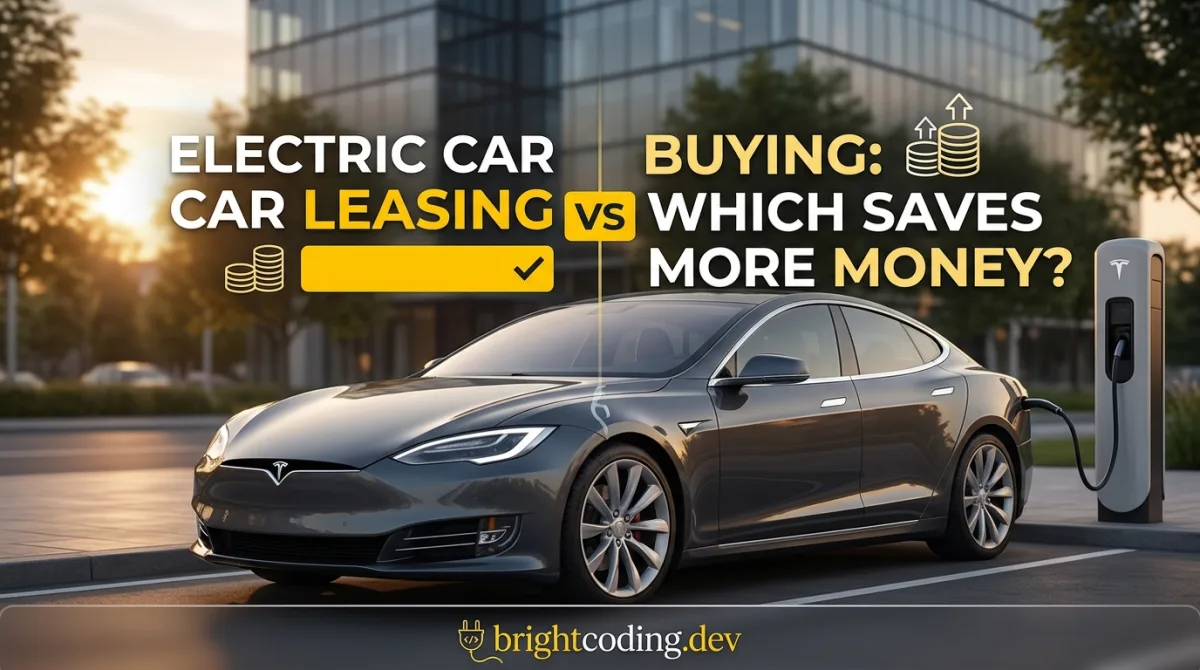
Leasing an electric car currently accounts for nearly 59% of all new EV transactions in the United States, compared to just 20% for traditional gas-powered vehicles. Rapid battery advancements, steep price cuts from major manufacturers, and shifting federal incentives have completely flipped traditional car-buying logic on its head.
Choosing the wrong financing method for an EV can easily cost you upwards of $12,000 over a three-year ownership cycle. Understanding how residual values, software updates, battery degradation, and tax loopholes impact your wallet is critical before signing any dealership paperwork.
Here is a direct financial breakdown of how leasing and buying stack up across real-world metrics.
Head-to-Head Comparison
Navigating the financial differences between financing a purchase and signing a lease requires looking closely at total outlay, tax benefits, and long-term risk. Below is a realistic comparison based on a standard $48,990 battery-electric vehicle driven 12,000 miles per year.
| Specification | Leasing (3-Year Term) | Buying (5-Year Loan) |
|---|---|---|
| Average Monthly Payment | $429 per month | $785 per month |
| Upfront Down Payment | $3,500 average | $5,000 average |
| Federal Tax Credit Access | Instant via lease loophole | Subject to strict income limits |
| Out-of-Warranty Repair Risk | 0% covered by factory warranty | High after 3 years or 36,000 miles |
| 3-Year Depreciation Impact | Absorbed by leasing company | $24,500 average loss in value |
- Commercial clean vehicle rules allow leasing companies to pass the $7,500 tax credit directly to consumers regardless of strict buyer income caps.
- Buying requires a substantially higher monthly outlay, averaging $356 more per month than a lease payment on identical $48,990 models.
- Depreciation hits EV owners harder than gas car owners, with average battery-electric models losing 49% of their value after 36 months.
- Lease agreements cap annual mileage, typically charging $0.25 per extra mile if you exceed the standard 12,000-mile allowance.
The Depreciation Trap and Federal Loophole Dynamics
Rapidly evolving battery chemistry makes buying an EV a unique financial risk compared to traditional combustion vehicles. A brand-new EV equipped with a 300-mile range battery today could see its resale value plummet when next-generation solid-state batteries offering 500 miles arrive in showrooms. Owners who bought their EVs in 2022 saw average resale values drop by 32.8% in a single year as major automakers slashed retail prices across popular models like the Tesla Model Y and Ford Mustang Mach-E.
Leasing shields drivers from this severe market volatility by shifting residual value risk entirely to the finance company. Furthermore, Section 45W of the Internal Revenue Code creates a unique loophole where leased EVs qualify for the full $7,500 commercial vehicle credit. This bypasses strict North American final assembly rules and battery material sourcing requirements that restrict standard purchase credits for high-income buyers.
"Leasing has become the ultimate hedge against rapid EV obsolescence," says Marcus Vance, Chief Automotive Analyst at EV Market Insights. "You let the lender carry the heavy depreciation burden while enjoying significantly lower monthly payments and guaranteed access to full tax incentives."
When you buy, you build equity after your five-year or six-year loan term ends, but that equity depends heavily on long-term battery health. A replacement battery pack for an out-of-warranty EV currently costs between $8,000 and $16,500, which heavily suppresses trade-in valuations on older electric cars. Buyers who retain their vehicles for eight to ten years can eventually offset depreciation through total fuel and maintenance savings, but short-term buyers almost always lose money.
Tips and Tricks
- Exploit the lease credit pass-through: Ask the dealer explicitly to apply the $7,500 commercial tax credit directly as a capital cost reduction on your lease contract to instantly lower your payment by roughly $208 per month.
- Negotiate the money factor: Convert the lease money factor to an equivalent interest rate by multiplying the decimal by 2,400 to ensure you are paying less than a 5.5% effective APR on your lease agreement.
- Buy out favorable leases: Check your end-of-lease buyout price against current used market values, because if your car is worth more than the pre-set residual value, you can purchase it and instantly capture $3,000 or more in equity.
- Plan your home charging install: Install a dedicated Level 2 240-volt charger before taking delivery to cut home charging costs to $0.04 per mile compared to public fast-charging rates of $0.16 per mile.
- Avoid long loan terms: Limit purchase loans to a maximum of 48 months to prevent carrying negative equity on an asset that depreciates by up to 50% across its first three years.
The Verdict
Leasing is the smartest financial option for drivers who want lower monthly payments, access to cutting-edge battery technology, and protection against steep depreciation. Buying makes far more sense for high-mileage drivers who plan to keep their vehicle for more than seven years to fully eliminate monthly payments and accumulate overall savings. Which financing route aligns best with your personal driving habits and budget?