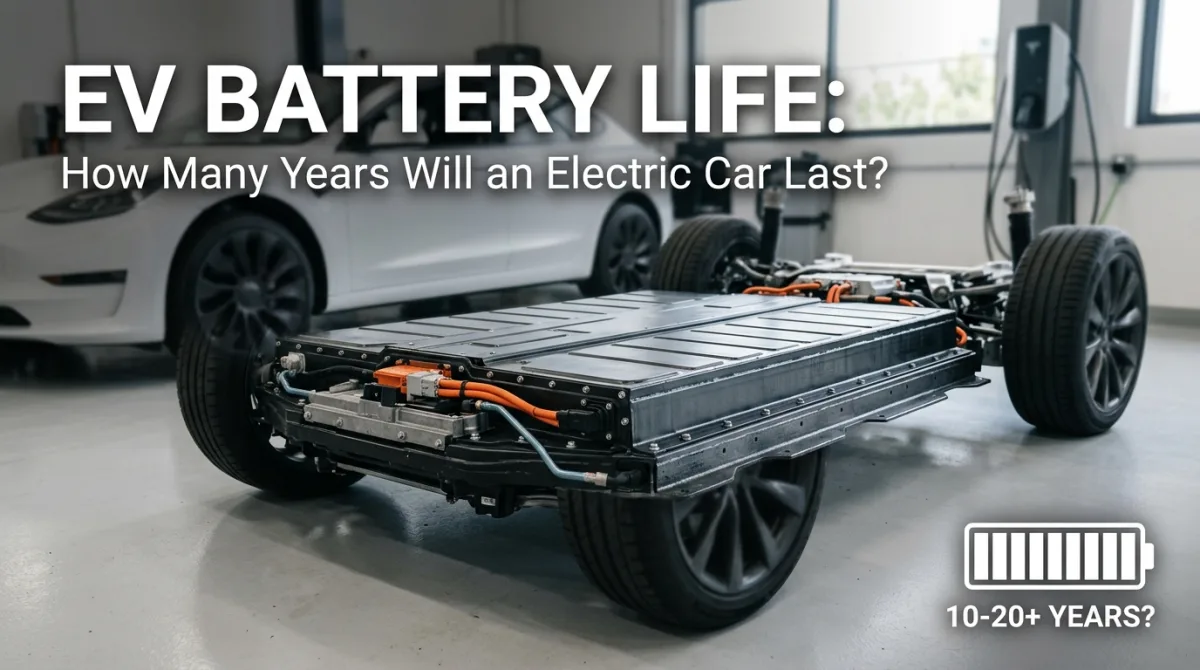
The battery is the most expensive component in an EV — and the biggest source of anxiety for new buyers. "Will my battery die in five years?" is the question we hear most.
The reassuring answer, backed by real fleet data: modern EV batteries outlast the cars around them. Here's what the science actually says.
How long does an EV battery last in 2026?
| Metric | Typical modern EV |
|---|---|
| Battery warranty | 8 years / 100,000 miles (many more) |
| Capacity retained after 5 years | 90–95% |
| Capacity retained after 10 years | 80–88% |
| Practical battery life | 15–20 years of typical driving |
| Distance before major degradation | 200,000–300,000 miles |
The battery in your EV will almost certainly outlive the car — and most people keep a car for 8–10 years.
What the real data shows
Fleet studies (Tesla, Nissan, and third-party data from companies like Recurrent) consistently show:
- Average degradation is only ~2% per year in the first 5 years
- Modern EVs routinely pass 150,000 miles with 85%+ capacity
- LFP batteries (now standard in many models) have dramatically slower degradation than older chemistries — see our LFP vs NMC guide
- Batteries don't fail suddenly — they fade gradually, and even at 80% capacity the car remains perfectly usable
The three things that age a battery
- Extreme heat — the #1 factor. Parking in direct sun in hot climates ages cells faster than anything else.
- Sustained high charge states — keeping the battery at 100% for long periods, especially in heat.
- Frequent fast charging — DC fast charging adds heat and micro-stress. Used occasionally it's fine; as a daily habit it accelerates aging.
Modern battery management systems (BMS) handle most of this automatically. Your job is mostly to avoid the worst habits.
How to make your battery last longer
- Set charge limit to 80% for daily driving (charge to 100% only before long trips)
- Avoid deep discharges — recharge before dropping below ~20% when practical
- Park in shade during hot summer days
- Use scheduled/preconditioned charging so the car charges at cooler times and stops when you leave
- Don't obsess — modern batteries forgive occasional lapses
> Curious how your habits affect battery life? The battery degradation calculator models capacity loss for your driving pattern.
The warranty safety net
Every major EV brand warranties the battery against failure and excessive degradation:
- 8 years / 100,000 miles is the industry baseline
- Many brands cover up to 150,000 or 200,000 miles (Hyundai, Kia, Tesla in some markets)
- If the battery drops below ~70% capacity under warranty, most brands will repair or replace it
That means even the "worst case" is usually covered for a decade.
FAQ
Will my EV battery need replacing? Probably not during your ownership. Battery replacement is rare — degradation is gradual and the car remains usable for 15–20 years. That's why the real 5-year cost of EV ownership is so favorable.
How many years does an EV battery last? Realistically 15–20 years, with typical use. The industry warranty floor is 8 years, but actual longevity is roughly double that.
What happens when the battery is at 80%? The car still works perfectly — you just have slightly less range. At 80% capacity, a 300-mile car still does 240 miles, which is plenty for daily driving.
The bottom line
An EV battery will comfortably last 10–15+ years for the average driver, with degradation of roughly 1–2% per year. It is not a ticking time bomb — it's the most durable component in the car. Buy your EV, follow the simple charging habits above, and forget about the battery until the odometer passes 200,000 miles.