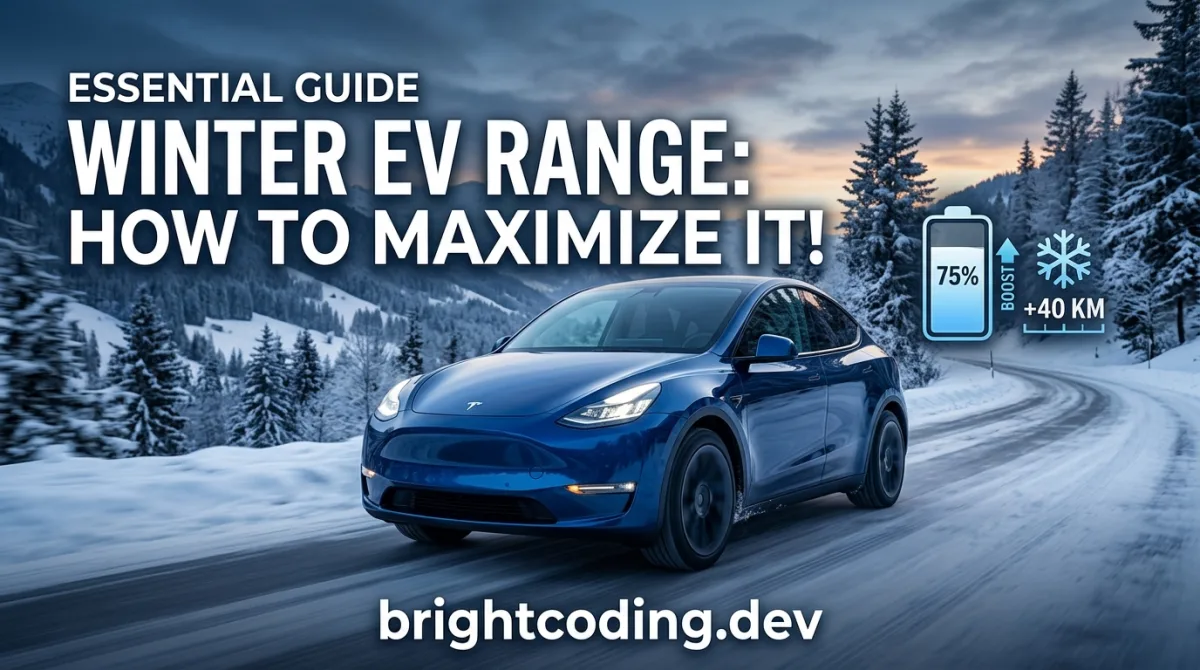
Cold weather takes a bite out of every EV's range. How big a bite depends on your car, your route and how you treat the cabin heater. If you follow the steps below, most drivers can claw back a meaningful chunk of that lost range, often somewhere in the 10-30% region, though the exact figure varies a lot by model, temperature and driving style. You should be able to work through the whole list in about 20 minutes of setup, then a few small habit changes over the following week.
The goal here is practical: fewer charging stops, less range anxiety and a warmer, smarter winter routine.
What you need before you start
- Your car's own app, if it has one (most do). This is for pre-conditioning and checking charge state.
- A tire pressure gauge, ideally a digital one.
- Your car's trip computer or energy-consumption screen, set to show kWh/100 km, kWh/100 mi or Wh/km depending on your region.
- A note of your current tire pressures from the door-jamb sticker, not the tire sidewall.
- Optional but genuinely useful: a plug-in energy monitor or your home charging app's session history.
- No account or paid tool required for the steps below.
One safety note before anything else: everything in this guide is low-voltage or software work any careful owner can do. Do not open the traction battery pack, the orange high-voltage cabling or the onboard charger housing. That is high-voltage work and belongs to a qualified technician, always.
Step 1: Check your tire pressures cold, and set them to the door sticker
Under-inflated tires are the cheapest range leak to fix. Cold air is denser, so tires lose pressure in winter anyway, and every few PSI below spec adds rolling resistance.
Do this first thing in the morning, before the car has moved, so the tires are genuinely cold. Check the sticker on the driver's door jamb (or fuel-filler flap on some models) and inflate to that number in bar or PSI, whichever your gauge uses. Do not inflate to the maximum printed on the tire sidewall, that is a limit, not a target.
Tip: recheck monthly through winter. A 10°C drop in ambient temperature can knock roughly 1 PSI off a tire.
Step 2: Pre-condition while still plugged in
Pre-conditioning means warming the cabin and, on many cars, the battery, while the car is still connected to the charger. The energy for that warmth comes from the wall, not your battery, so you leave with a full pack and a warm interior.
In your car's app or infotainment menu, look for a departure time, climate schedule or "precondition" option. Set it for 10-20 minutes before you leave. If your car supports battery pre-conditioning (often tied to a scheduled departure or a charger-navigation feature), enable that too, it helps both range and charging speed.
Tip: if you have no charger at home, a 5-minute pre-heat on battery is still better than heating the cabin from cold while driving, but you will pay for it in range.
Step 3: Heat the seats and steering wheel, not the air
Resistive cabin heaters are the single biggest winter range drain on most EVs. Heated seats and a heated steering wheel warm you directly for a fraction of the energy.
Turn the cabin temperature down a few degrees (try 18-19°C instead of 21-22°C), then switch on seat and wheel heating to compensate. On many cars this alone is worth several percent of range. If your car has a heat pump, you will lose far less to cabin heating than a resistive-only model, which is one of the real differences worth checking when you compare EVs head to head.
Tip: use the "auto" climate setting and lower the target temperature rather than fiddling with fan speed. Auto usually manages defogging better than manual.
Step 4: Use eco mode and dial back the right pedal
Eco or eco-climate mode typically softens throttle response, limits peak power and reduces heater draw. It is not magic, but it nudges your driving style in the right direction.
Select Eco (or your car's equivalent) in the drive mode menu. Then drive smoothly: gentle acceleration, earlier lift-off, and let regenerative braking do the slowing where it is safe. Watch your live consumption readout and try to keep it under your typical summer figure.
Tip: on cars with adjustable regen, a higher regen setting helps in stop-start traffic but can feel grabby on ice. Match it to conditions, not to the number.
Step 5: Reduce motorway speed a little
Aerodynamic drag rises with the square of speed, so high-speed cruising is where winter range vanishes fastest. Dropping from, say, 120 km/h to 100 km/h can make a noticeable difference, though the exact gain depends on the car.
On a long winter trip, set cruise control a bit lower than you would in summer and hold it steady. Steady speed beats constant surging.
Tip: if your car shows estimated range, watch how quickly it falls at different speeds on the same route. That personal data beats any generic figure.
Step 6: Plan charging stops and pre-warm the battery for DC fast charging
A cold battery charges slowly. Many EVs will warm the pack automatically when you navigate to a fast charger, but only if you use the car's built-in navigation to the charger, not a third-party map on your phone.
Enter the charger as a destination in the car's nav so battery pre-conditioning can trigger. Arrive with a lower state of charge where practical, since charging is fastest in the lower half of the pack. Expect winter DC speeds well below summer peaks, and plan an extra 10-20 minutes per stop.
Tip: for route planning, use the free EV calculators and tools on this site to sanity-check consumption and charging time before you set off.
Step 7: Park smart and keep the car plugged in when you can
A plugged-in car can keep its battery conditioned and its cabin warm without draining the pack. A garage, even an unheated one, is warmer than a windswept street.
Where possible, park plugged in, especially overnight in a cold snap. If you cannot, at least park out of the wind and, on very cold nights, accept that some range will be gone in the morning.
Tip: if you only have a slow granny charger, leaving it connected overnight still helps, it just conditions more slowly.
Step 8: Cut unnecessary loads and check for winter faults
Roof racks, bike carriers and snow build-up on the roof all cost range. So does a dragging brake or a failing 12V battery, which can quietly hurt efficiency and cause odd warnings.
Remove roof accessories when not in use and clear snow and ice fully, not just the windows. If you notice new warning lights, unusual consumption or a car that will not wake from sleep, work through the EV troubleshooting guides and the EV diagnostic and fuse guides before assuming it is "just the cold".
Tip: a weak 12V battery is a common winter culprit. It is low-voltage and owner-replaceable on many cars, but check your manual first.
Pro tips
- Charge to a lower target (for example 80%) for daily winter driving unless you need the full pack. It is gentler on the battery and faster to top up.
- Schedule charging to finish just before you leave, so the pack is still warm from charging.
- Combine trips. One long warm drive beats several cold short ones, because the cabin and battery only heat up once.
- Use the defroster sparingly and clear windows manually where safe. Defrost modes pull serious power.
- Keep an eye on your consumption trend over a week, not a single trip. Winter range varies day to day with temperature and wind.
- If you are still choosing a car, winter behaviour is a genuine differentiator. Check real-world winter figures where you can, and use the EV model directory to shortlist candidates.
Common pitfalls
- Inflating tires to the sidewall maximum. That is a safety limit, not a recommendation. Use the door sticker.
- Pre-heating on battery when you could be plugged in. It works, but it costs range you were trying to save.
- Blasting the cabin heater and ignoring seat heating. You are spending battery energy to warm air you are not sitting in.
- Assuming a cold battery is a broken battery. Slow winter charging and reduced range are usually normal. Only investigate if behaviour is clearly abnormal, and use the troubleshooting guides to tell the difference.
- Trusting the range estimate blindly. The guess-o-meter recalibrates as it learns your winter habits. Cross-check with your own consumption numbers.
Useful resources
- Compare winter-relevant models side by side with head-to-head EV comparisons: https://ev.brightcoding.dev/compare
- Browse models and specs in the EV model directory: https://ev.brightcoding.dev/vehicles
- Run your own consumption and charging numbers with the free EV calculators and tools: https://ev.brightcoding.dev/tools
- Work through faults with the EV troubleshooting guides: https://ev.brightcoding.dev/troubleshooting
- Dig into warning lights, fuses and low-voltage issues with the EV diagnostic and fuse guides: https://ev.brightcoding.dev/diagnostics
- Read more owner-focused articles on the EV blog: https://ev.brightcoding.dev/blog
For general background, official government efficiency sites and your car's own owner's manual are worth keeping bookmarked, and always verify model-specific figures against your manufacturer's documentation.
FAQ
How much range do I actually lose in winter? It varies widely. A common rough range is 10-30% in mild cold and more in severe cold, especially on short trips where the cabin never fully warms. Cars with a heat pump tend to lose less. Treat any single number as a guide and check your own car's behaviour.
Does pre-conditioning use my battery? If the car is plugged in, the energy mostly comes from the wall. If it is not plugged in, it comes from the battery and costs range.
Is it bad to fast charge in the cold? No, but it will be slower until the battery warms. Use the car's navigation to the charger so battery pre-conditioning can run, and expect longer stops.
Should I charge to 100% in winter? Only when you need the full range for a long trip. For daily driving, a lower target such as 80% is usually kinder to the battery and quicker.
Can I fix winter range loss myself? Most of it is driving style, heating choices, tire pressure and planning, all of which you can control. If range drops far below what the cold explains, or warnings appear, get it checked. High-voltage and traction-battery work always needs a qualified technician.
Final word
Winter will always cost you some range, but it does not have to ruin your week. Set your tire pressures, pre-condition while plugged in, lean on seat heating, plan your charging, and the car will feel far less nervous in the cold. Start with steps 1 to 3 today, they are the biggest and easiest wins, and build the rest into your routine over the next few drives.
Ready to act on what you just read? Explorethe EV model directory, head-to-head EV comparisons or the free EV calculators and tools. The rest of this site is built to help you take the next step.