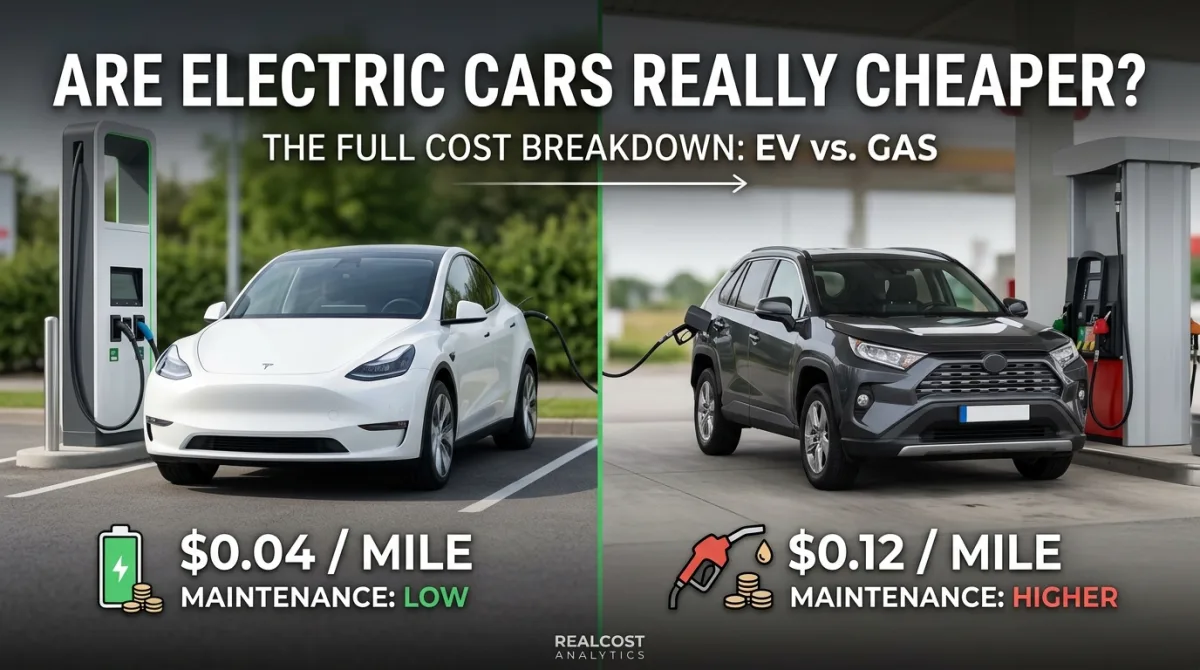
"Are electric cars really cheaper?" It's the most-asked question in EV research — and the answer is genuinely complicated. The truth depends on your mileage, your electricity price, your gas price, where you charge, and what you're comparing against.
Let's break down the full cost of EV ownership in 2026 — the honest version.
The three cost layers of any car
- Buying it — purchase price, incentives, financing, depreciation
- Running it — energy/fuel, insurance, maintenance, tires
- Living with it — charging setup, time spent refueling, resale value
Most comparisons only look at layers 1 and 2. The real picture needs all three.
Layer 1: Buying an EV in 2026
The sticker gap is shrinking fast. An equivalent EV now costs $3,000–$8,000 more than a gas car upfront — but incentives often flip the equation:
- US federal credit: up to $7,500 at point of sale
- France: up to €7,000 income-tested bonus
- Norway: ~25% VAT exemption
- Company-car schemes (Netherlands, UK): dramatic tax savings
After incentives, a new EV is often cheaper than the gas equivalent on day one. Our EV incentives calculator shows your exact number by country.
Layer 2: Running an EV (the real win)
| Cost per year (15,000 km) | Gas car | EV home charging | EV public charging |
|---|---|---|---|
| Energy | $1,650 | $450 | $1,100 |
| Maintenance | $700 | $350 | $350 |
| Insurance | $1,400 | $1,550 | $1,550 |
| Total | $3,750 | $2,350 | $3,000 |
With home charging, the EV is ~$1,400/year cheaper to run. Even public-only charging is cheaper. The numbers are strongly in the EV's favor here — as long as you charge at home.
Layer 3: Depreciation — the wild card
This is where the "EVs are more expensive" argument is actually true in some cases:
- New EVs depreciate faster than gas cars in many markets — up to 50% in 3 years for less popular models
- Used EVs are therefore incredible value
- Tesla and high-demand models hold value much better
The takeaway: depreciation is the biggest EV cost you can control. Buy used or buy high-demand, and the math swings hard in your favor.
The break-even analysis
How long until the EV's savings pay back its price premium?
| Scenario | Break-even |
|---|---|
| New EV vs new gas car, home charging, 20,000 km/yr | 1.5–2.5 years |
| New EV vs new gas car, home charging, 10,000 km/yr | 3–4 years |
| Used EV vs used gas car, home charging | Immediate |
| EV charged only at public fast chargers | 4–6 years (or never, at low mileage) |
Run the exact math with our total cost of ownership calculator — it handles all these variables for your location.
When the answer is genuinely "no, EVs aren't cheaper"
- You have no home or work charging (public rates erode most savings)
- You drive very little (fixed costs dominate; the energy saving is tiny)
- You buy a premium new EV that depreciates hard
- You live where electricity is very expensive and gas is very cheap
FAQ
Are EVs actually cheaper to own? For most people — yes, by roughly $1,000–$1,500/year when charging at home, before considering purchase. The exceptions are low-mileage drivers and public-charging-only users.
What's the biggest hidden EV cost? Depreciation. It's the largest single annual cost and the most variable. Buy used or high-demand models to control it.
Are EVs cheaper in the long run? Over 8–10 years, EVs almost always win because maintenance stays low while gas cars get expensive to keep. See the true 5-year cost of EV ownership.
The bottom line
"Are electric cars really cheaper?" For the majority of drivers — yes, clearly. The savings come from home charging and low maintenance, and the main risk (depreciation) is manageable. But it's not automatic: your mileage, charging setup and model choice decide the outcome. Run the numbers for your situation and let the calculator settle the argument.