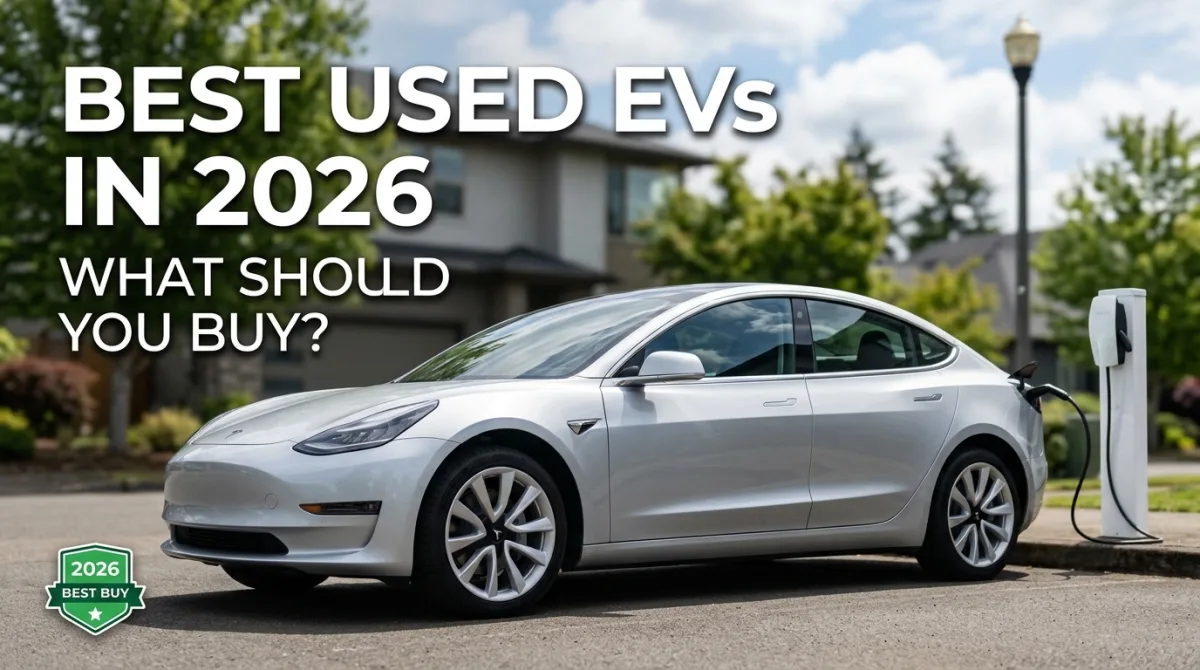
Used EV prices have been through the floor — and that's fantastic news for buyers. In 2026 you can pick up a three-year-old EV for less than half its original price, with years of battery life still under warranty.
But not every used EV is a bargain. Here's what to buy, what to skip, and how to avoid the traps.
Why used EVs are such a good deal right now
The last few years produced a glut of nearly-new EVs, and rapid tech improvements pushed used prices down hard:
- A 3-year-old EV typically sells for 40–55% of its new price
- Battery degradation is usually mild (8–12% over 3 years)
- Many still have years of battery warranty left (8-year/100k+ mile common)
- Falling new-car prices compress used prices further — your gain
The best used EVs to buy in 2026
| Model (2022–2023) | Typical used price | Original range | Why buy it |
|---|---|---|---|
| Tesla Model 3 | $22,000–$28,000 | 270–330 mi | Software, Supercharger, proven |
| Tesla Model Y | $28,000–$35,000 | 280–330 mi | Best used family EV |
| Hyundai Kona Electric | $15,000–$20,000 | 250 mi | Incredible value, reliable |
| Kia Niro EV | $16,000–$21,000 | 240 mi | Practical, efficient |
| VW ID.4 | $18,000–$24,000 | 240–260 mi | Room, comfort, cheap |
| Chevy Bolt EV | $12,000–$16,000 | 250 mi | The bargain king |
| Polestar 2 | $22,000–$28,000 | 260 mi | Premium feel, sharp steering |
| BMW i4 | $30,000–$38,000 | 270–300 mi | The driver's used EV |
| Ford Mustang Mach-E | $22,000–$28,000 | 230–270 mi | Crossover space, frequent OTA updates |
The used EV inspection checklist
- Check battery health — ask for the car's reported range at 100% and compare to original. A 3-year-old car should show 85–92% of original capacity.
- Check the fast-charging history — a car that was DC-fast-charged constantly may degrade faster. Request the charge history from the app if possible.
- Verify the battery warranty — most EVs carry an 8-year/100k-mile battery warranty; make sure you know the remaining term.
- Check for software updates — has the car been kept current? A well-updated used EV often has more range and features than when new.
- Look for tire wear — EVs chew tires; factor a set ($600–$1,000) into your budget if needed.
What to avoid when buying used
- Early Nissan Leafs (24–30 kWh) — old air-cooled batteries degrade hard, especially in warm climates
- High-mileage EVs with unknown fast-charge history — unless the price is irresistible
- Any EV without a battery health report — walk away if the seller won't share it
- Cars out of battery warranty with visible range loss — a battery replacement can cost $10k+
The used EV money math
Buying a used EV isn't just cheaper upfront — it fixes the depreciation problem entirely:
- New EV: loses ~50% in 3 years (the biggest EV ownership cost)
- Used EV: you buy after the drop, then it depreciates gently
Our EV depreciation tool shows the curve. And before you sign, run the EV vs gas calculator to confirm the running-cost savings are still worth it at your mileage.
FAQ
Is it safe to buy a used EV? Yes — but get the battery health report and confirm remaining warranty. Modern EVs are very reliable; the battery is the only big-ticket unknown.
What is the best cheap used EV? The Chevy Bolt EV is the value champion, often under $15,000 with 250 miles of range. The Kona Electric is the safest all-rounder.
How much battery loss is acceptable? Anything under 15% after 5 years is normal and fine. Above that, or with a poor charge history, negotiate hard or walk away.
The bottom line
2026 is a golden era for used EV buyers: proven cars, huge discounts, and generous remaining warranties. Buy a well-maintained 2–3-year-old EV with a clean battery report, skip the problem models, and you'll get near-new EV ownership at half the price.