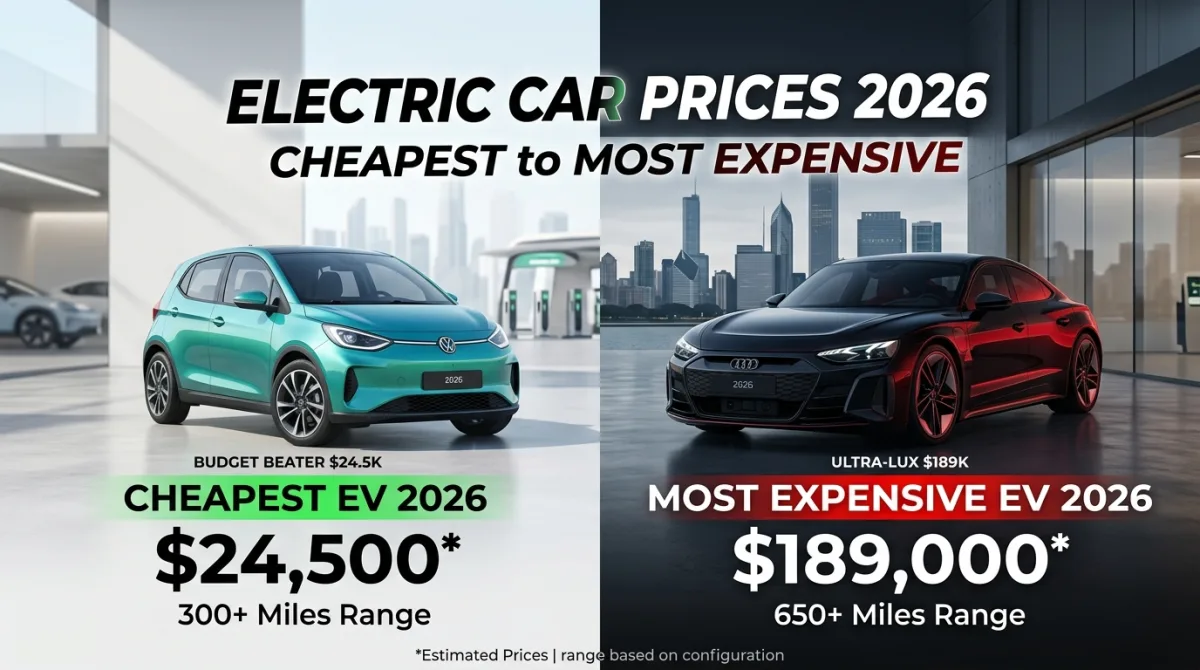
Electric car prices in 2026 span a wider range than ever — from under $20,000 for a city runabout to well over $150,000 for a luxury flagship. The good news: never before have EVs been available at this many price points.
Here is the complete 2026 EV price spectrum, from the cheapest to the most expensive, with what you actually get at each level.
The 2026 EV price ladder
Under $25,000 — the entry level
- Dacia Spring (~$19,000) — cheapest new EV; city-only range
- Leapmotor T03 (~$21,000) — ultra-budget urban runabout
- Nissan Leaf (~$23,000) — the proven veteran
- Citroën ë-C3 (~$23,000) — cheap, cheerful, practical
$25,000–$35,000 — the value zone
- MG4 (~$25,000) — the enthusiast's budget pick
- BYD Dolphin (~$24,000–$28,000) — best overall value
- Hyundai Kona Electric (~$28,000) — reliable and efficient
- Kia Niro EV (~$29,000) — the practical family choice
- Chevy Equinox EV (~$29,000) — the range-per-dollar king
- Volvo EX30 (~$29,500) — premium feel, small footprint
$35,000–$50,000 — the mainstream heartland
- Tesla Model 3 (~$38,000) — the benchmark
- Tesla Model Y (~$42,000) — the family crossover
- BYD Seal (~$40,000) — the value flagship
- Kia EV6 (~$43,000) — the all-rounder
- Hyundai Ioniq 6 (~$43,000) — the efficiency king
- VW ID.7 (~$45,000) — the long-distance cruiser
- Skoda Enyaq (~$45,000) — the honest family SUV
$50,000–$80,000 — the premium tier
- BMW i4 (~$55,000) — the driver's EV
- Polestar 2 (~$50,000) — refined Swedish minimalism
- Mercedes EQE (~$70,000) — luxury ride quality
- Audi Q6 e-tron (~$60,000) — tech-forward SUV
- Ford F-150 Lightning (~$55,000) — the electric pickup
$80,000+ — the luxury/performance tier
- Porsche Taycan (~$90,000+) — the driver's flagship
- Rivian R1S (~$85,000+) — adventure luxury SUV
- Lucid Air (~$90,000+) — range record holder
- Mercedes EQS (~$110,000+) — the S-Class of EVs
- Tesla Model S/X (~$80,000–$100,000) — the originals
> Prices are indicative base prices before incentives and vary by market. Use the comparator for exact specs.
What the price actually buys you
| Price band | Battery | Real range | Charging | Interior |
|---|---|---|---|---|
| Under $25k | 40–50 kWh | 150–200 mi | 50–100 kW | Basic but fine |
| $25–35k | 55–65 kWh | 230–280 mi | 100–150 kW | Good |
| $35–50k | 60–80 kWh | 280–350 mi | 150–250 kW | Very good |
| $50–80k | 75–100 kWh | 300–400 mi | 200–350 kW | Premium |
| $80k+ | 90–120 kWh | 350–500 mi | 250–400 kW | Luxury |
The sweet spot in 2026
For most buyers, the $30,000–$45,000 range is the sweet spot: modern LFP or NMC batteries, 250–350 miles of real range, decent fast charging, and — critically — many models qualify for incentives that knock thousands off the effective price.
Our EV incentives tool reveals the true out-the-door price after credits, which can move a car down a full price band. Check it before you negotiate.
Why EVs got cheaper in 2026
- Falling battery costs — pack prices dropped another 10–15% over the past year
- LFP adoption — cheaper, longer-lasting chemistry in mass-market cars
- Intense competition — dozens of new models fighting for buyers
- Scale — gigafactories ramped up, bringing manufacturing costs down
FAQ
What's the cheapest new EV in 2026? The Dacia Spring at around $19,000, though it's strictly a city car. For a real all-rounder, the Citroën ë-C3 or BYD Dolphin are the best entry points.
Do you need to spend $50k+ for a good EV? No. The $30,000–$40,000 bracket offers excellent range, charging and quality in 2026 — often with incentives making it even more affordable.
Are premium EVs worth the premium? You're paying for range, charging speed, interior luxury and brand. The core EV experience — quiet, instant torque, cheap running — is identical at any price.
The bottom line
In 2026, there is an EV for every budget, and prices are still trending down. Decide your price band, shortlist the models, then run the numbers with our tools to see the real cost of each. The best EV is the one that fits your budget — and 2026 is the best year ever for finding it.